
A hotel in Spain is rarely just a hotel. It is a palacio that outlived the family who built it, a convent that traded prayer for room service, a bank vault turned over to marble and light. Stay in the right room in the right city and the building itself becomes the first thing you remember about the trip, before the wine, before the ham, before the sunburn.
Here is where the architecture does the talking, city by city, on a private journey through Spain.
What is the most unique hotel in Madrid?
Madrid’s grandest hotels are not new money pretending at history. They are the history.
The Mandarin Oriental Ritz opened its doors in 1910 with King Alfonso XIII himself presiding over the ceremony. Grace Kelly and Prince Rainier of Monaco spent part of their honeymoon under its roof. Mata Hari and Salvador Dalí both passed through its bars and ballrooms in their own restless decades. A full remodel closed the hotel for three years before it reopened in 2021, and the result is a version of the Ritz that feels, if anything, more itself than before. Gold leaf catches differently now. The marble seems to hold more light.
The Four Seasons Madrid takes a different approach entirely, folding a hotel into a much larger urban project that includes private residences and a retail gallery built around a gastro-market. What survives from the original 19th-century structure is the ornate stone façade, elephant heads carved into the stonework and all, along with a double-height lobby lined in ivy-green marble columns, Alpujarra rugs underfoot, and a stained-glass roof pulling color down into the room below.
The Madrid EDITION takes the opposite gamble: a boxy modern former bank headquarters on Plaza de Celenque, reworked from the inside out. What remains from the original 18th-century site is a single ornate granite doorway attributed to architect Pedro de Rivera. Step past that doorway now and a vast spiral staircase in pale, pearl-toned stone spirals upward through the building’s new interior, old bones wrapped in a completely new skin.
And then there is the Santa Mauro, built between 1898 and 1902 as the private palacio of the Dukes of Santo Mauro, a family that still owns the building today. Forty-nine rooms, one address, and the particular hush of a private home that happens to take guests.
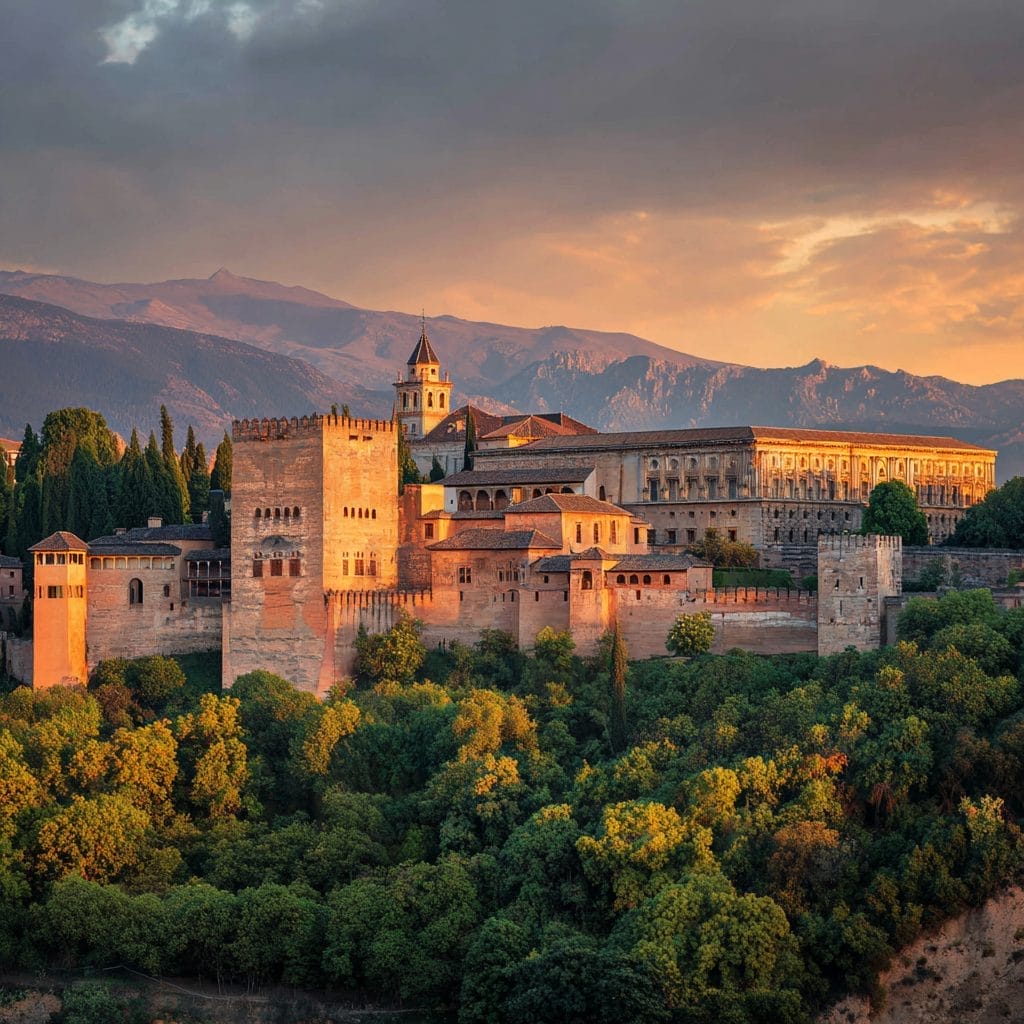
Where should I stay near the Alhambra in Granada?
Granada offers one true one-of-a-kind option, and it comes with a real trade-off worth understanding before you book.
The Parador de Granada sits inside the Alhambra’s own walls, in a former convent, a location no other hotel in the city can claim or ever will. The decor has been left largely alone, which means the experience runs closer to understated and quiet than luxurious. As a partially government-run property, service can move at its own pace. You are not buying polish here. You are buying proximity to one of the most fought-over hilltops in Europe, and waking up inside it.
For travelers who want the architectural romance of Granada without that particular compromise, the Palacio de los Patos is the better-run alternative: a five-star luxury hotel spread across two buildings, one a 19th-century palace, the other a new wing of glass and metal, offering a more consistent level of service alongside real character. The name comes from a fountain at the entrance decorated with two carved white swans, even though “pato” means duck, a small mismatch the hotel has never bothered to correct.
What hotel is inside a historic building in Cordoba?
Cordoba’s standard is a restored four-star property set inside a genuinely historic building, the kind of stay that puts you inside the old city’s stone and shadow rather than beside it.
For travelers who want to go further up in luxury without losing that historic grounding, the five-star Hospes Palacio del Bailío sits on a site with real Roman-era heritage beneath it, a step up in comfort layered directly over two thousand years of continuous use. The building itself dates to the 16th century, raised over the remains of a Roman villa whose mosaic floor and marble columns still sit beneath the hotel, visible through a glass floor in the restaurant and worked into the spa, where guests bathe in the same Roman baths the site has held since antiquity. The palace takes its name from a 16th-century bailiff of the Order of St. John who once owned the house, and the building was declared a Cultural Heritage Monument in 1982 before its restoration into a hotel.
Is there a good hotel on the clifftop in Ronda?
Ronda is honest about its limits. The clifftop old town is gorgeous, but small, and the hotel options reflect that.
A handful of historic properties exist, but service can be inconsistent. The government-run Parador occupies a striking clifftop position, but the building itself is a 18th-century structure that once served as Ronda’s city hall, and beyond the view, it does not have much else to distinguish it. Service here moves at the same unhurried government pace found at Granada’s Parador. And some of our past guests were not happy with the decor or the beds, so we generally shy away from it.
The hotel we favor on Ronda itineraries sits a genuine stone’s throw from that same clifftop in a great location for finding restaurants and tapas bars and it is simply better run. In a town this small like ancient Ronda, that combination, location plus consistent service, is the rarest thing on offer. Ask us if you’d like to know more.
What is the most iconic hotel in Seville?
Seville’s answer to the Ritz is the Hotel Alfonso XIII, a five-star grande dame designed in the 1920s by a local architect working in a neo-Moorish style specific to the city. Horseshoe arches, painted tilework, courtyards built for shade and slow afternoons: this is Seville’s architectural personality distilled into one address, and it has carried that role for a century.
King Alfonso XIII commissioned the hotel specifically to host fellow European royalty and dignitaries during the Ibero-American Exposition of 1929, Seville’s international showcase of the period, and the building opened in time for it, in 1928.
For travelers who want equal historic weight in a more intimate setting, the Palacio de Villapanes occupies a boutique five-star palace with its own devoted following, honeymooners included, drawn to a scale and quiet that a grand hotel cannot offer.
Frequently Asked Questions
What makes a hotel “architecturally interesting” in Spain?
The strongest examples preserve an original structure, a palacio, a convent, a Roman-era foundation, a historic façade, and build the guest experience around that original architecture rather than replacing it. The building’s history stays visible in the finished hotel.
Should I choose a Parador for historic character in Spain?
Parador hotels often occupy genuinely unique historic sites, including former convents and castles. Expect authentic surroundings and a meaningful location, alongside slower, government-paced service rather than five-star polish.
Is Madrid or Seville better for architecturally distinctive hotels?
Both cities offer strong options at different registers. Madrid leans toward grand 19th- and early 20th-century palacios and adaptive reuse of historic bank and civic buildings. Seville’s standout, the Alfonso XIII, works in a distinct neo-Moorish style built specifically for the city in the 1920s.
Planning your own architectural journey through Spain
Every one of these hotels earns its place in a private itinerary for a different reason: a king’s inauguration, a Roman foundation, a convent inside a fortress, a family palacio that never stopped being a family palacio. Matching the right property to the right traveler, and to the rest of a route through Madrid, Andalusia, and beyond, is the kind of detail that separates a well-planned trip from a memorable one.
If you are building a private journey through Spain and want guidance on where to sleep as well as where to eat and taste, reach out to us directly. We know these buildings, and in several cases, the families who still own them.
For assistance planning a stress-free, tailor-made, private luxury tour of Spain for 2027. Contact our experts in Spain today. Kindly note that we will cover northern Spain, including Barcelona, Bilbao, San Sebastian, and Santiago de Compostela, in a future post. If you have other requests, please let us know.
Luxury Tours
Itineraries for Spain
Itineraries for Portugal
Itineraries for Morocco
Multi-Country Tours