

Morocco Private Luxury Tours with Licensed Guides and Private Drivers
A private Morocco journey takes 7 days to cover one region, such as Marrakech with the High Atlas and Essaouira, and 12 to 14 days to cross the country from Fez to the Sahara and Marrakech. Spring, from March to early June, is the best season. A private driver handles the roads and a licensed guide the cities and sites.






Morocco Is Easy to Visit and Hard to Sequence Well
A good Morocco journey depends on decisions difficult to make from a screen: which regions to include, what to leave out, how far apart things really are, where to slow down, and which days on the road are worth having rather than enduring.
Magical Private Travel designs private Morocco journeys built around your interests, your pace, your hotels, and your guides, rather than a standard route with better rooms attached.
What follows is what we think a traveler should understand before planning a serious private trip to Morocco.
Why Morocco Is More Complex Than Most Travelers Expect
Marrakech arrives all at once: the souks, the Koutoubia, the palaces and the riads behind their plain walls, and the Atlas standing across the southern horizon. Fez, a day’s drive north, answers with something older and quieter, a medieval city whose tanneries, madrasas, and artisan quarters still occupy the ground they were built on.
Beyond those two, the country opens out further than most first-time visitors expect. The imperial cities include Meknes, walled and gated on the scale of a seventeenth-century ambition, and Rabat on the Atlantic. Volubilis holds Roman mosaics still lying on the floors of the houses they were laid for. The High Atlas divides the country in two, and the road across it descends into kasbah country, palm groves, and the dune fields beyond. On the coast, Essaouira is a fortified port laid out as a grid, and El Jadida keeps a Portuguese cistern rediscovered in 1916. In the north, Chefchaouen sits blue against the Rif, and Tangier looks across the strait at Spain.
Morocco does not reveal itself all at once, and the distances are longer than the map suggests. A journey that tries to take everything ends up spending its time in the car.
The difference between a Morocco trip that passes through you and one you talk about for years is decided in the planning: which regions, in what order, at what pace, with which guides, and with how much of the day given to the road. Most of that is invisible online.
Magical Private Travel has been planning private journeys in Morocco since 2002, from the Iberian peninsula and with people on the ground in Morocco itself. We know which experiences deliver what they promise, and which guides, hosts, and craftsmen will make your party feel like guests rather than customers.

For First-Time Visitors: Where to Start
If you are planning Morocco for the first time, here is the practical sequence.
Decide how many nights you have. Twelve to fourteen covers the country properly. Ten works if you focus on either the north or the south. Seven is possible and means choosing one axis and staying with it. Then decide what matters most: the imperial cities and their craft traditions, the desert and the routes that reach it, the mountains, or the coast. Those two decisions, nights available and primary interest, shape everything else.
Most first journeys take one of three shapes. A Marrakech-centered trip with the High Atlas and Essaouira works in seven to ten days and gives you the city, the mountains, and the Atlantic without a long transit. A north-to-south arc from Casablanca through Fez and Meknes, over the Middle Atlas to the desert and back through the southern valleys to Marrakech, needs twelve to fourteen days and covers the country in one logical line. A northern route through Tangier, Chefchaouen, Fez, and the Roman sites suits travelers combining Morocco with southern Spain who want the Andalusian thread followed rather than the desert reached.
The at-a-glance table below maps the regions. The planning essentials section covers timing, length, and pacing. The FAQ addresses what travelers ask us most. If you would rather start from the journeys we already build, see our private Morocco itineraries. A conversation with our team is still the fastest way to answer the question that applies to you.
Why Morocco Rewards a Private Journey
Morocco resists the standard itinerary, for reasons that compound each other.
The first is that the country holds several very different worlds and each one asks for a different kind of day. The medina of Fez and the dunes of Erg Chebbi belong to the same country and not to the same experience, and neither does the cedar forest of the Middle Atlas, the Portuguese fortifications of the Atlantic coast, or the Andalusian north. Each needs a different pace, a different guide, and a different framing to be understood rather than merely seen.
The second is that a great deal of Morocco does not explain itself. A medina is a plan, not a maze, but only if someone shows you the plan. A granary is not a stable, a kasbah is not a castle, and the difference between what the Almohads built and what the Alaouites built is visible on almost every street once you know what to look for. Without that, you photograph a wall. With it, you read a city.
Then there is the road. Morocco’s regions are far apart, and a journey of any ambition includes real driving days. With a private driver those hours become part of the trip: the Tizi n Tichka crossing, the Ziz gorges, the palm groves of the Draa. Without one, they are the price you pay between hotels.
A private journey planned properly is not an expensive version of a group tour. It is a different thing, an itinerary built around who you are, what you want, and how you want the days to feel.
The Planning Decisions That Matter Most in Morocco
Morocco does not lack options. It has more good ones than a single trip holds, spread across a country bigger than it looks. The work of planning is deciding what to leave out, where two nights are enough, and where one more day changes everything. These are the decisions that make the largest difference.
How many regions to include. Three in ten days makes a journey. Five in ten days makes a driving tour.
Which approach to the Sahara. The two are hundreds of kilometers apart and belong to different routes, so the choice follows the rest of the itinerary rather than the other way around.
How many nights to give the desert. Reached with a night in the dunes and the route treated as part of the journey, it is what our travelers describe first afterward. Compressed into an overnight from Marrakech, it becomes a long drive with a short reward.
How to treat the day between Fez and the desert. It crosses the Middle Atlas and it is a day in its own right, which is either the best drive of the trip or the longest, depending on how it is planned.
Whether you want Marrakech, Fez, or both. They answer to different centuries and different appetites, and the choice shapes the whole route.
Where to stay in each place. In Morocco the setting decides the day: a riad inside the medina and a property outside the walls produce entirely different mornings.
When to travel for the regions you have chosen. The coast, the mountains, the imperial cities, and the desert each run on their own calendar, and the shoulder seasons do not align across all four.
What to arrange in advance. The craft quarters, the workshops, and the tables worth having are the parts of Morocco that reward being planned rather than found by chance.
Dan’s Morocco Insider Cultural Notes
Moroccan Arabic, Darija, differs markedly from Modern Standard Arabic and carries Amazigh and French influence, with Spanish influence particularly visible in the north. Amazigh languages are spoken across much of the country, and French is in daily use nationally.
Bargaining is customary in many souks and is a social exchange as much as a transaction. Your guide explains where bargaining is customary, where prices are fixed, and how the process usually works.
Morocco is not one culture but several. Amazigh, Arab, Andalusian, Jewish, Saharan, and European histories all left something behind, and the interesting parts of the country are where they meet.
Distances are longer than the map suggests, and the road between two places is often the best part of the day. A private driver turns those hours into something rather than nothing.
The four imperial cities, Fez, Marrakech, Meknes, and Rabat, each held the capital at a different moment. Understanding which one and when is the shortest way into Moroccan history.
Morocco at a Glance
Sixteen destinations and regions that help organize a private journey through Morocco. Use this as your starting map, then decide which belong in your trip, in what order, and at what pace. How many to include, with how many days in each, is one of the first and most consequential planning decisions, and the answer is different for every traveler.
| Region | Known for | Works well for | Typical days |
| Marrakech | UNESCO medina, Jemaa el-Fna, Saadian palaces, working souks | First journeys, southern routes, city and mountains together | 2–3 |
| Fez | The great medieval medina, the Karaouiyine, the madrasas, the tanneries | Crafts, architecture, Islamic scholarship | 2 |
| Meknes | Moulay Ismail’s walled imperial city, Bab Mansour, Heri es-Souani | A quieter imperial city, travelers who want depth without crowds | ½–1 |
| Volubilis & Moulay Idriss | Roman mosaics in place, the hill town of the first dynasty | Roman and early Islamic history, a destination driving day | 1 |
| Rabat | The capital, the Kasbah of the Udayas, Chellah, the national collections | Museums, the Roman finds, a day between Casablanca and the north | 1 |
| Casablanca | The Hassan II Mosque, Art Deco and Mauresque downtown, the corniche | Arrival and departure days, twentieth-century architecture | ½–1 |
| El Jadida & the Doukkala | Portuguese Mazagan, the cistern, Azemmour, the Oualidia lagoon | The Portugal connection, breaking the coastal drive, oysters | 1 |
| Essaouira | Ramparts and sqalas, the working harbor, the grid medina, Gnaoua music | Slowing down, summer travel, families, the Atlantic | 1–3 |
| Tangier | The strait, the kasbah above the port, the American Legation, Cape Spartel | Arriving from or leaving for southern Spain, literary history | 1–2 |
| Asilah | Portuguese ramparts, the restored medina and its murals, the Raisuni palace | A half day on the Atlantic road south, art and architecture | ½ |
| Tetouan | The Andalusian medina, the Spanish Protectorate layer | The al-Andalus thread followed on the ground | 1 |
| Chefchaouen | The blue town of the Rif, the Andalusian building traditions, Ras el-Ma | Photography, early mornings, a slower northern day | 1–2 |
| The High Atlas | Tizi n Tichka, Telouet, Ourika, Imlil and Toubkal, Tin Mal, Ait Bouguemez | Mountain scenery, Amazigh villages, walking, the crossing south | 1–2 |
| The Middle Atlas | Cedar forest and macaques at Azrou, the plateau lakes, the Ziz gorges | Turning the Fez to Sahara driving day into a day worth having | 1 |
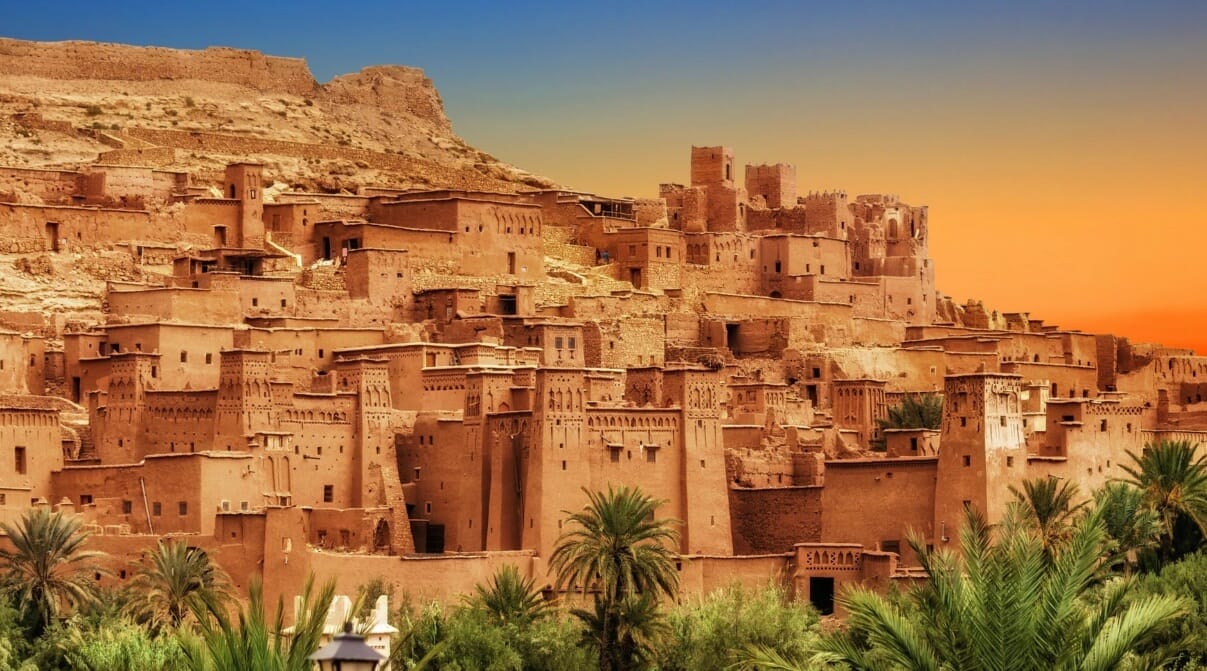
| Ouarzazate & the Southern Oases | Ait Ben Haddou, Kasbah Taourirt, Skoura, the Dades and Todra, the Draa | Kasbahs, oases, film country, the ground between mountains and desert | 1–2 |
| The Agafay Desert | Stony hamada south of Marrakech, tented camps, the Atlas on the horizon | A night under open sky when the Sahara does not fit the days | 1 night |
| The Sahara | Erg Chebbi at Merzouga, Erg Chegaga at M’Hamid, the Ziz and the Draa routes | Dunes, desert nights, the part travelers talk about most afterward | 2–3 |
The Regions
Marrakech
The Almoravid city at the foot of the High Atlas, founded around 1070, and the base southern journeys run from. It is the right choice for a first trip that wants one city, the mountains behind it, and the desert reachable. Two to three nights is the usual allowance, more if you intend to use the city rather than see it.
Private Marrakech ToursFez
The oldest of the imperial cities, and a denser, more inward kind of day than Marrakech. A licensed guide changes what the medina gives you here, and two full days work better than one. Meknes and Volubilis lie a short drive west, and the three are usually taken as one sequence, which is the argument for basing yourself in Fez rather than passing through.
Private Fez ToursMeknes
The imperial city Moulay Ismail built from 1672, walled and gated on the scale of a fifty-five-year reign. It is usually taken as a day from Fez or as the stop on the way to Volubilis, and that works. Travelers who give it a night find a working Moroccan city with an imperial city attached, which is a different proposition from either of the two larger imperial capitals and a quieter one.
Private Meknes ToursVolubilis and Moulay Idriss
A major Roman city in the province of Mauretania Tingitana, and a Mauretanian capital before that, with the hill town that grew around the tomb of Idriss I a few kilometers away. The pair turn the drive between the coast and Fez into a destination day. It is also where the Idrisid chapter of Moroccan history begins, which is an argument for taking it early in a journey rather than as a footnote at the end.
Private Volubilis ToursRabat
The capital, on the Atlantic at the mouth of the Bou Regreg. Rabat is the imperial city itineraries most often skip, and it works as a day between Casablanca and the north rather than as a stay. It holds the finds from Volubilis, so travelers who plan to see the Roman sites get more out of both by taking them together.
Private Rabat ToursCasablanca
Morocco’s Atlantic city, and where most journeys begin or end because of the airport. The decision is what to do with the half day that gives you. Casablanca repays it, and here the twentieth century rather than the twelfth is the reason to look up.
Private Casablanca ToursEl Jadida and the Doukkala Coast
The Portuguese City of Mazagan, held from 1502 to 1769, with Azemmour on the river and the oyster lagoon at Oualidia along the same coast. This is a day rather than a stay, and the decision is whether to use it to break the drive between Casablanca and the south or to skip it. For anyone who knows Portugal, it is where the two countries meet on the ground, which is reason enough on its own.
Private El Jadida ToursEssaouira
The fortified Atlantic port laid out from the 1760s, and where a Morocco itinerary slows down. It is also the answer to the summer problem, since the Atlantic climate here is distinct from the interior, so a July or August journey that includes the coast works when one that stays inland does not. Two or three nights is the version that works. A single day from Marrakech gives you the walls and the port and not much else.
Private Essaouira ToursTangier
The city on the Strait of Gibraltar, and the beginning of a northern route or the end of an Andalusian one. That makes it the obvious first or last stop for anyone combining Morocco with southern Spain. It also carries a twentieth-century literary history that gives the city a second layer entirely.
Private Tangier ToursAsilah
The walled Atlantic town under an hour south of Tangier by road, ringed by ramparts the Portuguese built after taking it in 1471. Its medina went through a restoration the Aga Khan Award for Architecture recognized in 1989, and the murals on its walls were commissioned as part of the same program, alongside the restoration of the Portuguese fortifications. Asilah sits on the coastal road from Tangier toward Rabat and works as a half day on the drive south rather than an overnight.
Asilah Travel GuideTetouan
The Andalusian city of the north, rebuilt by families arriving from al-Andalus and later the capital of the Spanish Protectorate. It sits between Tangier and Chefchaouen and suits a journey built around the connection with al-Andalus, because it is where that connection stops being an idea and becomes a street plan. It works as a day rather than a stay.
Private Tetouan ToursChefchaouen
The blue town of the western Rif, founded in 1471 and settled within a generation by families arriving from al-Andalus. It is a day from Tangier or Fez, and a night for anyone who wants the town in the early morning and the last of the light from the hillside, which are the two hours a day visit cannot reach. It is where the northern route slows down.
Private Chefchaouen ToursThe High Atlas
Morocco’s mountain divide, crossed at the Tizi n Tichka. It works three ways and they are not interchangeable. As a day from Marrakech it gives you a valley and a village. As a night in the mountains it changes the pace of the whole trip. As the crossing on the way south it turns a transfer day into one you remember. Which one you want depends on whether the mountains are a destination or a route on your itinerary.
Private High Atlas ToursThe Middle Atlas
The mountain country on the route from Fez toward the Sahara, and the region that decides whether the long driving day of a northern itinerary is time spent or time lost. It is cedar, water, and altitude between two places that have neither, and travelers who cross it with a stop or two built in arrive at the desert having seen a third Morocco on the way.
Private Middle Atlas ToursOuarzazate and the Southern Oases
The connecting ground between the High Atlas and the desert, where the mountain roads open toward the Dades and the Draa. The decision here is whether to sleep in it or drive through it. One or two nights is what separates a journey that reaches the Sahara from one that understands how the country changes on the way, and travelers who give it a night rarely regret the one they spent.
Private Ouarzazate ToursThe Agafay Desert
The stony desert south of Marrakech, hamada rather than dunes, with the High Atlas along the horizon. It is not the Sahara and should not be sold as it, and it carries luxury tented camps within reach of the city. Agafay answers a specific question: what to do when you want a night under open sky and the itinerary does not have the three days the Sahara requires. It also works as a final night before flying home from Marrakech.
Private Agafay ToursThe Sahara
Erg Chebbi at Merzouga is the dune field most Morocco journeys reach, approached along the Ziz valley from Fez or the Dades and Draa route from Ouarzazate. Erg Chegaga at M’Hamid lies further south, reached via Zagora, and rewards travelers willing to give it the extra day the distance costs. Both are real dunes rather than the stony hamada of Agafay, and a proper visit means a night in a desert camp, a camel or 4×4 arrival timed for sunset, and a night sky the coast and the cities cannot offer. Two to three nights, counting the approach, is what separates a journey that reaches the Sahara from one that only glimpses it.
Private Sahara ToursPlanning Essentials
When is the best time to visit Morocco?
Spring, from March into early June, is the period we recommend most often. The imperial cities are comfortable, the High Atlas is clear with snow still on the peaks, the southern valleys are warm rather than hot, and the roses bloom at Kelaat M’Gouna in April and May.
Morocco has four climates on one itinerary, and the seasons do not align across them.
Spring, from March into early June, is the period we recommend most often. The imperial cities are comfortable, the High Atlas is clear with snow still on the peaks, the southern valleys are warm rather than hot, and the roses bloom at Kelaat M’Gouna in April and May.
Autumn, from late September into November, is the other window we recommend, and it is when we prefer to place the desert, with the cities settled and the light long. The date harvest runs in the southern oases in October.
Summer is hot in Marrakech, Fez, and the south, and the desert is at its most demanding. It is the season the coast comes into its own. Essaouira holds the trade winds and stays cool when the interior does not, and the Atlantic towns fill with Moroccan families. A July or August journey centered on the coast and the mountains works well. One centered on the desert does not.
Winter is mild on the coast and in the imperial cities, cold at night in the desert and in the mountains, and snowy on the High Atlas passes. It is the quietest season in the medinas, and travelers who come to photograph the country often choose it. The desert nights are genuinely cold, which the camps prepare for.
Ramadan moves each year and changes the rhythm rather than the possibility. Afternoons are quiet, evenings come alive after sunset, and the atmosphere in the medinas at night is one of the most memorable things in the country. Restaurants and sites operate on different hours, and our team builds the itinerary around them.
How many days should we spend in Morocco?
Seven days covers one axis properly: either the imperial cities of the north with the Roman sites, or Marrakech with the High Atlas and the coast. Covering both, or reaching the Sahara, turns a seven-day trip into a drive.
In our planning, ten days is where the desert becomes possible without compromising everything else. Marrakech, the High Atlas crossing, the southern valleys, the dunes, and back is a complete journey in ten.
Twelve to fourteen days is the version that covers the country: Casablanca or Rabat on arrival, Fez and the imperial cities, the Middle Atlas crossing, the desert, the southern oases, the High Atlas, Marrakech, and the coast if you want it. This is the shape most travelers who come once and want to see Morocco properly should be planning toward.
Beyond fourteen, the country keeps giving. The north, the Atlantic coast, the Ait Bouguemez valley, and the second desert approach all open up, and the pace drops to something closer to living there than visiting.
Best Morocco itinerary routes for private luxury tours
Morocco has two natural axes and they meet in the middle.
The northern axis runs Casablanca or Tangier, then Rabat, Fez, Meknes, and Volubilis, then the Middle Atlas, then the Ziz valley and Merzouga.
The southern axis runs Marrakech, then the Tizi n Tichka and the High Atlas, then Ouarzazate and the southern oases, then the Draa or the Dades toward the desert.
We build full journeys that use both axes in one direction rather than doubling back. Flying into Casablanca and out of Marrakech, or the reverse, removes the repeated day, and in our experience it is the decision that does most for a Morocco itinerary.
Private driver vs. train vs. self-drive in Morocco
Morocco has a good train service on the northern corridor, between Tangier, Rabat, Casablanca, and Fez, and it is genuinely comfortable. It does not serve the mountains, the southern valleys, or the desert, which is where most of the country’s scenery is.
Self-driving is possible and some travelers enjoy it. What it costs you is the mountain passes and the medina arrivals, where local knowledge matters, and the hours when someone else driving means you are looking out of the window rather than at the road.
A private driver is not only transport. On a Morocco itinerary the driver is the person who knows which side of the pass has the light, where to stop for the view that is not signposted, and how to reach the door of a riad in a city where cars do not enter. For a journey that includes the mountains or the south, it is the difference between a trip and a logistics exercise.
Guides in Morocco, and why we use two roles rather than one
Guides in Morocco are licensed and examined, and the licensing is taken seriously. It is worth knowing the difference between a licensed guide and someone offering to show you around.
We choose to work with two separate roles on every journey: a licensed guide for the cities and the sites, and a private driver for the roads between them. Interpreting a medina on foot and reading a mountain road are different jobs, and giving each one to a specialist is what lets both be done properly.
We select top guides based on their experience, knowledge and engaging personalities, not egos. In practice the guide notices when the third madrasa is one too many, and knows the workshop two streets away that changes the afternoon.
Where to stay in Morocco, and why the setting decides the day
Morocco rewards travelers who choose the setting first: a riad inside the medina, a garden property outside the walls, a kasbah on the oasis road, or a camp in the dunes.
Morocco’s accommodation divides by setting more than by category, and the setting changes the trip.
A riad inside a medina puts the city outside the door at first light and last light, which are the hours the medinas are at their best. It also means a walk from the nearest vehicle access point, since cars reach the gates and not the lanes.
A property outside the walls gives you gardens, pools, and direct vehicle access, with the medina a short private transfer away. In Marrakech that often means the Palmeraie or the road toward the Atlas.
In the south, the kasbah properties on the oasis routes and the camps in the dune fields are the point of the journey rather than a place to sleep on the way through it.
The difference between these settings is character and position rather than level. Our team sets out the room types and the trade-off each setting involves, so the choice belongs to you and the daily transportation is arranged around it. This is one of the first conversations we have with each traveler, and it is covered in how a private itinerary comes together.
Morocco food by region
Moroccan food changes with the geography more than most visitors expect.
On the Atlantic coast it is fish and shellfish, landed and cooked plainly, with the oyster beds at Oualidia and the grills on the quay at Essaouira.
In the imperial cities it is the tagines, the pastilla, the preserved lemon and the slow-cooked lamb, and the pastry and mint tea that fill the afternoon.
In the mountains it is simpler and heavier, built around bread, oil, and what the season provides.
In the south it is dates, desert bread cooked in sand, and the food of the oases.
Our team considers dietary preferences when recommending restaurants and arranging reservations as part of the confirmed itinerary.
Morocco pacing guide
The most common regret we hear about Morocco is not about what a traveler missed. It is about the days spent moving rather than arriving.
Three regions in ten days is a good journey. Five is a tour of the country’s roads. If your time is limited, the better answer is almost always to cut a region and give the remaining ones the extra night, because Morocco rewards the second day in a place far more than it rewards the first day in another one.
What does a private Morocco journey cost?
Cost in Morocco is driven by four things more than by the country itself: how many nights you travel, how much of the route is on the road with a private driver, which settings you choose to sleep in, and how many separate regions the itinerary crosses. A journey that stays in two regions and uses one base costs differently from one that crosses the country and changes hotel most nights, even at the same standard of property.
The itineraries below carry a from-price each, which is the clearest starting reference. Our team gives you a full costed proposal before anything is committed, with each service named, and nothing is confirmed until you have seen it in writing.
Common Questions About Planning a Private Morocco Journey
Do I need a visa for Morocco?
Most travelers we work with enter Morocco without a visa for tourist stays, which are generally limited to ninety days, and need only a passport valid for the duration of the stay. Requirements depend on nationality and are set by the Moroccan authorities, so our team confirms the current position for each traveler as part of the planning.
What currency is used, and can I pay by card?
The Moroccan dirham. Travelers normally obtain dirhams in Morocco rather than beforehand, and our team explains how that works before you travel. Cards are accepted in hotels, in the better restaurants, and in the larger shops. Cash is what the souks, the small cafés, the workshops, and tipping run on.
How does tipping work?
Tipping is customary and it is part of how the country works rather than an afterthought. Guides, drivers, hotel staff, and restaurant service all expect it. Because the amounts and the conventions differ from what most visitors are used to, our team sets out clear guidance with your itinerary rather than leaving you to guess.
What language will I need?
None. Arabic and Amazigh are the official languages, French is in daily use in business and administration, and Spanish is widely spoken in the north. Your guide works in English throughout, and in the cities and the hotels English is common. Moroccan Arabic, Darija, differs markedly from Modern Standard Arabic, which is worth knowing if you have studied Arabic elsewhere.
Is Morocco a good destination for a first trip to North Africa?
Yes. The tourism infrastructure is long-established, the distances are manageable with a driver, the range of terrain and architecture is unusually wide for one country, and the hospitality tradition is real rather than performed. It is also close to Europe, which makes it easy to combine with Spain or Portugal.
Is Morocco suitable for traveling with children?
It works well with a private itinerary. The medinas hold a child’s attention, the camel and horse riding on the coast and in the desert are genuinely enjoyable rather than staged, the desert camps are a memory that lasts, and the pace is built around shorter days. Essaouira in particular is easy with children: the medina is level, the beach runs beside the town, and the wind keeps the summer heat down.
What if someone in our group has mobility considerations?
Walking distances, routing, and pacing are adapted from the first planning conversation. In Morocco that means choosing which parts of a medina to prioritize, how much of each day is on foot, where the vehicle meets you, and which properties involve a walk in from the nearest access point. Our team advises on suitability before booking.
How does Ramadan affect a journey?
It changes the rhythm rather than the possibility. Afternoons are quiet, and the medinas come alive after sunset in a way they do not at any other time of year. Restaurant and site hours shift, and our team builds the itinerary around them. Travelers who visit during Ramadan often say the evenings were the part of the trip they remember.
Should I visit Marrakech or Fez, and what is the difference?
They belong to different centuries and different appetites. Marrakech is Almoravid in origin, southern in character, and open in feel, with the Atlas visible and the desert beyond it, and it is the more immediate city and the better base for the mountains and the south. Fez is the older imperial capital, denser, more inward, and more scholarly, and it gives more to travelers interested in crafts, architecture, and Islamic scholarship. Most travelers who see both find they prefer one strongly, and which one is not predictable in advance. If you have the days for both, the usual sequence is Fez first, because arriving in Marrakech afterward is easier than the reverse.
Is the Sahara worth the time it takes?
Yes, if you give it the time it takes. Reached properly, with a night in the dunes and the route treated as part of the journey rather than as transit, it is the part of a Morocco trip our travelers describe first afterward. Done as a rushed overnight from Marrakech, it is a great deal of driving for a short experience. Which approach suits your route, Merzouga or M’Hamid, follows from where the itinerary comes from and where it goes next, and our team sets that out before you decide. If the days are not there, the Agafay desert near Marrakech gives you a night under open sky without the distance.
Can you arrange private or early access to sites in Morocco?
Where a site allows it, yes, and our team arranges it as part of the itinerary rather than on the day. What is possible varies by site and by season, so we confirm each arrangement in writing before you travel rather than promising it in advance.
How far in advance should we book?
For travel in the spring and autumn windows, six to nine months is comfortable, and longer for the properties with few rooms. The camps in the dune fields, the riads with a handful of suites, and the guides worth having all book early. Shorter notice is workable outside those windows, and our team will tell you honestly what is still available rather than what we would like to sell you.
What is your relationship with the guides, hotels, and local partners on our trip?
Direct and long-standing. We work with the same licensed guides, private drivers, hosts, and craftsmen year after year, several of those relationships going back many years, and everyone we work with is treated and paid as a partner rather than as a supplier. We do not book from a pool, which is why we know which guide in Fez suits which traveler and which rooms in a property are worth having.
Do you arrange the hotels, or do we book our own?
We arrange them. Choosing the property is part of designing the itinerary rather than a separate task, because in Morocco the setting decides the day. We hold relationships with the properties we use, and we know which rooms in them are worth having, which is not something a booking site tells you.
What happens if something goes wrong during the trip?
Our team remains reachable throughout the journey and on the ground in Morocco. Weather closes mountain passes, sites change their hours, and plans occasionally need moving. Handling that is part of what a private journey is for, and it is set out in our booking terms.
The Magical Difference: Your Time Well Spent
Our Founder
Magical Private Travel began in 2002, out of a private trip our founder Dan planned for family after the group bus version of Iberia had made the case against itself. The company has worked in Spain, Portugal, and Morocco ever since, and it is still run by the person who started it.
Our Credentials
Magical Private Travel is an American-owned luxury tour operator specializing in bespoke private journeys across Spain, Portugal, and Morocco since 2002, a U.S. LLC operating from Madrid, with more than 15,000 travelers behind it. We work in three countries and nowhere else. That is the whole business, and it is the reason we know which guide in Fez suits which traveler, which kasbah on the Draa is worth the detour, and which day on the road is the one you will remember. Depth in three countries is a different proposition from coverage across many.
Our Dual Fluency
Our American founder brings one perspective. Decades of living and working in Iberia, in Spanish and in English, bring the other. That combination is the point: we read what a trip needs to deliver from the outside, and we know the ground from the inside.
Our Guides
Knowledge is the minimum. What separates a good day from a memorable one is a guide who notices when your group has had enough of the twelfth century, who knows when to stop talking, and who has somewhere in mind three streets away when the plan needs to change. That is what we select for, and it is why we do not use a booking pool. We work with local guides, drivers, hosts, and craftsmen who know their cities and their country from the inside, and everyone we work with is treated and paid as a partner rather than as a supplier. That is a business decision as much as an ethical one: people who are treated well do better work, and you feel the difference on the ground.
Private Groups
Every journey we build is for one party alone. Your licensed guide and your private driver work with your party and no other, and nobody else joins the itinerary. Within the confirmed itinerary the pace is adjusted around you, and pacing is what most often decides whether a Morocco trip works.
Time Well Spent
Routes, pacing, walking, site selection, guides, drivers, and access arrangements are agreed before departure and set out in the confirmed itinerary. You know what each day holds before you leave. Magical Private Travel maintains excellent ratings on Trustpilot and Google’s independent review platforms, with client video testimonials on YouTube.
Destination expertise by Magical Private Travel, established in 2002. About Magical Private Travel
Get the Insider Morocco Trip Planning Guide
Before you start building an itinerary, read this.
Before you start building an itinerary, read this. Since 2002 and more than 15,000 travelers, we have learned what makes a private Morocco journey work and what quietly compromises one. We put the most important of it into a short planning guide: the regional decisions, the timing, the pacing traps, and the questions to ask any agency before you book. No sales pitch, no generic advice, only what we would tell a friend who asked.
"*" indicates required fields
Private Luxury Morocco Tour Itineraries
Each of these is a starting point rather than a fixed product. Tell us which one is closest and our team rebuilds it around your dates, your pace, and what you want to see.

Morocco
7-Day Private Northern Morocco Tour: Rabat, Tangier, Chefchaouen and Fez
Casablanca, Rabat, Asilah, Tangier, Chefchaouen and Fez, a loop of the north. 7 days from $6,188 pp.

Morocco
8-Day Private Morocco Tour: Marrakech, Agafay, the High Atlas and Oualidia
Marrakech, a night in the Agafay desert, the High Atlas, the Ourika Valley and Oualidia. 8 days from $7,072 pp.
Morocco
10-Day Private Morocco Tour: Fez, Two Nights in the Sahara and Marrakech
Casablanca, Fez, two nights in the Sahara, the kasbah road and Marrakech. 10 days from $8,840 pp.

Morocco
15-Day Private Morocco Tour: Tangier and Fes to the Sahara and Marrakech
Tangier, Chefchaouen, Fes, the Sahara, Ouarzazate and Marrakech. 15 days from $23,500 pp.

Morocco
12-Day Private Morocco Tour: The Atlas, the Sahara, the coast and Marrakech
Casablanca, Taroudant, the Anti-Atlas, the Draa Valley, the Sahara and Marrakech. 12 days from $19,112 pp.

Morocco
14-Day Private Morocco Tour: Rabat, Fez, the Sahara and Six Nights in Marrakech
Rabat, Fez, Volubilis, the Sahara, Ouarzazate and six nights in Marrakech. 14 days from $19,984 pp.
What Our Travelers Say

My husband and I recently traveled with another couple on a wonderful 12-day private journey through Morocco with Dan & Rachel of Magical Private Travel. Our trip was very smooth, organized from start to finish, excellent guides, comfortable transfers, luxury hotels in good locations, well chosen experiences, and all the details handled. We loved the many different sides of Morocco, including Casablanca, the coast, Berber villages, desert landscapes, Ouarzazate, the Atlas Mountains, Marrakech, and Essaouira. Every place felt different and memorable. We also really appreciated the suggestion and planning of a winery visit. We did not even know that was an option in Morocco, and it turned out to be a wonderful treat and one of the special surprises of the trip.
Iuliia Kolpina, Trustpilot
Hit pretty much the whole country, getting a great feel for the people, the customs, the architecture and geography. Chose luxury accommodations over riads, and couldn’t have been more comfortable. Got various added exposures beyond just normal tourist stops. Transport was always convenient and timely. Have a photo treasure of memories.
J Jones, Trustpilot
Ready to Start Planning Your Morocco Journey?
If you are considering a private Morocco journey, the next step is a thirty-minute conversation about turning what you now know into the right trip for the specific people traveling with you. Tell us when you travel, how long you have, and what matters most to you, and our team designs the route around it, with a licensed guide and a private driver arranged before you travel.
Start a ConversationThirty minutes, and you will know whether Magical Private Travel is the right fit.
Pair Morocco With Spain or Portugal?
Many of our clients combine Morocco with Spain, Portugal, or both, and Magical Private Travel has been planning Iberian and Iberia-plus-Morocco itineraries continuously since 2002.
The arc we most often recommend runs south through Andalusia to Tarifa or Algeciras, crosses the strait to Tangier, and continues through Tetouan and Chefchaouen to Fez and the Roman sites. That sequence follows the al-Andalus thread on the ground rather than as an idea, and it moves in one direction without backtracking. See our private journeys through Spain.
Morocco also combines naturally with Portugal. Seven to ten days in Portugal followed by a direct flight to Casablanca or Marrakech is a route we have planned many times, and the Portuguese fortifications of the Moroccan Atlantic coast, at El Jadida above all, make the historical connection between the two countries visible in one afternoon. See our private journeys through Portugal.
