






Private journeys through Portugal’s largest region, where a Roman bathhouse hides inside a city hall lobby, a stone circle older than Stonehenge sits inside a working cork plantation, and the walled city of Évora carries two thousand years of history without making a show of any of it.
The Alentejo does not rush toward you, and it does not perform for you either. The plains open flat and wide beneath a sky that feels larger than the rest of Portugal, whitewashed towns appear on the horizon long before you reach them, and most of what makes the region distinctive sits a few steps off whatever street you happen to be walking down.
Évora alone holds enough for two full days, and the towns beyond it, Vila Viçosa in its marble, Elvas along its border, Monsaraz above its lake, each set a different pace. Sorting out which belongs in a first visit and which can wait is not a small decision, and it is one a private itinerary makes for you, built by people who have made it for other travelers many times before.
Magical Private Travel has been arranging private journeys through the Alentejo since 2002. Most visitors see only Évora. Fewer see what surrounds it.
Alentejo at a Glance
Anchor city Évora, a UNESCO World Heritage Site since 1986
Best visited March to June or September to December
From Lisbon: About 90 minutes by private car
Known for cork, wine, megalithic sites, and the Alqueva Dark Sky Reserve
Magical Private Travel has arranged Alentejo journeys since 2002.
Why Travelers Choose Magical Private Travel for the Alentejo
Most travelers see the Alentejo as a single day out of Lisbon, built around Évora and little else. That day works well as an introduction. It also means missing most of what makes the region worth a return visit.
Working across the Alentejo since 2002 has produced a specific kind of access: wine estates that open a cellar for a private tasting rather than the standard visitor circuit, back roads that lead directly to the region’s megalithic sites, an introduction to Évora that moves past the three most-photographed sights into the streets where the city lives.
For American travelers, the Alentejo is often the destination that resets their sense of Portugal. The wine, the cork forests, the scale of the plains, and the quiet outside Évora’s walls look nothing like the Portugal most visitors photographed all week in Lisbon and Porto. The trip earns its place in an itinerary when it is built around that contrast.

Évora and Monsaraz: The Alentejo’s Living Capital
Évora’s historic center was declared a UNESCO World Heritage Site in 1986, recognized as one of the finest surviving examples of a Portuguese Golden Age city. Walking the city today means moving through nearly two thousand years of continuous history compressed into streets narrow enough to touch both sides at once.
The Roman Temple of Diana, though the dedication was widely believed to be to Emperor Augustus or the imperial cult more broadly, has stood at the city’s highest point since the 1st century AD. Its Corinthian columns survive largely by accident. Medieval Évora walled the temple into a fortress, and centuries later it served as the town slaughterhouse, until 19th-century restoration stripped away the later additions and returned the columns to view.
A second Roman ruin sits in plain sight and most visitors walk past it. Inside the lobby of Évora’s own City Hall, workers doing renovations in 1987 broke into a 2nd-century Roman bath complex, its circular steam room still lined in marble and its heating system still visible beneath the floor. It is free to see, open during office hours, and rarely appears on a first-time visitor’s list.
A few minutes’ walk away, the Chapel of Bones inside the Church of St. Francis holds the remains of roughly five thousand people, arranged into the walls and columns by Franciscan monks in the 16th century, when Évora’s cemeteries had run out of room. The inscription above the entrance translates to a warning that the bones inside are waiting for the visitor’s own. It is one of the more unusual sights in Portugal, and the one most travelers bring up first on the drive back.
From the cathedral, consecrated in 1204 and still the largest medieval one in Portugal, the whole layout of the city becomes visible: walls that layer Roman, Moorish, and medieval stonework on top of each other and still ring the entire historic center, streets that funnel down toward Praça do Giraldo, where the city has done its buying, selling, and gossiping since the Roman period and still does, over coffee, every morning. Walk far enough toward the northeast edge of town and the walls give way to the 16th-century Água de Prata aqueduct, its final stretch wide enough that houses and shops have been built directly into its arches.
A handful of Évora’s best sights sit slightly out of the main sightline. The Igreja dos Lóios, next to the Roman Temple, is privately owned by the Cadaval family and easy to walk past entirely, though its interior is lined floor to ceiling in 1711 azulejos depicting the life of its founder. A few streets over, the Páteo de São Miguel, once a lodging for Portugal’s first-dynasty kings and later home to the Counts of Basto, hides a ceiling of 16th-century frescoes on mythological themes rare for the period, restored and now the seat of the same Eugénio de Almeida Foundation behind Adega Cartuxa. In the Jardim Público, the city’s public garden, the Ruínas Fingidas look medieval but were built in the 19th century from salvaged fragments of demolished monuments, a Romantic-era folly now populated mostly by wandering peacocks. And tucked down a side street in the old town, the small Casa do Montado explains the cork harvest in more depth than a vineyard visit alone provides.
Forty-five minutes east, Monsaraz sits above the Alqueva reservoir on a ridge that has drawn settlement since long before the Moors. A whitewashed hilltop village small enough to see on foot in an hour, it is worth the drive for the view alone. Most itineraries that include Évora also include Monsaraz, and the pairing works well: one city built for a golden age, one village built around a single, extraordinary view.
Beyond Évora: Cork, Wine, and the Rustic Table

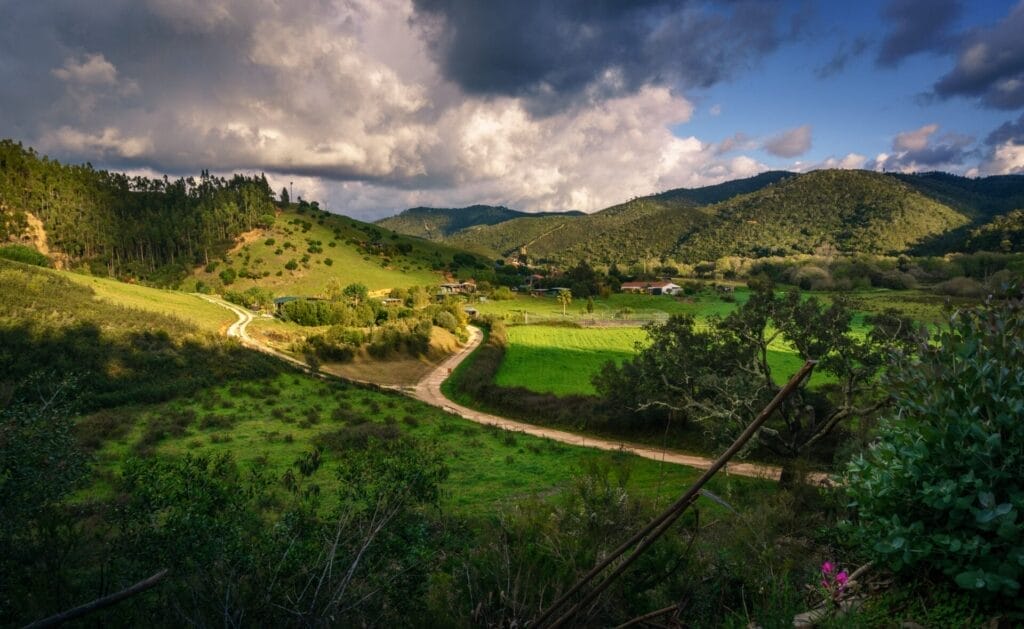
Beyond the walls, the Alentejo unfolds as cork plantations, wine estates, and whitewashed villages spread across plains that cover close to a third of Portugal’s mainland. None of it separates into tidy industries the way a brochure might suggest. The montado, the region’s defining terrain, is cork oaks, pasture, and grain grown together on purpose, worked out over centuries rather than designed by an agronomist: the trees stand far enough apart to graze cattle and pigs beneath them, the pigs that will become porco preto eat the acorns those same trees drop, and the cork itself comes off without harming the tree at all, a trick of bark that grows in three layers so the outer two can be stripped while the living inner layer stays untouched.
Each tree is first harvested around age 25, then again every nine years after that, numbers painted on the trunk to mark the year, for a lifespan that can reach 200 years. Portugal produces roughly half the world’s cork, and most of the country’s cork forest grows in land exactly like this.
Wine tells a similar story of an old idea surviving on its own terms. Aragonez, the grape behind most Alentejo reds, is genetically the same variety as Tempranillo in Rioja and Tinta Roriz in the Douro, and yet it produces something recognizably different here: flatter plains instead of river terraces, granite and clay instead of schist, and closer to 3,000 hours of sunshine a year.
Herdade do Esporão and Adega Cartuxa anchor the region’s larger estates. Near Vidigueira, a handful of smaller producers still ferment wine the way Rome did two thousand years ago, in large clay talha rather than oak or steel. The clay lets in roughly twice the oxygen of a barrel without adding any of oak’s flavor, and the skins that rise during fermentation get pushed back down by hand, once a day, until the talha is finally tapped each November on São Martinho’s Day. It is one of the few continuous winemaking traditions in Europe.
The table runs equally deep, built on porco preto, the acorn-fed black pig raised in the montado, and on farmhouse cheeses like Queijo Serpa, made in villages south of Évora using methods that have barely changed in generations. For tasting notes and pairing detail, our Portugal food and wine guide goes further into both.
What Are the Alentejo’s Megalithic Sites?
The plains around Évora hold one of the densest concentrations of Neolithic monuments in Europe, more than ten significant sites within a short drive of the city, most of it older than anything else on a typical Portugal itinerary. The density is not an accident of preservation. The same open granite plains that made this good farmland six thousand years ago also supplied the stone, and the land has stayed agricultural and thinly populated ever since, which is a large part of why so much of it is still standing.
The Cromeleque dos Almendres, about thirteen kilometers west of the city, is a circle of roughly ninety-five granite stones raised in stages beginning around the 6th millennium BC. Often described as the oldest stone circle in Europe, it predates Stonehenge by close to two thousand years. The site was rediscovered in the 1960s during a geological survey and remains free to visit, though reaching it takes a private car and a guide who knows the turns off the N114.
A short drive further on, the Anta Grande do Zambujeiro, near the village of Valverde, is considered the largest dolmen in the Iberian Peninsula, its burial chamber standing some six meters high beneath what was originally an earth mound. Built around 4000 to 3500 BC and excavated in the 1960s by the same archaeologist who uncovered Almendres, Henrique Leonor Pina, it offers a different kind of megalithic experience: less a monument built to be seen from a distance, more a chamber built to be entered.
What Is Alqueva Lake and the Dark Sky Reserve?
Completed in 2002 on the Guadiana River, the Alqueva Dam created the largest artificial lake in Western Europe: 250 square kilometers of water stretching more than 80 kilometers across terrain long defined by drought. The scale of the engineering shows in the numbers alone, and in the handful of villages and ancient olive groves that now sit beneath the surface.
What the dam also created, almost by accident, was one of the clearest night skies in Europe. The Alqueva Dark Sky Reserve was the first place in the world certified as a Starlight Tourism Destination, and the region sees more than 250 cloud-free nights a year. A private evening on or near the lake, away from any town light, shows a version of the night sky that few American travelers will have seen since childhood, if ever.
The dam’s less-photographed legacy matters equally. Alentejo wine grows on some of the driest, poorest soil in the country, in a region that used to lose crops to drought as often as it brought them in, and Alqueva’s irrigation water is a real part of why the wine industry has expanded the way it has since the reservoir filled in the early 2000s. Estates whose bottles now turn up in Lisbon and New York would not exist in their current form without a dam built for reasons that had nothing to do with wine at all.
What Are the Best Towns and Stops Beyond Évora?
Vila Viçosa
The ancestral seat of the House of Braganza, Portugal’s last royal dynasty, about an hour from Évora. The Ducal Palace, its 110-meter facade faced in local marble, was begun in the early 16th century and remained the family’s principal residence until 1640, when the reigning duke became King João IV and moved the court to Lisbon. The palace’s interiors, still furnished much as the family left them, are a rare look at Portuguese royal life outside the capital.
Estremoz and Borba
Twin marble towns a short drive from Vila Viçosa, sitting above some of the finest marble deposits in the world. In Estremoz and Borba, marble is common enough to appear in doorsteps, curbstones, and market stalls rather than only in palaces, and both towns make a natural stop on the way between Évora and the Spanish border.
Elvas
A fortified border town roughly 90 minutes from Évora, its 17th-century star-shaped ramparts recognized by UNESCO in 2012 as the largest bulwarked dry-ditch defense system in the world. The Amoreira Aqueduct, seven kilometers long, still carries water into the old town. Elvas rewards travelers heading toward or arriving from Spain, and pairs naturally with a stop in Vila Viçosa or Estremoz along the way.
How Do I Get to Évora and the Alentejo from Lisbon?
Your private driver covers the route from Lisbon to Évora in approximately 90 minutes, crossing the Tagus and following the A2 and A6 motorways east across increasingly open country. The drive itself is a useful introduction to the region: within half an hour of leaving Lisbon’s outskirts, the terrain opens into the wheat fields and cork forests that define the rest of the trip.
From Évora, the rest of the Alentejo sits within easy reach by private car. Monsaraz and the Alqueva Lake are roughly 45 minutes east, Vila Viçosa and Estremoz about an hour northeast, and Elvas closer to 90 minutes, near the Spanish border. The Cromeleque dos Almendres, the Anta Grande do Zambujeiro, and the region’s smaller wine estates are only reachable by car, which is part of why knowing the back roads, not only the highway, changes what a single day here can include.
How Should I Structure an Alentejo Itinerary?
Évora alone justifies a full day, and travelers arriving from Lisbon in the morning and returning that evening will see the Roman Temple, the Chapel of Bones, the cathedral, and the old town at a reasonable pace, with lunch built in. It is the itinerary most first-time visitors take, and it earns its popularity.
Staying overnight opens considerably more. A second day allows time for Monsaraz and the lake, or for a wine estate visit built around Esporão, Cartuxa, or one of the smaller talha producers, without the pressure of a return drive to Lisbon. For those combining the Alentejo with a longer Portugal itinerary, two nights based in or near Évora typically covers the city itself, one wine day, and one day exploring the megalithic sites and towns beyond it.
Anyone who wants the Alentejo as more than a detour from Lisbon can add a loop through Vila Viçosa, Estremoz, and Elvas, taking in the marble towns and the border fortifications, and connecting naturally onward toward the Algarve or back through Setúbal, depending on the rest of the trip.

When Is the Best Time to Visit the Alentejo?
Spring, from March through May, is the strongest season. Wildflowers cover the plains, temperatures sit comfortably between 18°C and 22°C, and the roads carry a fraction of summer’s traffic.
Summer runs hot. July and August routinely push past 35°C, and the open plains offer little shade outside the towns themselves. Itineraries during this window lean on early starts, a long midday break, and evening visits to the wine estates and the lake, when the heat has eased and the stargazing begins.
September and October bring the wine harvest and a second mild window, with fewer visitors than spring and the cork oaks and vineyards at their most photogenic. Winter is quiet and often colder than travelers expect from southern Portugal, with the plains stripped back and some rural properties operating on reduced hours.
Our Experience in the Alentejo
Magical Private Travel has been arranging private journeys through the Alentejo since 2002, working with wine estates across the region, building relationships with guides who grew up on these plains, and learning which towns, wineries, and megalithic sites reward a detour and which are better left to the guidebooks.
In Évora, that means a guide, Diogo, who already knows which cellar door opens for a private tasting, which turn leads to the Anta Grande do Zambujeiro without a wrong turn onto a farm track, and which quiet weekday morning to see the Roman baths inside City Hall before the lobby fills with people paying parking tickets. That knowledge shapes how an Alentejo day gets built. Someone with a serious interest in wine gets an itinerary anchored around Esporão or Cartuxa. A guest drawn to history and architecture gets Évora paired with Vila Viçosa or Elvas. Anyone who wants the dark sky gets an evening built around the lake rather than a passing mention of it.
The Alentejo forms part of many of the Portugal itineraries Magical Private Travel designs each year, often combined with Lisbon, the Algarve, and Setúbal.
Destination expertise by Magical Private Travel, established in 2002.
About Magical Private TravelWhat Our Past Travelers Say

Best planned trip to Portugal!
Our trip to Portugal was planned and carried out beautifully using this company. Carlos was our guide for the week and he was friendly, knowledgable and fun! He was also incredibly adaptable when necessary. Our tour included personal experiences I could have never planned by myself. I hope to use this tour company many more times in the future!
Great trip to Portugal and Madeira
Great trip to Portugal and Madeira. Dan and his krewe leave nothing to chance. All was perfect! This is the second time we have used his agency and would highly recommend
Best way to visit Portugal!
Our trip through Portugal was fantastic. We loved the places we visited and we particularly loved Bernardo, the best tour guide ever!
I have been reflecting on the trip through my jet-lagged brain and fortunately have some great photos to jog our collective memory.
Top three memories? That’s tough. The sunset sail in Lisbon was fabulous and a wonderful finish to our time in Portugal. We absolutely loved the Douro Valley lunch and wine pairing, entertained thoroughly by Rafael. Third top memory was the wine tasting and amazing lunch at Esporao. To Dan and his crew at Magical Spain, thank you for a lovely itinerary through Portugal!
Frequently Asked Questions: Alentejo Private Tours
Can I visit Évora as a day trip from Lisbon?
Yes, and it is the most common way travelers see the Alentejo. A private car covers the route in about 90 minutes each way, leaving a full day in Évora for the Roman Temple, the Chapel of Bones, the cathedral, and lunch in the old town. Travelers with a genuine interest in wine, the megalithic sites, or Monsaraz and the towns beyond Évora generally find that one overnight opens far more of the region than a single day allows.
What is the Chapel of Bones and why was it built?
The Capela dos Ossos, inside the Church of St. Francis in Évora, is lined with the bones of roughly five thousand people, arranged by Franciscan monks in the 16th century after the city’s cemeteries ran out of space. The inscription above the entrance warns visitors that the bones inside are waiting for their own, a memento mori built at a time when the Church placed heavy emphasis on the transience of earthly life. It remains one of Évora’s most visited sights.
What is the Alentejo wine region known for?
The Alentejo DOC, consolidated in 2003, spans eight sub-regions and produces rich, approachable reds built mainly on Aragonez, Trincadeira, and Alicante Bouschet. Estates like Herdade do Esporão and Adega Cartuxa anchor the region’s reputation, alongside vinho de talha, an ancient method of fermenting and aging wine in large clay amphoras rather than barrels, still practiced near Vidigueira and considered one of the oldest continuous winemaking traditions in Europe.
What are the Cromeleque dos Almendres and the Anta Grande do Zambujeiro?
Two of Europe’s most significant Neolithic sites, both within a short drive of Évora. The Cromeleque dos Almendres is a circle of roughly ninety-five granite stones, often described as the oldest stone circle in Europe and older than Stonehenge by close to two thousand years. The Anta Grande do Zambujeiro, nearby, is considered the largest dolmen in the Iberian Peninsula. Neither has public transport access, and both are best reached with a private guide who knows the roads.
Is Alqueva Lake worth visiting?
For travelers with an interest in stargazing or quiet landscapes, yes. The Alqueva Dam created the largest artificial lake in Western Europe in 2002, and the surrounding Dark Sky Reserve, the first Starlight Tourism Destination certified anywhere, offers more than 250 clear nights a year. Monsaraz, the medieval hilltop village above the lake, pairs naturally with an evening there.
How does a private Alentejo tour differ from a group tour?
A private Alentejo itinerary moves at your pace, with a guide whose sole focus is your party for the day. Group tours generally cover Évora’s three main sights and little else, on a fixed schedule that leaves no room for a wine estate, a megalithic site, or an extra hour in Monsaraz. A private arrangement can include all three, based on what the traveler wants to see.
What types of Alentejo itineraries does Magical Private Travel design?
Magical Private Travel designs Alentejo itineraries across a full range, from a single day in Évora out of Lisbon to multi-night stays covering the wine region, the megalithic sites, and the towns around Vila Viçosa and Elvas. The Alentejo also features in longer Portugal itineraries, most often paired with Lisbon and the Algarve, or built as a wine-focused extension for travelers who have already spent time in the Douro.
Why can cork be harvested without cutting down the tree?
The cork oak is the only tree whose bark grows in layers that allow the outer two to be stripped away while the living inner layer stays untouched. A tree is first harvested around age 25 and then every nine years after that, for a lifespan that can reach 200 years, and Portugal produces more cork than any other country, a large share of it from the Alentejo’s montado.
Why does vinho de talha taste different from other Portuguese wine?
It ferments and ages in large clay vessels instead of oak barrels or steel tanks, a method that traces back to Roman winemaking and never stopped in the Alentejo the way it did almost everywhere else in Europe. Clay lets in roughly twice the oxygen of an oak barrel without adding any of oak’s flavor, which is part of why talha wines taste rounder and more approachable earlier than barrel-aged versions of the same grape.
Why does the Alentejo have so many prehistoric monuments?
More than ten megalithic sites cluster in the district around Évora, one of the richest concentrations of prehistoric monuments anywhere in Europe. The plains stayed rural and lightly built for thousands of years after these communities raised the stones, which is largely why so many survived intact. Most sit on private farmland reached only by car.
Why choose Magical Private Travel for the Alentejo?
Working across the Alentejo’s wine estates and historic towns since 2002 has produced a specific kind of access, from cellar visits at Esporão and Cartuxa to knowing which of Évora’s streets are worth a second look. What gets built depends on who is traveling, whether that means a full day around wine, one around history, or a night built around the stars.
Types of Alentejo Journeys We Design
The Alentejo works as a single day, a short stay, or the anchor of a longer Portugal itinerary, depending on what the traveler wants from it.
The most common structure pairs a day trip to Évora with a longer stay in Lisbon, covering the Roman Temple, the Chapel of Bones, and the cathedral before returning the same evening. For travelers who want more, one or two nights based in Évora opens Monsaraz, the megalithic sites, and the towns beyond the city, including Vila Viçosa and Elvas.
Wine-focused itineraries move through the region’s estates, from Esporão and Cartuxa to the smaller talha producers near Vidigueira. Stargazing itineraries anchor an evening or overnight near the Alqueva Lake. For travelers combining regions, the Alentejo pairs naturally with Lisbon, the Algarve, or an extended wine-focused trip that also includes the Douro.
Plan Your Alentejo Journey
The Alentejo rewards travelers willing to give it more than a single afternoon. The question is not whether Évora belongs in a Portugal itinerary. It almost always does. The question is how much of the region around it to include, and when to go.
Most of Portugal wants to be photographed. The Alentejo would rather be understood.
Every Alentejo itinerary starts with the same question: how much of the region beyond Évora do you want to see? It is often a question visitors only begin asking on the drive back to Lisbon. We have been helping answer it on purpose since 2002.
Contact Us Today