






Lisbon rewards travelers who arrive with a plan built around how the city behaves, not only a list of what to see. Cruise ships dock regularly and affect foot traffic at Alfama and Belém between 9am and 4pm. The Mosteiro dos Jerónimos rewards an early morning visit. Magical Private Travel has designed private Lisbon journeys since 2002, with guides selected for their depth in specific quarters of the city and the judgment to know when to let a place speak for itself.
Why Travelers Choose Magical Private Travel for Lisbon
Our focus is deliberately narrow: Spain, Portugal, and Morocco. Based on your interest, your energy level, and your mobility, we’ll have different Lisbon recommendations that will be ideal for you. We discover this by asking some questions either via email or a video call.
The practical knowledge that matters in Lisbon is not what most travelers expect. Knowing that Alfama is worth visiting is not expertise. Knowing that on any morning when a large cruise vessel is docked, movement through Alfama and Belém slows considerably and the character of both changes once the busiest groups arrive: that is operational knowledge. Don’t worry. with our local guides, we have many options to provide an optimal Lisbon experience.
Fado works the same way. The difference between a tasca that has held its lineage and one that has drifted toward performance for a tour bus is not something a website tells you. It takes knowing which venues have held their standards.
That calibration of timing, pacing, and sequencing is what working in Lisbon since 2002 produces: a working knowledge of how the city behaves on a given day, and an itinerary built around that reality. A couple wanting to absorb the city quietly moves through a different Lisbon than a family covering ground. The knowledge is the same. The pace is not.
Planning Your Lisbon Days: Neighborhoods and Pacing
Lisbon’s historic core divides into five neighborhoods that reward a private guide’s attention: Alfama, Mouraria, Belém, Baixa and Chiado, and Príncipe Real. Each rewards a different kind of morning, and the order you visit them in matters more than most guidebooks suggest.
Alfama and the Castelo
Alfama is Lisbon’s oldest quarter, its Moorish street plan intact since before the 1755 earthquake. At its upper edge, the Castelo de São Jorge dates to the 11th century and was taken by Portugal’s first king, Afonso Henriques, during the Siege of Lisbon in 1147. The logical route runs downhill, from the castle through Alfama toward the Baixa, which matters most for travelers with limited mobility or young children, since it moves the day’s hardest climb out of the afternoon.
Mouraria and Fado
Mouraria, next to Alfama, is where fado took root in the early 19th century, recognized by UNESCO as Intangible Cultural Heritage in 2011. Maria Severa, who lived and sang in Mouraria’s taverns in the 1840s, is remembered as the genre’s first iconic voice. Fado houses vary considerably in authenticity, and your guide knows which venues have held their standards and which have shifted toward performance for a tourist audience.
Belém
Belém sits west along the Tagus and deserves its own half-day, ideally at opening. The Mosteiro dos Jerónimos, largely completed by 1601 in the Manueline style, is the anchor, with Vasco da Gama’s tomb inside. Church and cloister keep separate hours, and additional closures apply, so we confirm current times before each visit rather than assume a fixed schedule. The Torre de Belém stands nearby, and the Museu Nacional dos Coches has occupied its purpose-built building since 2015.
Baixa and Chiado
The Baixa is the rational street grid the Marquis of Pombal built after the 1755 earthquake destroyed the medieval city. The Elevador de Santa Justa, a wrought-iron lift built in 1902 by engineer Raoul Mesnier du Ponsard, connects it to Chiado above. For a flexible lunch nearby, the Time Out Market occupies the historic Mercado da Ribeira in the Cais do Sodré neighborhood, a short ride from both the Baixa and Chiado.
Príncipe Real
Príncipe Real is one of Lisbon’s most appealing upscale residential neighborhoods: antique dealers, independent bookshops, and some of the city’s best natural wine shops. It rarely appears on standard itineraries and pairs naturally with an evening in Chiado.
A full neighborhood-by-neighborhood guide, including the miradouros, Parque das Nações, and the palaces and gardens most first-time visitors never find, is available on our Lisbon Neighborhoods Guide.
Lisbon Beyond the Obvious
Every guidebook covers Alfama, Belém, and Sintra. A handful of places rarely make that list and reward a traveler willing to go slightly out of the way, among them a private 17th-century palace in the Benfica neighborhood still inhabited by its founding family, a fantastical ceramic garden behind a city museum, and an 18th-century tile courtyard inside a working school that requires advance permission to visit. We cover these in full on our Hidden Lisbon guide, and a guide with long-standing local relationships can arrange access to several of them.
Where to Stay in Lisbon
Which neighborhood to explore and which to sleep in are different questions. Alfama and Mouraria reward exploration by day but run loud and steep at night. Chiado and Príncipe Real solve that problem: central enough to reach most of the historic core on foot, quiet enough to sleep, and close to the restaurants and wine bars worth staying out for. Belém is calmer still, and suits travelers centering their stay on the monastery and the waterfront rather than the evening scene.
Magical Private Travel places each itinerary’s base according to the traveler’s pace and priorities, not by default. A full comparison of Lisbon’s neighborhoods for accommodation is available on our Where to Stay in Lisbon guide.
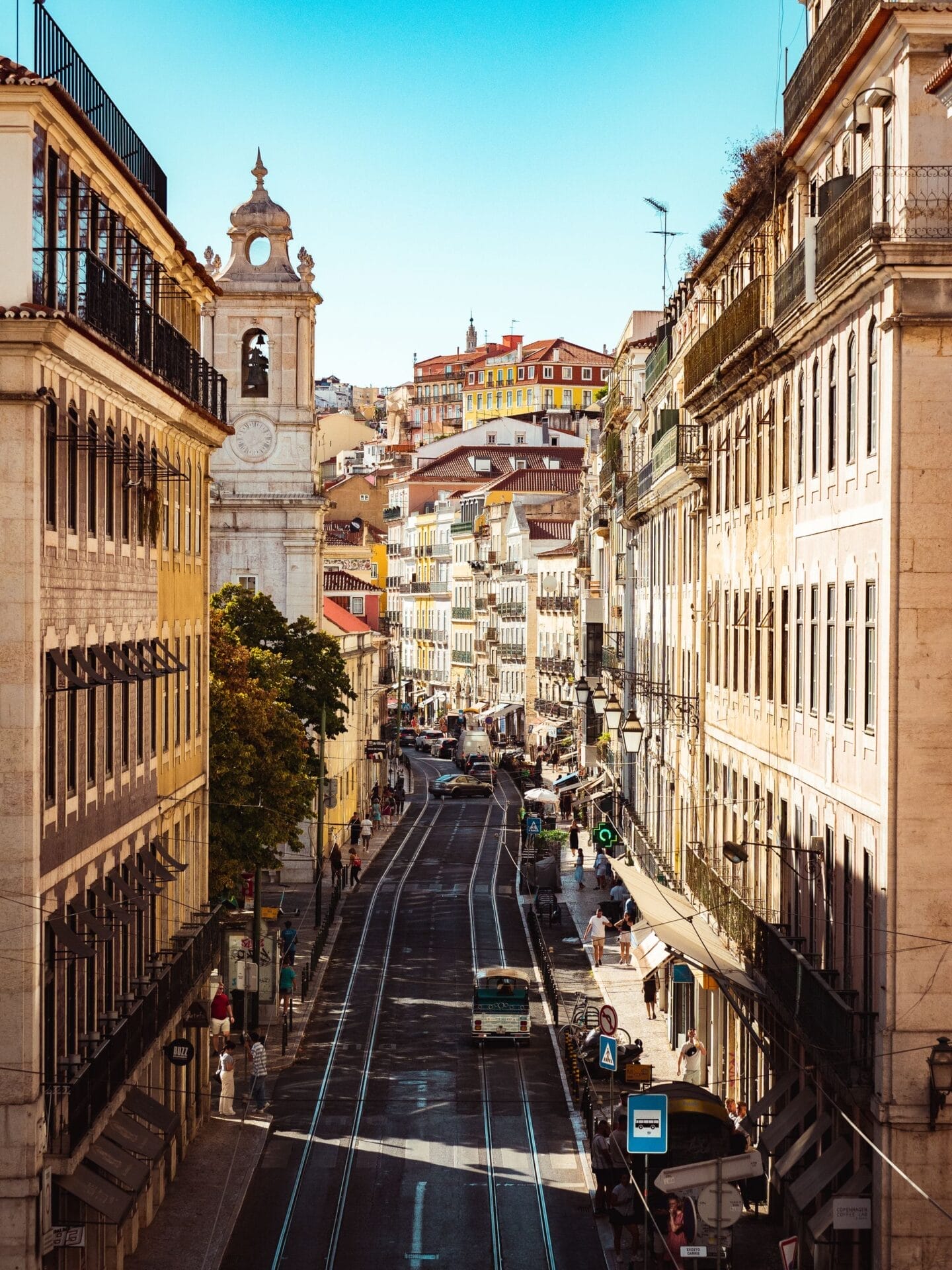
How Long Should You Spend in Lisbon?
Two full days cover Alfama, Belém, and one central neighborhood, enough for a genuine first impression, and work well as a connection point within a broader Portugal itinerary.
Three days allow more room to slow down: a second neighborhood explored properly, an evening of fado without rushing to the next stop. For many travelers, three days is the right length for Lisbon, not a compromise.
Four nights or more allows the kind of unscheduled time that turns sightseeing into travel: a ceramics workshop in Mouraria, a morning at the Feira da Ladra flea market, a second evening of fado in a different neighborhood. Most Magical Private Travel Lisbon itineraries run two to five nights, calibrated to the traveler’s interests.
When Is the Best Time to Visit Lisbon?
April through June is the most consistent window: mild temperatures between 18°C and 24°C (64°F–75°F), visitor volumes below peak summer levels, and the city’s jacaranda trees blooming in May and into June. Late June adds the Santos Populares street festivals, when Alfama, Mouraria, and Graça fill with sardines, music, and paper garlands.
September and October are the second strong window, with summer heat gone and the city’s restaurants and cultural programming at full operation.
July and August bring peak crowds and temperatures that can approach or occasionally exceed 40°C (104°F) during heat waves. Much of the local population leaves the city in August, and some neighborhood restaurants close for the month. A well-designed private itinerary softens the worst of the crowds with early starts and adjusted routing, though July and August remain the least optimal window, particularly at Belém.
November through March is Lisbon’s quietest, most local-feeling period. Rain is possible, especially December through February, but the city’s museums, tabernas, and fado houses sustain a visit well. The Museu Nacional do Azulejo remains closed for renovation at the time of this review, so its reopening status should be confirmed before it is built into an itinerary. The Gulbenkian Museum, by contrast, reopened on July 18, 2026 after its own renovation and is once again an important option for art-focused Lisbon itineraries.
A good Lisbon itinerary leaves things out on purpose
Skipping a third miradouro to spend an extra hour at the Gulbenkian, or trading a second night in the city for an evening in Mouraria most visitors never find: that kind of editing is what separates a designed trip from a checklist. One miradouro, chosen for the right hour, is worth more than four visited on a schedule. We have been making those calls for travelers since 2002.
Frequently Asked Questions About Lisbon, Portugal
Is Lisbon safe for travelers?
Lisbon is generally considered one of the safer major capitals in Europe for visitors, though pickpocketing is a real consideration in crowded tourist areas and on public transport. Your guide routes around the city’s busier corners at busier hours.
How does Lisbon compare to Paris or Rome for travel costs?
Lisbon is meaningfully less expensive than Paris, Rome, or Amsterdam for accommodation, meals, and entrance fees at the mid-market level. At the luxury level, where five-star hotels and fine dining are the comparison points, the gap narrows but remains. A well-positioned boutique hotel in Chiado or Príncipe Real typically runs lower than a comparable property in central Rome.
How do I get to Lisbon from the United States?
Humberto Delgado Airport receives direct flights from several US cities. TAP Air Portugal operates nonstop routes from Boston, Newark, New York, Miami, Washington Dulles, Los Angeles, and San Francisco, with some routes seasonal. United, Delta, and American Airlines also serve Lisbon with varying seasonal nonstop availability. Flight time from the US East Coast runs approximately seven hours, and the airport sits about 20 minutes from the city center by private transfer.
What is included in a private Lisbon tour with Magical Private Travel?
Inclusions vary by itinerary, since each trip is designed around your dates, group, and interests rather than sold as a fixed package. Our Portugal private tour itineraries page outlines typical inclusions in detail, and we confirm the specifics for your trip during planning.
How is a private Lisbon tour different from a group tour?
A private tour runs on your schedule, at your pace, with a guide whose sole focus is your party. There is no fixed group departure, and no other travelers are added to your itinerary. The difference is most visible at sites like the Jerónimos Monastery or the Castelo de São Jorge, where group tours move through quickly at peak hours and a private schedule allows earlier access and more time at the places that matter most to you.
Is Lisbon suitable for travelers with mobility considerations?
Lisbon’s terrain varies, from the level streets of Belém and the Baixa to the hill quarters of Alfama. A Magical Private Travel itinerary accounts for this from the first planning conversation, and your guide is glad to discuss what will be most comfortable before the itinerary is finalized.
Is Lisbon a walkable city?
Lisbon’s historic core is compact enough to walk, but its seven hills make walkability a different proposition than in a flat city. Alfama, Mouraria, and Bairro Alto involve real climbing, while Chiado, Baixa, and Belém are flatter underfoot. Most visitors combine walking within a neighborhood with private transfers between them.
Can I combine Lisbon with Porto or the Algarve?
Yes. Lisbon to Porto runs about three hours by private car, with stops in the Silver Coast or Óbidos built into the journey rather than treated as dead time. Lisbon to the Algarve is a similar three hours by private car. Magical Private Travel designs multi-destination Portugal itineraries with pacing built in, not a different city every night.
Do I need to speak Portuguese to travel in Lisbon?
No. English is widely spoken across Lisbon’s hotels, restaurants, and tourist areas, and your Magical Private Travel guide is fully English-speaking. A bilingual guide adds more than translation: understanding both the city and the traveler means smoother local conversations and better access when it matters.
How much does a private tour of Lisbon cost?
Cost reflects what you want from the journey: accommodation level, group size, season, depth of access, and length of stay all shape the investment. We design the itinerary first, then align the cost to match. The right starting point is a conversation, not a price sheet.
What is fado music?
Fado is a Portuguese musical tradition recognized by UNESCO as Intangible Cultural Heritage in 2011. It emerged as a multicultural urban tradition in early 19th-century Lisbon, shaped by local song, rural musical traditions carried in by internal migration, Afro-Brazilian influences, and the cosmopolitan life of the port city, with Mouraria and Alfama becoming its two most closely associated neighborhoods. Maria Severa, who sang and died in Mouraria in the 1840s, is remembered as the genre’s first iconic voice. Venues vary in authenticity, and it is worth asking your guide which ones have held their standards.
Is Lisbon worth visiting for a full week?
A week works well if Lisbon is the only stop on the trip, or the pace is deliberately slow. Two or three days give a real sense of the city, a full week adds unscheduled time and a second neighborhood explored in depth. The right length depends on what else is on the itinerary. Most Magical Private Travel Lisbon itineraries run two to five nights.
Where Lisbon Leads Next
Lisbon works well as the beginning of something larger: a full day in Sintra, north toward Porto and the Douro, east into the Alentejo, or south toward the Algarve. How those combinations come together, by length of stay, pace, and season, is covered on our Portugal itineraries page.
Plan Your Lisbon Journey
Lisbon rewards the traveler who arrives prepared. We have been doing that preparation on behalf of others since 2002. Ready to see how a private Lisbon journey fits into your Portugal trip? Explore our [LINK: Portugal private tour itineraries or contact us.
Contact Us Today