


Spain · Private and tailor-made
Andalusia, with the Mezquita After Closing
Walk among the Mezquita's 850 columns in Córdoba after the doors close to the public.
By arrangement · How private access worksSuggested length
7 days
Price guide
From $6,188 per person, excl. international flights, based on two sharing
Includes hotels, private guiding, experiences and transfers
When
Spring and autumn, especially April and October
or call +1 (727) 699-5439
A planner replies within one business day
American precision with local expertise · Planned from Europe since 2002 · Nearly 17,000 American travelers · Never cancelled a journey
Pottery, tiles and flamenco run deep in Triana, the riverside quarter across from Seville’s cathedral. This 7-day private tour of southern Spain runs from Seville through Roman Carmona to Córdoba, then past the old bodegas of Montilla to Granada. In Córdoba, by arrangement, you walk among the Mezquita’s 850 columns after the doors close to the public, the horseshoe arches running row after row into the quiet. Lunch there starts with salmorejo, Córdoba’s chilled cream of tomato, bread and olive oil. In Seville you walk the Real Alcázar and the cathedral beneath the Giralda, and the week ends in the Albaicín and at the Alhambra. Private guides and drivers look after you. Any day can move, stretch or slow down to suit you.
Walk the Mudéjar palace Peter I built inside the Real Alcázar, Seville.
Visit the Roman necropolis and the Seville Gate in Carmona, on the road to Córdoba.
Walk among the 850 columns of the Mezquita-Cathedral, Córdoba.
Taste salmorejo, the chilled tomato and bread cream, in the city of its birth, Córdoba.
Taste wines from the old soleras of Andalusia’s oldest winery, where it suits your party, Montilla.
Walk the Court of the Lions in the Nasrid Palaces with Israel, where your dates allow, Granada.

“We love to tailor-make trips you’ll talk about for years, built on our local relationships & story-worthy experiences.” – Magical’s American founder, in Europe since 1998, culinary enthusiast & world traveler.







A Journey Designed Just for You
Our resident experts wrote this itinerary as a starting point, and your planner shapes every day around your interests, pace and travel style.
What do our American travelers say?
The 7-day southern Spain itinerary at a glance
The route uses three bases and six nights: two in Seville, two in Córdoba and two in Granada. You change hotels twice in seven days, and each city gives you one full day with no transfer ahead of you. The two travel days carry visits of their own, Carmona and the Guadalquivir valley on day three and Montilla on day five, so no day goes to the road alone.
A licensed driver covers every leg by road. Seville and Córdoba lie about 140 kilometers apart, about 1 hour 15 minutes on the direct motorway, and the day runs longer with the stop in Carmona, 33 kilometers northeast of Seville. Córdoba to Granada takes about 2 hours 10 minutes on the direct route, more with the Montilla stop. The journey begins at Seville airport, about 10 kilometers east of the city, or at Santa Justa station, and ends in Granada, where the airport lies about 15 kilometers west of the center.
Spring and autumn suit the route best. Spain’s state weather agency, AEMET, records average daily highs in Seville of about 23°C (74°F) in April and 26°C (79°F) in October. Córdoba averages about 23°C (73°F) in April and 25°C (77°F) in October, against 37°C (98°F) in July, and Granada about 21°C (69°F) in April and 23°C (74°F) in October. Summer and winter departures both work with a different daily rhythm, and our team plans the hours around the season.
Licensed guides we work with on this route include Andrés and Rosario in Seville, David and Paco in Córdoba, and Israel and Rafael in Granada. Each is a highly educated local expert who cares about the people in their group. We request your guides by name, and your planner confirms who leads each day once your dates are set.
Why the route runs from Seville to Granada
The journey moves through the three great cities of Al-Andalus. Córdoba holds the Umayyad chapter: Abd al-Rahman I began the Great Mosque in 785, and Abd al-Rahman III made the city the seat of an independent caliphate in 929. Seville holds the Almohad chapter, with the Giralda, finished in 1198, and the Castilian kings who followed, among them Peter I and his Mudéjar palace. Granada holds the last chapter, the Nasrid court Muhammad I began on the Alhambra hill in 1238. Our article on art and culture in Andalusia sets the three cities side by side.
The order also works on the ground. Seville makes an easy start, with an airport close to the city and high-speed trains from Madrid in about 2 hours 30 minutes. The road then follows the Guadalquivir upstream to Córdoba and turns southeast through olive and vine country to Granada, so the route never doubles back. The Alhambra comes on day six, once the week has found its rhythm, and Granada’s own airport sits close by for the trip home. A driver suits this route because Carmona, the river castles and Montilla lie between the cities. Our article on Córdoba or Ronda between Granada and Seville explains why Córdoba earns its two nights.
Journey at a glance
Length
7 days
From
$6,188 per person, double occupancy
Route
Seville, Carmona, Córdoba, Montilla, Granada
Your planner adjusts every day to your dates.

Day One
Seville: The Real Alcázar, the Cathedral and Plaza de España
Your licensed driver meets you at Seville airport, about 10 kilometers east of the city, or at Santa Justa station, and brings you to a hotel in the old center for two nights. After you settle in, your licensed guide leads you into the Real Alcázar, where Peter I of Castile built his Mudéjar palace in the 1360s, with carved stucco, tiled courtyards and gardens of bitter orange trees. The royal family still uses the upper floors, and the producers of Game of Thrones filmed part of the fifth season here. Next door, work on the cathedral began in 1402 on the site of the Almohad great mosque, and the Almohads completed its minaret, the Giralda, on 10 March 1198. Christopher Columbus lies inside. You walk on through the lanes of Santa Cruz, and where it suits your party, the afternoon ends at Plaza de España, which Aníbal González designed for the Ibero-American Exposition of 1929, where tiled alcoves stand for the provinces of Spain and four bridges cross the moat. Logistics: Seville airport or Santa Justa station to the old center by road, licensed driver, then an afternoon on foot with your licensed guide.
Day Two
Triana, Its Market and Its Potters
Your licensed guide meets you in the hotel lobby for a morning on foot through the small plazas and flowered patios of the old town, then across the Guadalquivir to Triana, the riverside quarter with a long pottery and tile tradition and a deep flamenco culture. The Mercado de Triana stands on the foundations of the Castle of San Jorge, and its stalls of olives, cured ham and fresh fish fill the morning with color and noise. A few streets away, the Centro Cerámica Triana occupies the old Santa Ana pottery, where the original kilns sit in the courtyard and the upper floor shows ceramics from the 12th to the 20th century. Where it suits your party, the afternoon turns to a private session with a chef, cooking paella and tapas to share at the table, or to a visit with one of the ceramic workshops still at work in Triana. In the evening Calle Betis, along the waterfront, looks back across the river to the city. Logistics: a walking day in Seville with your licensed guide, and your licensed driver handles any transfers.

Day Three
Roman Carmona and the River Road to Córdoba
Where it suits your party, the morning starts in the countryside east of Seville, with an easy walk alongside your licensed guide or a visit to a working olive mill in the hills of Carmona, with a taste of oil from the estate's own olives. Carmona sits on a ridge 33 kilometers northeast of Seville, and Julius Caesar called it by far the strongest city of the whole province. You enter through the Seville Gate, which Carthaginian builders began in the third century BC and the Almohads later folded into a fortress, the Alcázar de la Puerta de Sevilla. Below the town, the Roman necropolis holds hundreds of family tombs, among them the Tomb of Servilia, laid out like a Roman villa, and the Tomb of the Elephant, with dining rooms cut into the living rock. In the afternoon your licensed driver follows the Guadalquivir valley toward Córdoba, past the castle of Almodóvar del Río on its hilltop, a fortress of Umayyad origin about 24 kilometers from Córdoba. Logistics: Seville to Córdoba by road, about 140 kilometers and about 1 hour 15 minutes on the direct motorway, longer with the stops in Carmona and the valley, licensed driver, with your licensed guide in Carmona.
Day Four
Córdoba: The Mezquita, the Judería and the Roman Bridge
Abd al-Rahman I, founder of the Emirate of Córdoba, began the Great Mosque in 785, and his successors enlarged it until the late 10th century. With your licensed guide you cross the Courtyard of the Oranges into the prayer hall, where about 850 columns of jasper, onyx, marble and granite carry row after row of horseshoe arches. Castile took the city in 1236 and turned the mosque into a cathedral, and from 1523 builders raised a Renaissance nave in the middle of the prayer hall. UNESCO inscribed the mosque in 1984 and extended the listing to the historic center in 1994. A few lanes away in the Judería stands the synagogue completed in 1315, the only one in Córdoba to survive, with a statue of Maimonides, born in the city, nearby. Courtyard houses fill the old quarter, and at the Palacio de Viana twelve patios open one onto the next. Lunch brings salmorejo, Córdoba's chilled cream of tomato, bread, olive oil and garlic, topped with ham and egg. In the evening you cross the Roman bridge, closed to traffic since 2004, toward the Calahorra Tower, and where it suits your party, the equestrian show at the Royal Stables, which Philip II founded in 1570 to breed the Spanish horse, closes the day. Logistics: a walking day in Córdoba's old center with your licensed guide, and your licensed driver for any evening transfer.
Day Five
Montilla's Bodegas and the Albaicín of Granada
Your licensed driver heads south from Córdoba into the Montilla-Moriles wine country, a designation of origin since 1932. Montilla gave its name to amontillado, and where it suits your party, you stop at Alvear, founded in 1729 and the oldest winery in Andalusia, for a walk through the cellars and a tasting from its old soleras, with Pedro Ximénez among the wines. In Granada you check in to a hotel in the historic center for two nights, and your licensed guide leads you up into the Albaicín, the hillside quarter north of the Darro where the Zirids built their citadel long before the Alhambra rose across the valley. UNESCO added the Albaicín to the Alhambra listing in 1994. The lanes climb past cármenes, whitewashed houses with walled gardens, to the Mirador de San Nicolás, where the whole length of the Alhambra faces you across the valley. Where it suits your party, the walk continues to Sacromonte, the hillside of cave houses where Granada's Roma families settled after 1492 and where the zambra dance began. In most of Granada's bars a free tapa arrives with each drink, and our team reserves a dinner table with a view on request. Logistics: Córdoba to Granada by road, about 2 hours 10 minutes on the direct route and longer with the Montilla stop, licensed driver.
Day Six
The Alhambra and the Generalife
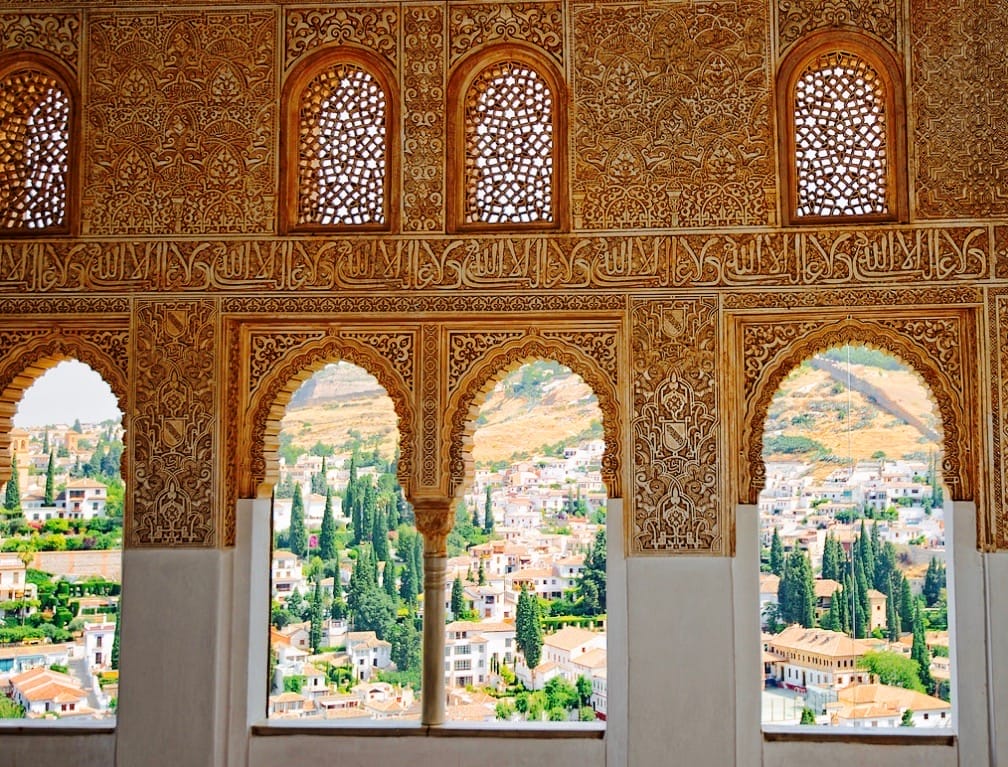
Muhammad I, the first Nasrid emir, began the Alhambra on the Sabika hill in 1238, and his successors turned it into a palace city. Our team books the timed entry to the Nasrid Palaces, and where your dates allow, Israel, one of our licensed guides in Granada, leads the morning. You start in the Alcazaba, the oldest part of the complex, then enter the Comares Palace, where the Court of the Myrtles leads to the Hall of the Ambassadors, the largest room in the Alhambra. In the Court of the Lions, which Muhammad V began in the second period of his reign, from 1362, twelve marble lions surround the fountain. The visit ends in the Generalife, the summer palace and country estate of the Nasrid rulers, where a channel of water runs the length of the Patio de la Acequia between rows of jets, and orchards still fill the lower terraces. Washington Irving brought the Alhambra to readers abroad with Tales of the Alhambra in 1832. The afternoon stays free, and our team reserves a table with a view on request. Logistics: the hotel to the Alhambra by road, a short drive up the hill, licensed driver, with your licensed guide inside the complex.

Day Seven
Departure from Granada
The morning stays free for a last walk along the Darro, where the river runs below the old stone bridges of the Albaicín, or a final coffee in the old center. At the agreed time your licensed driver meets you at the hotel entrance, takes care of the luggage and brings you to Granada airport, about 15 kilometers west of the city, or to Granada station for your train connection. Travelers with more time often extend the journey to northern Spain, Portugal or Morocco, and our team plans those extensions on the same private basis. Logistics: hotel to Granada airport, about 15 kilometers, or to Granada station by road, licensed driver.
Is 7 days enough for southern Spain?
Yes, seven days covers southern Spain’s three great Moorish cities, Seville, Córdoba and Granada, with two nights in each and one full day per city. The week takes in the Real Alcázar, the cathedral and Triana in Seville, the Mezquita and the Judería in Córdoba, and the Albaicín and the Alhambra in Granada, with Carmona and Montilla on the two road days. It leaves out the white villages, Ronda, Málaga and the coast. If those matter to you, ten days or more serves you better, and our team adds them to the same route.
Is Córdoba worth an overnight stay, or only a day trip?
Córdoba rewards an overnight stay, and this route gives it two nights. A day trip from Seville fits the Mezquita and a walk through the Judería. Two nights add the Roman bridge in the evening, the patios of the Palacio de Viana, the Alcázar de los Reyes Cristianos, where Columbus had his first audience with Ferdinand and Isabella, the equestrian show at the Royal Stables, and an unhurried lunch of salmorejo and flamenquín, the Cordoban roll of pork loin and serrano ham fried in breadcrumbs. You also arrive in Granada rested, with the Alhambra still ahead.
How do you travel from Seville to Córdoba and Granada?
By road with a licensed driver, on two travel days with planned stops. Day three runs from Seville to Córdoba, about 140 kilometers, by way of Carmona and the Guadalquivir valley. Day five runs from Córdoba to Granada, about 2 hours 10 minutes on the direct route, with a stop in Montilla. High-speed trains also link Seville and Córdoba in about 45 minutes, and our team prices a train leg on request, but the road lets you stop in Carmona and Montilla on the way. Our article on Carmona’s Roman and medieval heritage describes the first of those stops in more depth.
This southern Spain route or another 7-day Andalusia journey?
Choose this route if you want Córdoba in depth and a week spent entirely in the south, with Roman Carmona and the bodegas of Montilla on the road days. For travelers who want mountain villages and walking more than a second day in Córdoba, our team reshapes the week on request, with a walk in the Sierra de Aracena, a private cooking demonstration in Seville and a day in the Alpujarras villages from Granada.
If you fly into Madrid, the 7-day Madrid, Granada and Seville journey trades Córdoba and Carmona for the Prado and the Royal Armory and links the cities by high-speed train, and Majestic Madrid and Moorish Andalusia follows the same three cities with a flamenco evening in Seville. With ten days, the 10-day Highlights of Spain journey joins Madrid, Andalusia and Barcelona in one route. All of them start from the Spain destination page, and our team adjusts any of them to your dates.
Who this journey suits
Travelers on a second trip to Spain who saw Madrid or Barcelona before and now want the south alone. Couples who prefer two nights in every base and a car at the door. History and architecture travelers following Al-Andalus from the Umayyads to the Nasrids. Food and wine lovers drawn to Montilla’s cellars, the olive country around Carmona and the tapas bars of Granada. Families with teenage or adult children, and friends traveling together as a private party, who want one plan and one point of contact. Your guide is glad to advise on suitability before booking for anyone who prefers shorter walking days.
The people behind the route
Our team selects top guides based on their experience, knowledge and engaging personalities, not egos. In Granada, where your dates allow, Israel, one of our licensed guides, leads our Alhambra days. He paces the Nasrid Palaces around your timed entry, starts in the Alcazaba, and keeps the Generalife for the end of the morning, when the gardens fill with the sound of water.
What the 7-day journey costs and what it includes
The 7-day route starts from $6,188 per person, double occupancy. The from-price covers six nights in deluxe four-star properties selected for comfort, location and service. Five-star luxury properties are available by request. It includes licensed guides for the visits described, a licensed driver for airport, station and road transfers, and timed entry to the Alhambra’s Nasrid Palaces.
Four things move the price: the season, the hotel category, the size of your private party, and added experiences such as the cooking session in Seville, the olive mill near Carmona, the Montilla tasting or the equestrian show in Córdoba. Magical Private Travel maintains excellent ratings on Trustpilot and Google’s independent review platforms.
To shape this route around your dates and your party, speak with our team about your week in southern Spain.
Frequently asked questions about the 7-day southern Spain journey
How much does the 7-day private southern Spain tour cost?
This 7-day route starts from $6,188 per person, based on two people sharing a room. The from-price covers the route as written: six hotel nights, licensed guides for the visits described and a licensed driver for airport, station and road transfers, with the full list of inclusions set out in your written quote. Four things move the price. The season matters most, since hotel rates rise and fall through the year. Five-star hotels raise it. Party size changes it, because the guide and driver serve the whole party, so larger private parties pay less per person. Added experiences, such as the cooking session in Seville, the Montilla winery visit or the equestrian show in Córdoba, add to it. Our team sends a written quote for your dates and party before you commit.
When is the best time to visit Seville, Córdoba and Granada?
Spring and autumn suit this route best, with April and October the strongest months. Spain’s weather agency, AEMET, records average daily highs in Seville of about 23°C (74°F) in April and 26°C (79°F) in October. Córdoba averages about 23°C (73°F) in April and 25°C (77°F) in October, and Granada about 21°C (69°F) and 23°C (74°F). July brings the hottest stretch, with average highs of about 36°C (97°F) in Seville, 37°C (98°F) in Córdoba and 35°C (95°F) in Granada, and summer departures work well with early starts, lunch indoors and evening walks. In spring, orange blossom scents the patios of Seville and Córdoba. Winter brings cooler days and the quietest hotels of the year, a good fit for a week built around palaces and monuments. Our team plans each day around the season you choose.
Do we need to book the Alhambra in advance?
Yes, and our team handles it. Every Alhambra ticket with the Nasrid Palaces carries an assigned entry time, and the monument asks visitors to arrive punctually for it. Visitors who buy or collect tickets at the monument’s own ticket offices must do so at least one hour before the time assigned to the Nasrid Palaces. For this reason our team books your timed entry as soon as you confirm your dates, and your licensed guide plans day six around it. The Alhambra also asks each visitor to carry an original passport or ID card across the whole complex, so bring the passports you travel on, and each child under 12 needs a free ticket of their own. Where your dates allow, Israel, one of our licensed guides in Granada, leads the visit. The Generalife and the Alcazaba sit within the same complex and need no separate journey.
Are the guide and the driver the same person?
In Spain they are two different people. A licensed guide leads the visits, and a licensed driver handles the vehicle and the road transfers. Your licensed guide changes from city to city, so your guide in Seville differs from your guide in Córdoba and in Granada, and each knows their own city in depth. The licensed driver covers the two road days, from Seville to Córdoba by way of Carmona and from Córdoba to Granada by way of Montilla, and handles the airport and station transfers at both ends. This split lets your guide focus on the site and your driver focus on the road and the luggage. Where your dates allow, Israel, one of our licensed guides in Granada, leads the Alhambra.
Which airports should we fly into and out of?
Fly into Seville and home from Granada. Seville airport lies about 10 kilometers east of the city, and Granada airport about 15 kilometers west of the city center, so both transfers stay short. An open-jaw ticket of this kind avoids a drive back across Andalusia at the end of the week. Travelers who arrive in Madrid take the high-speed train to Seville, about 2 hours 30 minutes, and a licensed driver meets the train at Santa Justa. On day seven your licensed driver brings you to Granada airport or to Granada station for a train connection, and our team aligns the itinerary with your flight and train times once you have them. Our team also arranges VIP airport assistance on request, covering meet-and-greet and help through the terminal.
Why does the route stop in Carmona on the way to Córdoba?
Carmona sits on a ridge 33 kilometers northeast of Seville, in the direction of Córdoba, so it breaks the drive. It also holds layers of history the rest of the week leaves out. Carthaginian builders began the Seville Gate in the third century BC, Julius Caesar called the town by far the strongest city of the whole province, and the Almohads later built a fortress around the old gate. Below the town, the Roman necropolis holds hundreds of family tombs, among them the Tomb of Servilia and the Tomb of the Elephant, with its rock-cut dining rooms. Where it suits your party, the morning also includes an easy country walk or a working olive mill in the hills of Carmona. Our article on Carmona’s Roman and medieval heritage covers the town in more depth.
What should we eat and drink in Seville, Córdoba and Granada?
Each city on the route keeps its own table. In Seville, the Mercado de Triana sells olives, cured ham and fresh fish under one roof, and the tapas bars of the old town and Triana turn a walk into dinner. In Córdoba, salmorejo, the chilled cream of tomato, bread, olive oil and garlic topped with ham and egg, comes from the city itself, and flamenquín, pork loin rolled around serrano ham and fried in breadcrumbs, follows it. On the road to Granada, Montilla’s bodegas pour the wines of the Montilla-Moriles designation, the source of the name amontillado. In Granada, most bars bring a free tapa with each drink, so two or three bars make an evening. Where it suits your party, our team reserves tables each night. Our guide to tapas in Spain has more ideas.
Which optional experiences fit this route?
Several options fit the shape of the week, and your planner adds the ones your party prefers. In Seville, a private cooking session with a chef, with paella and tapas to share, suits the free afternoon of day two, as does a visit to a ceramic workshop in Triana or a flamenco evening in the quarter where the art runs deep. On day three, an easy country walk or a visit to an olive mill near Carmona fits the morning. In Córdoba, the equestrian show at the Royal Stables, which Philip II founded in 1570 to breed the Spanish horse, closes day four. On day five, a cellar visit and tasting at Alvear in Montilla, founded in 1729, breaks the drive to Granada. Each option adds to the from-price, and your planner prices it in your written quote. Our list of ideas for a perfect day in Seville has more.
Does this journey suit families or travelers with limited mobility?
Families travel this route often, because a private guide and driver set the pace around the youngest and the oldest in the party. Teenagers tend to respond to the Roman tombs in Carmona, the forest of columns in the Mezquita, the horses of the Royal Stables and the lions of the Alhambra, and the two-night bases leave room for a slow morning or a pool afternoon. Several days involve walking on cobbled streets and slopes, especially in the Albaicín, the Judería and across the Alhambra hill. Your guide is glad to advise on suitability before booking, and our team adjusts walking routes, adds vehicle time between sites, or shortens days where it helps. Our page on accessible travel in Spain sets out how our team plans for travelers who need step-free routes or extra support.
Does the route extend to Portugal or Morocco?
Yes. Portugal lies west of Seville, and Morocco lies across the Strait of Gibraltar from Andalusia, so the week extends naturally in either direction. American travelers who add Portugal often continue to Lisbon and Sintra for three or four nights, the shape of our 10-day Madrid, Seville and Lisbon journey. Where your dates allow, Luisa, one of our licensed guides in Lisbon and Sintra, leads those days alongside a licensed driver. Travelers who add Morocco usually cross from Andalusia to Tangier, Fez or Marrakech, and our Spain and Morocco private journey shows one way to combine the two. In Morocco our team works with private drivers and licensed guides as separate roles. Our multi-country journeys page collects the other combinations, and your planner prices the extension alongside the 7-day route.
Who do we contact if something goes wrong or we want a change?
Your planner designs your journey with you and stays in touch after you land. For the fastest response at any hour, message your private WhatsApp group, where our 24/7 support team works alongside Rachel or Dan. Because we begin no more than five journeys per country each week, peak spring and fall dates fill early, and that limit is what lets us stay this close to every trip.
We keep a list of vetted four- and five-star hotels, well located and enjoyed by our past travelers and by our own team.
Examples for each overnight stop on this route. Choose a deluxe boutique hotel or a five-star stay, and your travel advisor matches each night to your wishes, the season and availability.
Seville
Boutique: Hotel Casa 1800 Sevilla. A 19th-century mansion with a patio and a rooftop pool facing the cathedral and Giralda.
Five-star: Hotel Alfonso XIII. Built for the 1929 Ibero-American Exposition, a neo-Mudéjar palace of tiles and arches near the Alcázar.
Córdoba
Boutique: Balcón de Córdoba. A century-old house with three patios and a rooftop terrace looking at the Mezquita.
Five-star: Hospes Palacio del Bailío. A 16th-century palace built over Roman remains, seen through the glass floor of its patio.
Granada
Boutique: Parador de Granada. A 15th-century Franciscan convent inside the Alhambra precinct, with gardens facing the Generalife.
Five-star: Hospes Palacio de los Patos. A 19th-century palace beside a contemporary wing, linked by gardens, with a spa below.
What's Included
A Very Personalized Itinerary, Just For You and Your Schedule
Hand-Picked Ultra-Luxury & Boutique Hotel Options
Insider Experiences + Inspiring Sightseeing + Magical Upgrades
Private Touring with Your Own Personal Expert Guide
Private Airport & Train Station Luxury Transfers
Full Breakfasts + Food & Wine Tasting Options
Your Choice of Activities on “Design Your Days”®
Expert Advice, Restaurant Ideas & Reservations
24/7 Support & Concierge Service from Spain, Portugal & Morocco
Magical is an award-winning luxury travel agency
Private journeys with soul & stories
Excellent independent reviews
Your private WhatsApp group with our 24/7 team and Rachel or Dan
Hidden gems, insider fun & vetted hotels
Your private guide, deluxe vehicle & flexible pace
24/7 concierge-style support
We handle everything — you live the dream
American Precision, Local Soul
Our Unforgettable Trips Are Tailored Just For You
Hi from Europe,
Along with our local partners across Portugal, Spain, Morocco and beyond we believe that our clients deserve the truly tailor-made private luxury trips, not generic "one-size-fits-all" plans.
Get inspired with our sample trips then get in touch about an expert-made personalized custom luxury itinerary, just for you.
Kind regards,
Dan O'Beirne & the MPT team
Request a Quote