






Coimbra sits on a hill above the Mondego River in central Portugal, on the main route between Porto and Lisbon. It became the seat of Afonso Henriques’s court in 1131 and served as capital of the kingdom from 1143 to 1255. Its university, founded in 1290, is the oldest in the Portuguese-speaking world and forms the UNESCO property University of Coimbra, Alta and Sofia. One full day covers the university and the old town, while two allow the Roman layers and the far bank.
Coimbra is read upward. Beneath the museum at the top of the old town lies the cryptoporticus of Aeminium, the vaulted substructure that carried the Roman forum, still standing after two thousand years. Above it sits the medieval city, where Portugal was governed for over a century and where the country’s first two kings are buried. And above that, on the crown of the hill, the university has been permanently established since 1537 and based in the former royal palace since 1544. Three Portugals, stacked on one slope.
A stay in Coimbra can center on the university and its Baroque library, on the Roman and medieval layers below it, on the distinctive fado and song tradition associated with the city, or on the gardens and monasteries across the river. Magical Private Travel designs private Coimbra tours as part of tailor-made journeys across Portugal, shaped around the travelers, the wider route, and the pace they want.
Why Visit Coimbra?
The University on the Hill
The University of Coimbra was established by King Dinis in 1290 and confirmed by Pope Nicholas IV later that year. After moving several times between Lisbon and Coimbra, it was permanently established here in 1537 and settled in the former royal palace, today’s Paço das Escolas, in 1544. It is the oldest university in the Portuguese-speaking world, and it was inscribed by UNESCO in 2013 as the University of Coimbra, Alta and Sofia. The listing covers not a single building but a working academic city, its colleges, its ceremonial spaces, and the streets that grew around them.
The Joanina Library
Built between 1717 and 1728 under King João V, the Joanina is Portuguese Baroque at full stretch: three richly decorated halls, gilded and polychrome oak shelving, painted ceilings, six tables made with precious tropical woods, and nearly sixty thousand volumes dating principally from the fifteenth to the eighteenth centuries. Bats have lived in the building for roughly two and a half centuries, helping control the insects that would damage the books, which is why the tables are protected with leather covers at the end of each day.
The Roman City Underneath
Before Coimbra there was Aeminium. The Museu Nacional Machado de Castro stands on the site of its forum, and beneath the museum runs the cryptoporticus, a two-thousand-year-old system of vaulted galleries built to level the sloping ground and carry the public square above. It is one of the most impressive Roman structures still preserved in Portugal. In 2019, the boundaries of the UNESCO property were extended to include the Museu Nacional de Machado de Castro, of which the cryptoporticus forms a defining part.
The Medieval Capital
Coimbra became the seat of Afonso Henriques’s court in 1131 and served as capital of the Portuguese kingdom from 1143 to 1255. The city still carries the evidence. The Monastery of Santa Cruz, founded in 1131, was extensively transformed during the sixteenth century and holds the monumental tombs of Afonso Henriques and Sancho I, the country’s first two kings. The church was formally recognized as a National Pantheon in 2003. Below the university, the Sé Velha dates principally from the second half of the twelfth century and is one of Portugal’s major Romanesque monuments, with a robust, crenellated exterior and a richly carved portal.
Fado de Coimbra
Coimbra developed a distinct fado and song tradition in close relationship with the university and its student serenades. Traditionally performed by male students in academic dress and accompanied by the Coimbra guitar, it draws on poetry, love, departure, and saudade. During the Monumental Serenades, listeners remain silent rather than applaud, while staged performances elsewhere in the city follow their own format.
How to Experience Coimbra
The University and the Pátio das Escolas
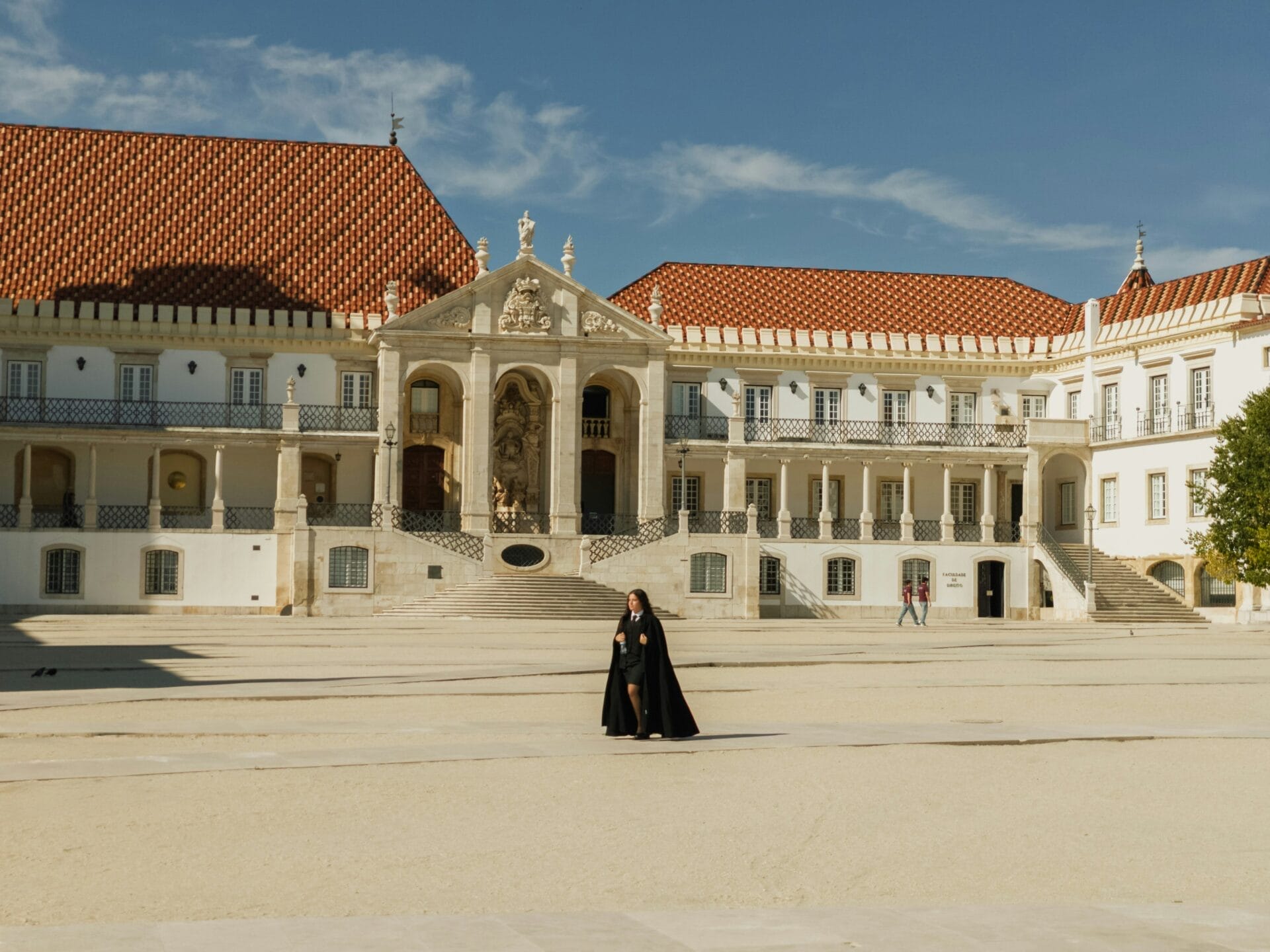
A guided visit crosses the Porta Férrea into the Pátio das Escolas, the courtyard at the top of the city, with the university tower above it and the Mondego valley open below. Inside, the Sala dos Capelos was the throne room of the royal palace and is now the ceremonial hall, and the Chapel of São Miguel holds Manueline stonework, azulejo, and an eighteenth-century organ installed between 1733 and 1737. The Joanina is the culmination, and the sequence matters as much as the rooms.
The Cryptoporticus and Machado de Castro
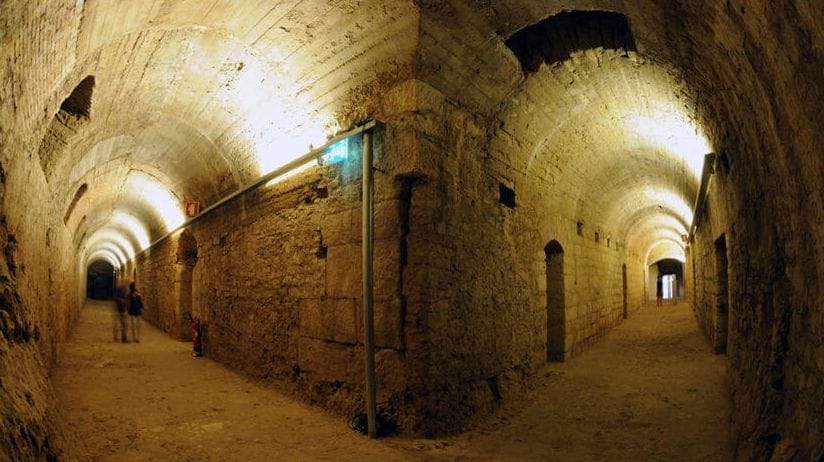
The museum above the Roman galleries holds a major collection of medieval and Renaissance sculpture, including the most representative group of works from workshops active in Coimbra from the fourteenth through the sixteenth centuries, many carved in Ançã limestone. Descending from the museum galleries into the Roman substructure below is the clearest single expression of how the city’s layers intersect.
The Baixa, Santa Cruz, and the Old Gate
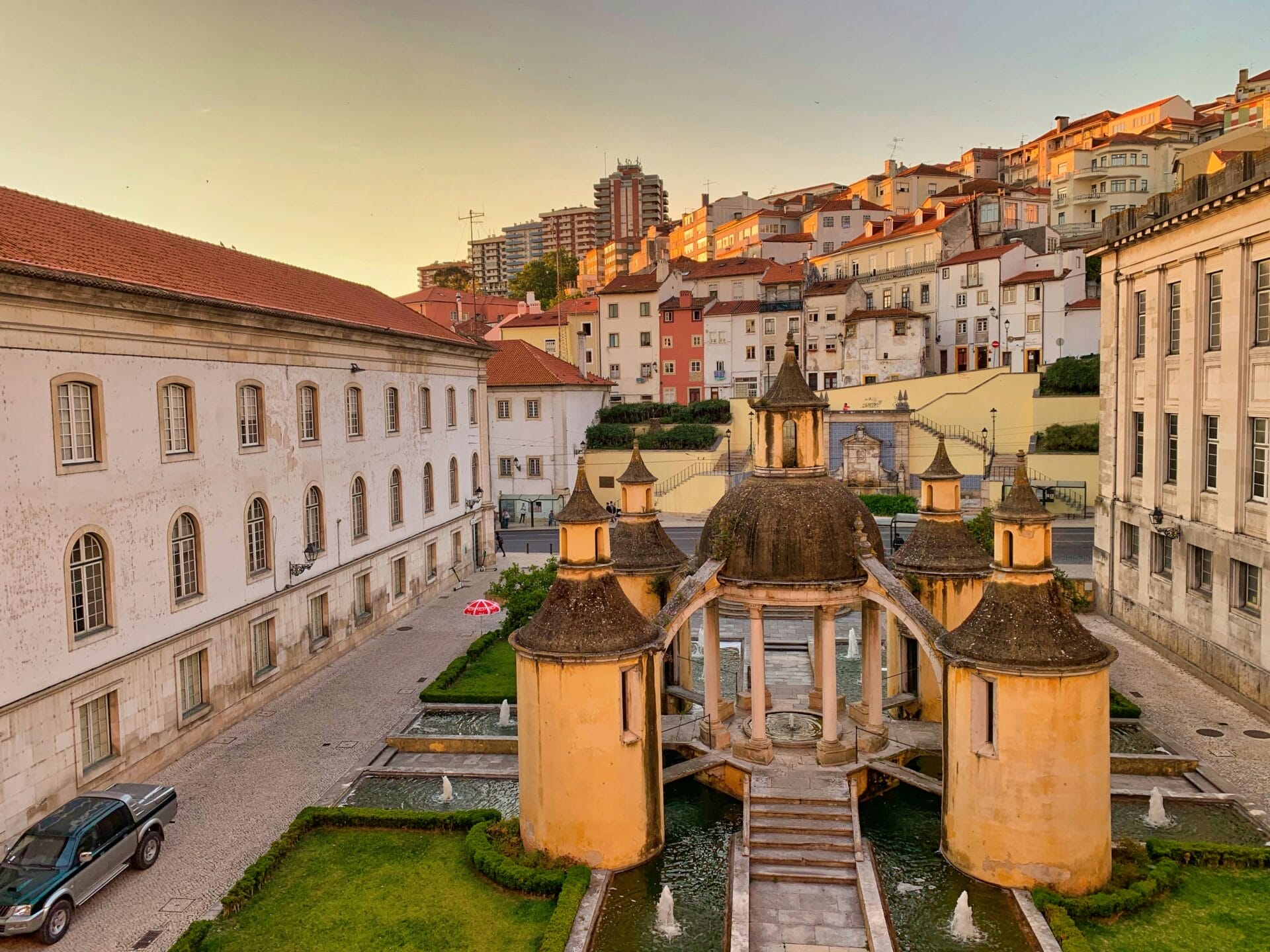
Down the hill, the Arco de Almedina still stands as the gate through the Moorish and medieval walls, and the stepped lanes behind it lead into the Baixa. Santa Cruz sits at the foot, with the royal tombs, the Manueline portal, and the Claustro do Silêncio behind. Beside it, the Jardim da Manga preserves a distinctive yellow Renaissance fountain designed by João de Ruão. Local tradition links its name to a sketch King João III is said to have drawn on his sleeve.
Across the Mondego

The far bank gives the view back: the city stepped up its hill, seen best from the Pedro e Inês footbridge. On that side stand the excavated ruins of Santa Clara-a-Velha, a thirteenth-century Gothic convent abandoned to the river’s flooding and recovered from the silt in modern excavation, and the gardens of the Quinta das Lágrimas, tied to the story of Pedro and Inês de Castro. The university’s botanical garden, laid out in the eighteenth century, climbs the slope on the city side.
Student Coimbra
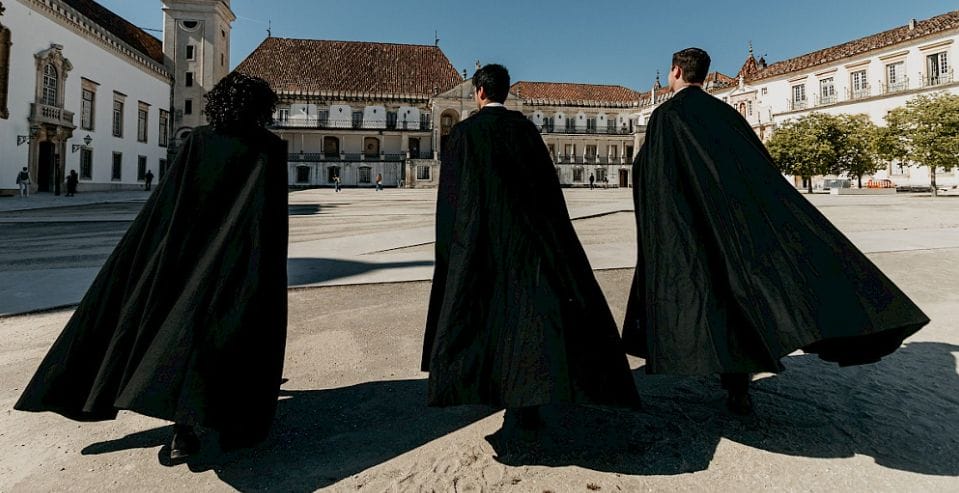
The academic tradition here is lived rather than displayed. Academic dress remains a visible part of the city’s ceremonies and student traditions, alongside the self-governed student houses known as repúblicas, some with long and distinctive histories, and the Queima das Fitas each May, which opens at midnight on the steps of the Sé Velha with a serenade heard in silence. At the Penedo da Saudade, stone plaques carry poems left by generations of students.
Coimbra’s Table
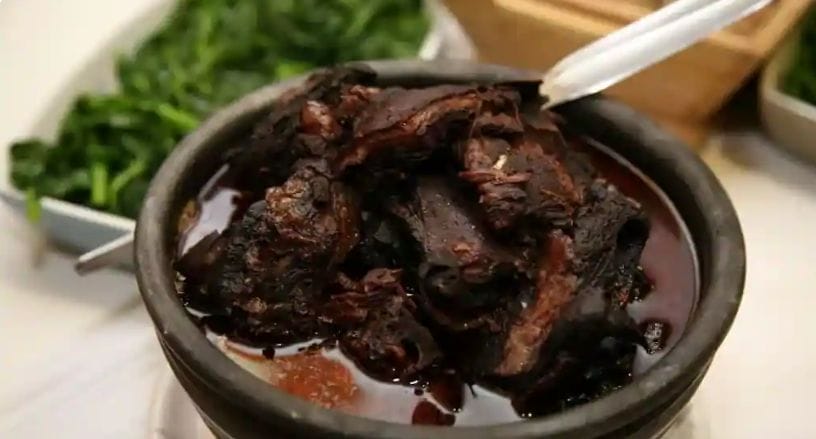
The regional table is robust and deeply traditional: chanfana, goat slow-cooked in red wine in a clay pot, leitão from the nearby Bairrada region, and the convent sweets that follow, arrufadas and pastéis de Santa Clara among them. Bairrada also supplies the wine. Our team considers dietary preferences when recommending restaurants and arranging reservations as part of the confirmed itinerary.
Coimbra with Magical Private Travel
Magical Private Travel designs private tours in Coimbra as part of tailor-made journeys through Portugal. We coordinate reservations and arrange expert private guides and transportation according to each day’s program, with every service detailed in the confirmed itinerary. Opening arrangements, operating conditions, and any required advance access are confirmed as part of the itinerary.
Coimbra rewards being taken in the right order. The city runs vertically, from the river to the university, and a day built downhill from the top reads as a sequence rather than a list. That ordering is the practical difference private planning makes here, along with a guide who can connect the Roman galleries to the medieval tombs to the Baroque library above them.
Our guides are selected as much for how they read a room as for what they know, which matters in a city where one traveler wants the full academic and architectural history and another wants the library, the view, and an unhurried lunch. Pacing, mobility, and interests all shape the plan before the trip begins, and our team remains available throughout the journey.
Destination expertise by Magical Private Travel, established in 2002.
How Coimbra Fits into a Portugal Journey
On the Route Between Porto and Lisbon
Coimbra lies directly on the main route between Porto and Lisbon, which makes it a natural stop rather than a detour, and a strong overnight for travelers who prefer not to cover that distance in one push.
Aveiro and the Coast
Aveiro lies north toward the coast, and the two pair well for travelers moving south through the country, the lagoon and the canals set against the university and the river.
The Serra and the Interior
East of the city the country rises toward the Serra da Estrela, Portugal’s highest range on the mainland, and the fortified villages of the interior. For travelers with time, Coimbra is the natural point to turn inland rather than continue down the coast.
How Long Do You Need in Coimbra?
One full day covers the university, the Joanina, the Sé Velha, and the Baixa, taken downhill from the top. Two days add the cryptoporticus and the Machado de Castro collection at a more deliberate pace, the botanical garden on the university side, Santa Clara-a-Velha and the gardens across the Mondego, and an evening performance of Coimbra fado when available. Travelers moving between Porto and Lisbon often give Coimbra a single day and continue, while those staying a night find the city changes character once the day visitors have gone.
When Is the Best Time to Visit Coimbra?
Spring and early autumn are the most comfortable seasons for a city that is walked uphill and down, with mild temperatures and the botanical garden and the riverbank at their best.
May belongs to the students. The Queima das Fitas is an eight-day academic celebration whose defining moments include the Monumental Serenade at midnight on the steps of the Sé Velha and the student parade through the city. Exact dates follow the academic calendar each year.
Summer is warm, and university life becomes quieter once term ends, while winter is cool and green and particularly well suited to the interiors, from the library and the ceremonial halls to the Roman galleries below the museum. Seasonal timing is considered as part of every itinerary.

Frequently Asked Questions About Coimbra, Portugal
Is Coimbra worth visiting between Porto and Lisbon?
Yes. Coimbra lies directly on the main route between the two cities and holds a UNESCO-listed university, the tombs of Portugal’s first two kings, and a Roman substructure two thousand years old, which makes it a stop with substance rather than a break in the drive.
What is the Joanina Library?
The Baroque library of the University of Coimbra, built between 1717 and 1728 under King João V. Three richly decorated halls hold nearly sixty thousand volumes on gilded and polychrome oak shelving, and a resident bat colony helps control the insects that would damage them.
Why was Coimbra the capital of Portugal?
Because Afonso Henriques established his court in Coimbra in 1131, making it the political center of the emerging Portuguese state. After Portugal’s independence was recognized in 1143, Coimbra served as the capital of the kingdom until 1255. Afonso Henriques and Sancho I, the first two kings, are buried at the Monastery of Santa Cruz.
What is fado de Coimbra?
A distinct tradition from the fado of Lisbon, developed alongside the university and its student serenades, traditionally performed by male students in academic dress and accompanied by the Coimbra guitar. During the Monumental Serenades, listeners remain silent rather than applaud.
Is Coimbra suitable for travelers with mobility considerations?
The city is built on a steep hill, and the classic route runs between the university at the top and the Baixa below. Private transportation can reduce the steepest climbs by bringing travelers close to the university level, though cobbled surfaces, slopes, and steps remain at some historic sites. Walking distances, transportation, routing, and site selection can all be adapted from the first planning conversation.
Plan Your Coimbra Journey
A Roman forum under a museum, Portugal’s first two kings at Santa Cruz, a Baroque library guarded by bats, and a university based in the former royal palace since 1544. Tell us how you want to experience Coimbra, and we will shape it around your time, interests, and wider journey.
Contact Us Today