


Multi-Country · 14 days · Private and tailor-made
Jewish Spain and Portugal, Girona to Porto
Walk the stepped lanes of Girona's medieval Jewish quarter, the Call, with a private guide.
Suggested length
14 days
Price guide
From $15,446 per person, excl. international flights, based on two sharing. Family rates for 2+ children under 21.
Includes hotels, private guiding, experiences and transfers
When
April to June and September to October
or call +1 (727) 699-5439
A planner replies within one business day
American precision with local expertise · Planned from Europe since 2002 · 17,000+ American travelers · Never cancelled a journey
Fourteen days following the road many Sephardic families took in 1492, from Barcelona and Girona to Lisbon and Porto, at your pace.
- Walk the stepped lanes of the Call, Girona’s medieval Jewish quarter
- Stand under the carved ceiling of Toledo’s Sinagoga del Tránsito, home of the Sephardic Museum
- Step into Córdoba’s small synagogue of 1315, its stucco carved with Psalms
- Walk the Alfama and the Largo de São Domingos with Luisa in Lisbon
- Visit Porto’s Kadoorie synagogue, the largest in the Iberian Peninsula
- Taste salmorejo, Córdoba’s cold cream of tomato and bread, near the old Jewish quarter

“Hi from Europe. After planning luxury travel from Iberia since 2002, we have key relationships across our destinations and the judgment to tailor trips wisely for our discerning clients. Get our experience, relationships and insider savvy on your side. See our reviews and request a custom itinerary.”
Dan O’Beirne, American Founder · Iberia-Based Travel Specialist · Travel Leaders Network member. As featured in USA Today, & Euro Business News · Game of Thrones location consultant.






A Journey Designed Just for You
Our resident experts wrote this itinerary as a starting point, and your planner shapes every day around your interests, pace and travel style.
What do our American travelers say?
The 14-day Spain and Portugal Jewish heritage itinerary at a glance
The route uses five bases and thirteen nights: three in Barcelona, two in Madrid, three in Seville, three in Lisbon and two in Porto. Eight nights fall in Spain and five in Portugal. Girona and Besalú, Toledo, Córdoba and Sintra run as day trips from a base, so you unpack four times after the first night.
Three high-speed rail journeys carry the long legs inside Spain. The train runs from Barcelona to Madrid in about 2 hours 30 minutes, from Madrid to Seville in about 2 hours 30 minutes, and from Seville to Córdoba and back in about 45 minutes each way. A licensed driver handles the road days, about 1 hour 30 minutes from Barcelona to Girona and about 50 minutes from Madrid to Toledo. Two days run long by road. Day nine crosses into Portugal, about 3 hours from Seville to Évora and about 1 hour 35 minutes on to Lisbon. Day twelve runs north from Lisbon to Porto through Óbidos, Tomar and Coimbra, about four hours of driving in four legs. In Portugal a licensed driver-guide drives both days.
You stay in deluxe four-star properties selected for comfort, location and service. Five-star luxury properties are available by request. Each hotel sits within walking distance of the old quarter you visit, so most touring days start at the front door.
Spring and autumn suit a route which runs from the Mediterranean to the Atlantic. AEMET, Spain’s weather agency, records average daily highs in Seville of about 23°C (74°F) in April and 26°C (79°F) in October, against 36°C (97°F) in July. IPMA, Portugal’s weather institute, records about 20°C (68°F) in April and 23°C (73°F) in October in Lisbon.
Licensed guides we work with on this route include Irma and Mariona in Barcelona, Ana and Alicia in Madrid, Melanie in Toledo, Andrés and Rosario in Seville, David and Paco in Córdoba, Luisa and Anabela in Lisbon, and Susana and Tania in Porto. Each is a highly educated local expert who cares about the people in their group. We request your guides by name, and your planner confirms who leads each day once your dates are set.
Why the route runs from Barcelona to Porto
The journey reads the Sephardic story in the order it happened, from east to west. Catalonia comes first, where Girona’s Jewish community lived in the Call from the late 9th century until 1492. Castile follows, with Toledo’s two medieval synagogues and the Plaza Mayor in Madrid, where the Inquisition held an auto de fe in 1680. Andalusia closes the Spanish half, with Seville, seat of the first tribunal of the Inquisition in 1481, and Córdoba, the city of Maimonides.
Then the road turns west, the direction many families took when Isabella and Ferdinand expelled the Jews of their kingdoms in 1492. The Jews of Castile went mainly to Portugal. Within five years Manuel I forced the whole community to convert, and the Portuguese chapters of the story begin. Évora held one of the largest Jewish quarters in Portugal. Lisbon keeps the memorial to the massacre of 1506 and Shaaré Tikvah, the first synagogue built in Portugal since the late 15th century. Tomar keeps its 15th-century synagogue, and Coimbra kept a tribunal of the Inquisition until 1821. Porto ends the journey with the synagogue Captain Artur Barros Basto and his community opened in 1938, so the route closes with a living congregation, not a ruin. Our multi-country journeys page collects every route which combines Spain and Portugal.
For more on each country this route crosses, our Spain destination guide and Portugal destination guide cover the cities on the way and the regions around them.
Journey at a glance
Length
14 days
From
$15,446 per person, double occupancy
Family rates for 2+ children under 21
Route
Barcelona, Girona, Besalú, Madrid, Toledo, Seville, Córdoba, Évora, Lisbon, Sintra, Coimbra, Porto
Your planner adjusts every day to your dates.
Day One
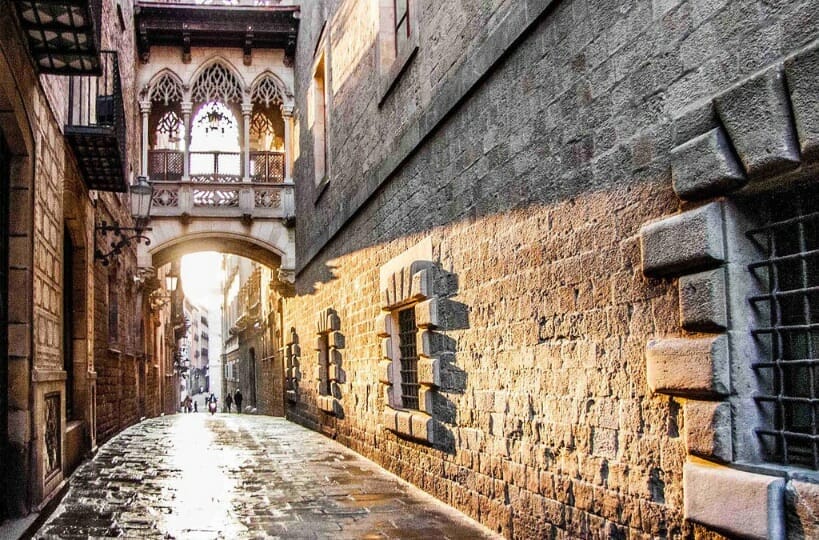
Arrive in Barcelona: The Gothic Quarter and the Call
Your licensed driver meets you at Barcelona airport. In the late afternoon, your licensed guide walks you through the Gothic Quarter into the Call, the medieval Jewish quarter behind the cathedral, a word which first meant a narrow alley. Where opening days allow, step into MUHBA El Call, in the house of a medieval veil weaver. Your guide explains how the attacks of 1391 broke up the community. Opt for tapas, starting with bread rubbed with tomato and olive oil.
Day Two
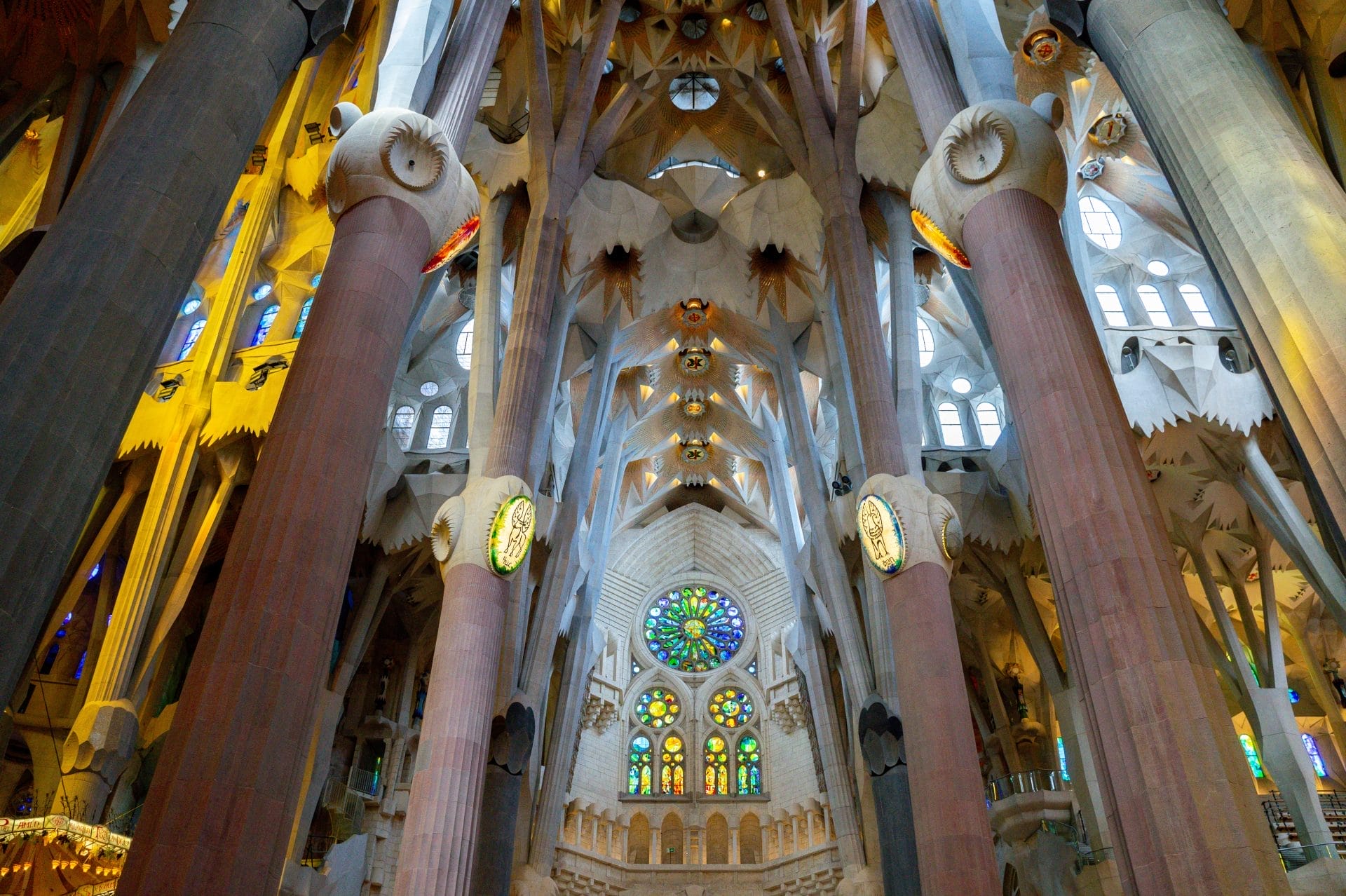
Gaudí's Barcelona: The Sagrada Família and Park Güell
Your licensed guide spends the day with Gaudí. At the Sagrada Família, where he lies in the crypt, colored light falls through the stained glass onto the nave in the afternoon. Then head up to Park Güell, where Jujol's serpentine bench curves along the main terrace in bright ceramic mosaic and the tiled salamander locals call El Drac guards the stairway.
Day Three
Girona and Besalú: Two Medieval Jewish Quarters
Head north to Girona, where a Jewish community lived in the Call from the late 9th century until 1492. Your licensed guide climbs the stepped lanes to the Bonastruc ça Porta centre, named for Nahmanides, the rabbi born here in 1194, and the Museum of Jewish History, with gravestones from the medieval cemetery. Opt for lunch above the painted houses on the Onyar river. In Besalú, 36 steps lead down to a vaulted mikveh rediscovered in 1964.

Day Four
Madrid by High-Speed Train: The Plaza Mayor or the Prado
Take the high-speed train to Madrid. Your licensed guide walks you from the Royal Palace to the Plaza Mayor, where in 1680 the Inquisition held an auto de fe and more than half the accused were conversos charged with keeping Jewish practice in secret. If art comes first for you, Ana, an art historian, takes the afternoon instead at the Prado, where your dates allow, and shows you Rizi's painting of that ceremony beside Las Meninas.

Day Five
Toledo: Two Synagogues, a Mosque and Marzipan
Your licensed guide leads a day among the monuments of three faiths in Toledo. Samuel ha-Leví built the Sinagoga del Tránsito around 1357, with Hebrew and Arabic inscriptions in its stucco under a carved ceiling, and today it houses Spain's national museum of Sephardic culture. Santa María la Blanca keeps five aisles of white horseshoe arches, and the small mosque of Cristo de la Luz dates from about 999. Before you leave, taste Toledo's almond marzipan.

Day Six
Seville: Santa Cruz, the Cathedral and the Alcázar
Take the high-speed train south to Seville. Your licensed guide begins in Santa Cruz, where Ferdinand III gathered the city's Jewish community in 1248, and where the church of Santa María la Blanca stands on the site of a former synagogue. Then visit the cathedral, which holds the remains of Christopher Columbus, and the Alcázar, where Arabic inscriptions call King Pedro I sultan. Opt for a horse-drawn carriage back through the streets at dusk.

Day Seven
Seville: Triana, the River and the Plaza de España
Cross the river to Triana, where the foundations of the Inquisition's castle headquarters lie beneath the market, and fishmongers and fruit sellers call out across the hall upstairs. Back on the east bank, pass the Torre del Oro and walk through María Luisa Park to the tiled Plaza de España. Where your dates allow, the evening brings flamenco, with guitar, song and the sharp beat of heels on the boards.
Day Eight
Córdoba: The Synagogue, Maimonides and the Mosque-Cathedral
Take a morning train to Córdoba, where your licensed guide leads you along Calle Judíos to the synagogue of 1315, its small prayer hall carved with verses from the Psalms. Nearby, a statue of Maimonides, born in Córdoba in 1138, sits in the Plaza de Tiberíades. Lunch brings salmorejo, a cold cream of tomato and bread. In the afternoon, walk the Mosque-Cathedral, its forest of red and white arches running back into the half-light.

Day Nine
Into Portugal: Évora and the Alentejo
A long road day crosses into Portugal, with Évora to break it. Your licensed driver-guide starts at the Roman temple, then walks you into the old judiaria near the Praça do Giraldo. Until the 15th century, Évora kept one of the largest Jewish communities in Portugal, with two synagogues, a hospital and baths. Lunch brings açorda alentejana, a bread soup of garlic, coriander and olive oil with a poached egg. Reach Lisbon by evening.
Day Ten
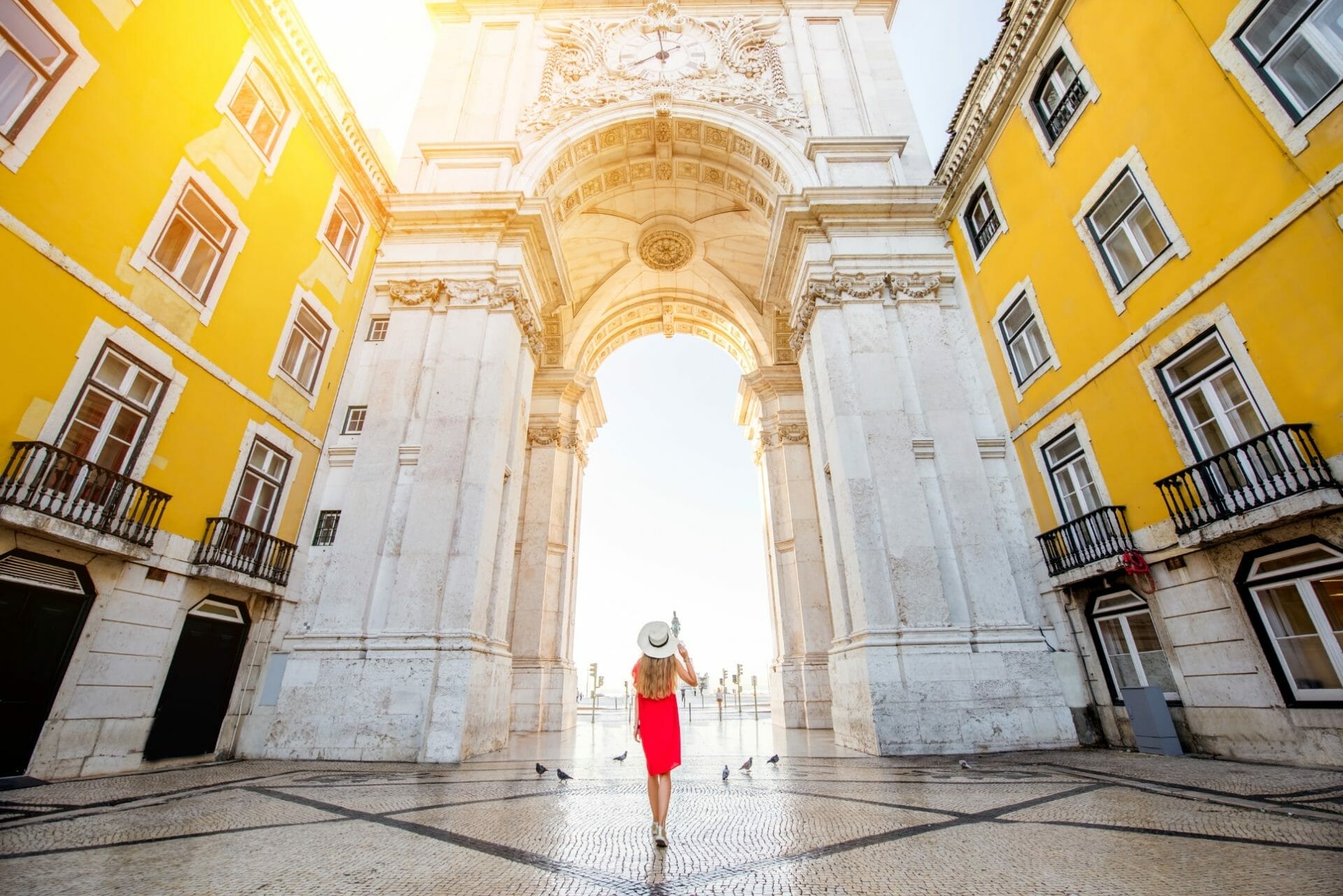
Lisbon: Shaaré Tikvah, the Alfama and Belém
Where your dates allow, Luisa, one of our licensed guides in Lisbon and Sintra, leads the day. Start at Shaaré Tikvah, the Doors of Hope, built in 1904 behind a courtyard because the law forbade non-Catholic temples from facing the street. In the Alfama, trace the medieval Jewish quarter along the Rua da Judiaria to the memorial of 1506 in the Largo de São Domingos. In Belém, Luisa links Vasco da Gama's voyage to Abraham Zacuto's astronomical tables.

Day Eleven
Sintra, Azenhas do Mar and Cabo da Roca
Where your dates allow, Luisa leads the day in Sintra, the first centre of European Romantic architecture, from the red and yellow Pena Palace above the forest to the old town bakeries and their queijadas, small sweets of fresh cheese and eggs. Then follow the coast to Azenhas do Mar, a village of white houses on a cliff, and Cabo da Roca, the westernmost point of continental Europe. Opt for Cascais and an evening of fado.
Day Twelve
Lisbon to Porto: Óbidos, Tomar and Coimbra
The longest road day heads north in four legs. In walled Óbidos, the Jewish quarter stood near the Rua Direita, and ginjinha, a sour cherry liqueur, comes in a small chocolate cup. In Tomar, a synagogue from the mid-15th century still stands, its vaults carried on four columns and eight clay jars set high to carry the sound of the chant. In Coimbra, the old Jewish quarter climbed the steep Rua do Corpo de Deus. Reach Porto by evening.

Day Thirteen
Porto: The Kadoorie Synagogue and the Old Jewish Quarters
Your licensed driver-guide starts at the Kadoorie Mekor Haim synagogue, founded by Captain Barros Basto and inaugurated in 1938 in Art Deco style, the largest synagogue in the Iberian Peninsula, with the Jewish Museum of Porto open since 2015. Then walk the Rua de Sant'Ana, the oldest Jewish quarter, up to the Olival quarter, past the Sé and the Livraria Lello. Opt for a port tasting in Vila Nova de Gaia or a food tour.

Day Fourteen
Departure from Porto
The morning stays free for a last walk along the Ribeira, with the iron arch of the Dom Luís I Bridge above you and the port lodges across the water. Your licensed driver-guide collects you at a time set around your flight, and our team stays in touch until you board.
Getting around
- Day 1: Barcelona airport to your hotel with a licensed driver, then a light walk with your licensed guide.
- Day 2: A full guided day in Barcelona, with Sagrada Família entry booked in advance.
- Day 3: Barcelona to Girona, about 1 hour 30 minutes, then about 40 minutes to Besalú, back to Barcelona in the evening.
- Day 4: Barcelona to Madrid by high-speed train, about 2 hours 30 minutes, met by a licensed driver.
- Day 5: Madrid to Toledo by road, about 50 minutes each way.
- Day 6: Madrid to Seville by high-speed train, about 2 hours 30 minutes, met at Santa Justa by a licensed driver.
- Day 7: A full day in Seville on foot, with your licensed driver for the crossing to Triana.
- Day 8: Seville to Córdoba by high-speed train, about 45 minutes each way.
- Day 9: Seville to Évora by road, about 3 hours, then Évora to Lisbon, about 1 hour 35 minutes.
- Day 10: A full day in Lisbon with Luisa and your licensed driver.
- Day 11: Lisbon to Sintra and the coast by road, back to Lisbon in the evening.
- Day 12: Lisbon to Óbidos, about 1 hour, Óbidos to Tomar, about 1 hour, Tomar to Coimbra, about 50 minutes, and Coimbra to Porto, about 1 hour 15 minutes.
- Day 13: A full day in Porto on foot and by car.
- Day 14: Hotel to Porto airport with your licensed driver-guide.
- In Spain, a licensed guide leads each visit and a licensed driver handles every transfer. In Portugal, a licensed driver-guide travels with you, with Luisa in Lisbon and Sintra.
Where did Spain’s Jewish families go after 1492?
Many went to Portugal, and the Jews of Castile went there above all, which is why this route continues west after Córdoba. Their refuge lasted only a few years. In December 1496 Manuel I ordered every Jew in Portugal to accept baptism or leave, and in 1497 he turned the order into a forced conversion of the whole community, Portuguese families and refugees from Spain alike. The converts became New Christians. A mob killed some 2,000 of them in Lisbon in April 1506, and John III established the Portuguese Inquisition in 1536, with tribunals in Lisbon, Évora, Coimbra and Porto, until its abolition in 1821. The route shows each chapter in place, from Évora’s judiaria to the Largo de São Domingos in Lisbon and the Inquisition courtyard in Coimbra, and it ends with the revival of the 20th century in Lisbon and Porto.
How many days do you need for a Jewish heritage tour of Spain and Portugal?
Fourteen days covers the principal Sephardic sites of both countries at a steady pace, with time in Catalonia, Castile, Andalusia, the Alentejo, Lisbon, central Portugal and Porto. Ten days suits one country well, and our Spain and Portugal journeys of ten days each exist for this reason. Below fourteen days, a route through both countries starts to lose either Girona or Tomar, the two places where the medieval story survives most clearly in stone. Sixteen to eighteen days leave room for Granada, Belmonte or the Douro Valley.
Which medieval and modern synagogues still stand in Portugal?
Portugal keeps two medieval synagogue buildings, in Tomar and in Castelo de Vide, and two working synagogues of the 20th century, in Lisbon and Porto. Tomar’s dates from the mid-15th century and houses the Abraão Zacuto Luso-Hebraic Museum. Castelo de Vide’s, from the late 14th century, has held a small museum of the town’s Jewish community since 2019. Shaaré Tikvah in Lisbon opened in 1904, and the Kadoorie Mekor Haim synagogue in Porto in 1938. This route visits Tomar, Lisbon and Porto, and visits to the two working synagogues follow the communities’ own visiting hours. Castelo de Vide sits on our 10-day Portugal journey.
This 14-day route, the 10-day Spain journey or the 10-day Portugal journey?
Choose this 14-day route if you want the whole arc in one trip, from the medieval quarters of Catalonia, Castile and Andalusia to the forced conversions in Portugal and the synagogues of Lisbon and Porto. It suits a first visit to both countries and travelers who want to see where the story went after 1492.
The 10-day Jewish heritage tour of Spain serves you better if Spain is the focus or your time is shorter. It runs from Seville to Barcelona by fast train, adds a night in Córdoba, gives the Prado a full day with Ana and visits Girona near the end, staying in Spain throughout. The 10-day Portugal journey with Jewish heritage suits travelers who already know Spain. It covers Lisbon, Sintra, Óbidos and Tomar, Évora, Marvão and Castelo de Vide, Belmonte, Porto and two days in the Douro Valley, with more of the Portuguese story than this route has room for.
If Jewish heritage forms one interest among several, the Barcelona to Lisbon private tour crosses both countries in 14 days with Granada, the Alhambra and the Algarve coast, and our team adds Toledo’s synagogues or a Jewish quarter walk on request. Our article on Jewish heritage tours of Portugal sets out more of the Portuguese sites.
Who this journey suits
Families and multigenerational groups tracing Sephardic roots, or marking a bar or bat mitzvah year with a journey of meaning, follow one story from city to city. Grandparents and grandchildren share the same guided days, and our team paces the walking and the rest to fit the oldest and youngest travelers.
Couples and friends with a strong interest in history, art and architecture appreciate the depth of the guiding and the balance of synagogues, museums, old quarters and food. Synagogue groups, Jewish community organizations and other affinity groups travel the route as a private party, with a licensed guide for the whole group.
First-time visitors see Barcelona, Madrid, Seville, Lisbon and Porto in two weeks, while returning visitors find a new reading of cities they already know. Your guide is glad to advise on suitability before booking, especially for the stepped lanes of Girona’s Call, the descent to the Besalú mikveh and the slopes of the Alfama.
The people behind the route
In Madrid, where your dates allow, Ana, an art historian, leads our Prado visits. On this route she takes the afternoon of day four if you choose art over the Plaza Mayor, and she builds it around Rizi’s Auto-da-fé in the Plaza Mayor of Madrid, set beside Velázquez and Goya. Our page on the highlights of the Prado gives a sense of her approach.
In Lisbon and Sintra, where your dates allow, Luisa, one of our licensed guides, leads days ten and eleven alongside a licensed driver, from Shaaré Tikvah and the Alfama to the Pena Palace. American travelers who add Granada meet Israel, one of our licensed guides in Granada, where your dates allow. He leads our Alhambra days, and the Alhambra belongs to this story: Isabella and Ferdinand issued the decree of expulsion there on 31 March 1492. In every other city a licensed guide who lives there leads your touring in Spain, and a licensed driver-guide looks after you in Portugal.
What the 14-day journey costs and what it includes
The 14-day route starts from $15,446 per person, double occupancy, for the route as written. The from-price covers thirteen nights in hotels in or beside the old quarters, licensed guides for the visits described, licensed drivers in Spain, Luisa and a licensed driver in Lisbon and Sintra where your dates allow, licensed driver-guides elsewhere in Portugal, timed entry to the Sagrada Família, and full planning and support from our team.
Four things move the price: the season, the hotel category and room type, the size of your private party, and the options you choose, such as the Prado afternoon with Ana, the flamenco evening in Seville, the fado night in Lisbon, the port tasting in Gaia, or extra nights for Granada or the Douro. Magical Private Travel maintains excellent ratings on Trustpilot and Google’s independent review platforms.
When you are ready to plan, speak with our team about your dates, your party and the parts of Sephardic Spain and Portugal you most want to see.
Frequently asked questions about the Spain and Portugal Jewish heritage tour
What happened to the Jews of Spain who crossed into Portugal in 1492?
Isabella and Ferdinand issued the Alhambra Decree on 31 March 1492 and gave the Jews of their kingdoms until 31 July to convert or leave. Many families from Castile crossed into Portugal, where King John II let them in for a tax of eight cruzados per person. The refuge lasted a few years. In December 1496 Manuel I, pressed by Spain’s monarchs, ordered every Jew to accept baptism or go, and in 1497 he forced the conversion of the whole community instead, refugees and Portuguese families alike. In 1499 he barred the New Christians from leaving. On 19 April 1506 a riot which began at the Church of São Domingos in Lisbon killed some 2,000 conversos, and in 1536 John III established the Portuguese Inquisition, which lasted until 1821. On days nine to thirteen your guides show you each chapter in place, in Évora, Lisbon, Tomar, Coimbra and Porto.
Which synagogues and Jewish sites does the 14-day tour visit?
In Spain the route visits three medieval synagogue buildings: the Sinagoga del Tránsito and Santa María la Blanca in Toledo, and the synagogue on Calle Judíos in Córdoba, dated 1315. It walks the former Jewish quarters of Barcelona, Girona, Besalú and Seville, with MUHBA El Call in Barcelona where opening days allow, the Museum of Jewish History in Girona, the mikveh in Besalú, the Museo Sefardí in Toledo and the Inquisition site beneath the Triana market in Seville. In Portugal you see the judiaria of Évora, the Alfama quarter and the 1506 memorial in Lisbon, Shaaré Tikvah of 1904, the 15th-century synagogue in Tomar, the old Jewish quarter of Coimbra, and in Porto the Kadoorie Mekor Haim synagogue of 1938 and the streets of the medieval Olival quarter. Visits to working synagogues follow the communities’ own hours, and our team checks them for your dates.
Who was Abraham Zacuto, and why does Tomar’s museum carry his name?
Abraham Zacuto was an astronomer, mathematician and rabbi born in Salamanca in 1452. After the decree of 1492 he took refuge in Lisbon, and Vasco da Gama’s expedition used his astronomical tables and a new nautical astrolabe on the voyage to India. When Manuel I forced the conversions, Zacuto fled again, first to Tunis. His life runs through two days of this route. On day ten Luisa shows you the Tower of Belém, built to commemorate da Gama’s voyage, where your dates allow. On day twelve you reach Tomar, where Samuel Schwarz, a Jewish engineer and scholar, bought the old synagogue in 1923, restored it and founded the Abraão Zacuto Luso-Hebraic Museum inside it. The collection holds tombstones and Hebrew inscriptions gathered from across Portugal, and the building became a National Monument in 1921.
How does the route cross from Spain into Portugal?
By road, on day nine. A licensed driver-guide collects you at your hotel in Seville and drives west into the Alentejo, about 3 hours to Évora. Portugal runs one hour behind Spain, so you gain an hour on the way. You spend the middle of the day in Évora with the same driver-guide, at the Roman temple, in the old judiaria and over a lunch of açorda alentejana, then continue to Lisbon, about 1 hour 35 minutes by road. The road crossing keeps luggage in one vehicle from hotel to hotel, with no airport between the two countries, and it follows the direction many families from Castile took in 1492. Our team sets the departure time from Seville around the season, so the afternoon in Évora never feels rushed.
How do we travel between the cities, and who guides us?
In Spain high-speed trains carry the long legs: Barcelona to Madrid and Madrid to Seville, about 2 hours 30 minutes each, and Seville to Córdoba, about 45 minutes. A licensed driver meets you at each station and drives the day trips to Girona and Besalú and to Toledo. A licensed guide leads each visit, and the guide and the driver are always two separate people. In Lisbon and Sintra, where your dates allow, Luisa, one of our licensed guides, leads the touring alongside a licensed driver. Elsewhere in Portugal, from Seville to Évora and Lisbon, from Lisbon to Porto and around Porto, a licensed driver-guide looks after you, one person holding both licenses. Our team coordinates every handover, so you meet each new guide at the hotel or the station.
When is the best time to take this tour?
April to June and September to October give the most comfortable walking weather in both countries. AEMET, Spain’s weather agency, records average daily highs in Seville of about 23°C (74°F) in April and 26°C (79°F) in October, against 36°C (97°F) in July. Madrid averages about 18°C (65°F) in April and Barcelona about 18°C (64°F) in April and 22°C (72°F) in October. IPMA, Portugal’s weather institute, records average highs in Lisbon of about 20°C (68°F) in April and 23°C (73°F) in October, and in Porto of about 18°C (64°F) in April and 20°C (69°F) in October. Summer trips work well with early starts in Seville and Córdoba and lunch indoors. Winter brings cooler days and quieter museums, a good fit for a journey built around synagogues and collections. Our team also checks opening days for your dates, since several sites keep limited weekly hours.
Does the route extend to Granada, Belmonte, Castelo de Vide or the Douro Valley?
Yes, and each addition lengthens the trip and changes the price. Granada adds two nights and the Alhambra, where Isabella and Ferdinand issued the decree of 1492. Where your dates allow, Israel, one of our licensed guides in Granada, leads the Alhambra day. Castelo de Vide, in the Alentejo near the Spanish border, keeps a late 14th-century synagogue with a small museum. Belmonte, in central Portugal, has a community descended from crypto-Jews, families who kept Jewish practice in secret for centuries after 1497. The Douro Valley adds terraced vineyards and port wine estates within reach of Porto. Our 10-day Portugal journey with Jewish heritage already includes all three Portuguese places, and our team builds any of them into this route on request.
Is this tour only for Jewish travelers?
No. The route suits anyone interested in the history of Spain and Portugal, and many travelers book it for the depth it brings to cities they planned to visit anyway. Barcelona, Madrid, Seville, Lisbon and Porto appear on most first trips to Iberia, and this journey shows them through a lens most visitors miss: the medieval Jewish communities who lived, worked and studied in these streets, and the converso families who stayed after 1497. Your licensed guides present the history plainly and in context, with the Christian and Muslim history of each city alongside. Gaudí, the Alcázar, the Pena Palace and the port cellars of Gaia keep the trip in balance, and travelers of every background leave with a fuller understanding of how both countries took shape.
Does the journey suit multigenerational families?
Yes. A private guide and driver set the pace around the youngest and the oldest in the party, and the story of the route gives grandparents and grandchildren something to talk about at every lunch. Teenagers tend to respond to Park Güell, the Plaza de España, the cliffs at Cabo da Roca and the staircase of the Livraria Lello. Several days involve walking on cobbles and slopes, especially in Girona’s Call, Toledo, the Alfama and Sintra, and the Besalú mikveh lies down 36 steps. Your guide is glad to advise on suitability before booking, and our team adjusts walking routes, adds vehicle time between sites or shortens days where it helps. Our page on accessible travel sets out how our team plans for travelers who need step-free routes or extra support.
Who do we contact if something goes wrong or we want a change?
Your planner designs your journey with you and stays in touch after you land. For the fastest response at any hour, message your private WhatsApp group, where our 24/7 support team works alongside Rachel or Dan. Because we begin no more than five journeys per country each week, peak spring and fall dates fill early, and that limit is what lets us stay this close to every trip.
We keep a list of vetted four- and five-star hotels, well located and enjoyed by our past travelers and by our own team.
Examples for each overnight stop on this route. Choose a deluxe boutique hotel or a five-star stay, and your travel advisor matches each night to your wishes, the season and availability.
Barcelona
Boutique: H10 Casa Mimosa. A listed 19th-century Modernista building on Pau Claris, on the same block as Gaudí’s La Pedrera.
Five-star: Mandarin Oriental Barcelona. A former bank on Passeig de Gràcia turned into a calm, pale-toned hotel with a rooftop pool.
Madrid
Boutique: Tótem Madrid. A restored 19th-century building on Calle Hermosilla, steps from Serrano’s shops in the Salamanca district.
Five-star: Rosewood Villa Magna. Reopened by Rosewood in 2021 on the Paseo de la Castellana, with a leafy front garden.
Seville
Boutique: Hotel Casa 1800 Sevilla. A 19th-century mansion with a patio and a rooftop pool facing the cathedral and Giralda.
Five-star: Hotel Alfonso XIII. Built for the 1929 Ibero-American Exposition, a neo-Mudéjar palace of tiles and arches near the Alcázar.
Lisbon
Boutique: Memmo Alfama. A design hotel on an Alfama lane, with a pool beside its wine-bar terrace over the Tagus.
Five-star: Four Seasons Hotel Ritz Lisbon. A 1959 landmark beside Eduardo VII Park, filled with mid-century Portuguese art and tapestries.
Porto
Boutique: Torel 1884. An 1884 palace near São Bento station, with rooms themed on Portugal’s voyages of discovery.
Five-star: The Yeatman. Terraced into the Gaia hillside among the port lodges, every room with a terrace facing Porto.
What's Included
A personalized itinerary, built around you and your schedule
Hand-picked luxury and boutique hotels
Insider experiences, inspiring sightseeing and magical upgrades
Private touring with your own personal expert guide
Private luxury transfers from airports and train stations
Full breakfasts, plus food and wine tasting options
Your choice of activities on “Design Your Days”®
Expert advice, restaurant ideas and reservations
24/7 support and concierge service from Spain, Portugal and Morocco
Magical is an award-winning luxury travel agency
Private journeys with soul & stories
Excellent independent reviews
Your private WhatsApp group with our 24/7 team and Rachel or Dan
Hidden gems, insider fun & vetted hotels
Your private guide, deluxe vehicle & flexible pace
24/7 concierge-style support
Life is short, vacation memorably
American Precision, Local Soul
Our Unforgettable Trips Are Tailored Just For You
Hi from Europe,
Along with our local partners across Portugal, Spain, Morocco and beyond we believe that our clients deserve the truly tailor-made private luxury trips, not generic "one-size-fits-all" plans.
Get inspired with our sample trips then get in touch about an expert-made personalized custom luxury itinerary, just for you.
Kind regards,
Dan O'Beirne & the MPT team
Start planning