


Morocco · Private and tailor-made
Southern Morocco, the Anti-Atlas to the Sahara
Watch the sun rise over the Erg Chebbi dunes from your desert camp.
Suggested length
12 days
Price guide
From $14,376 per person, excl. international flights, based on two sharing
Includes hotels, private guiding, experiences and transfers
When
March to April and late September to November
or call +1 (727) 699-5439
A planner replies within one business day
American precision with local expertise · Planned from Europe since 2002 · Nearly 17,000 American travelers · Never cancelled a journey
Before dawn the dunes of Erg Chebbi lie grey and still, and then you watch the sun rise over them from your desert camp. This 12-day private tour of Morocco sweeps through the south of the country in one loop by road from Marrakech. It begins on the Atlantic at Essaouira, then reaches the earthen ramparts of Taroudant, the pink granite of Tafraout and the silver souk of Tiznit before following the palm groves of the Draa toward the Sahara. The Todra Gorge and the Ksar of Aït Benhaddou come after the sand, and the High Atlas leads back down to Marrakech. A private driver and your own guides stay close all the way. Your planner tailors each day to your pace.
Walk the souks inside the earthen ramparts of Taroudant.
Watch the sun rise over the Erg Chebbi dunes from a desert camp, near Merzouga.
Walk the floor of the Todra Gorge between walls up to 400 meters high, near Tinghir.
Climb through the earthen lanes of the Ksar of Aït Benhaddou, outside Ouarzazate.
Meet the storytellers and musicians of Jemaa el-Fna at dusk, Marrakech.
Taste grilled fish at the harbor after a walk on the sea bastion, Essaouira.

“We love to tailor-make trips you’ll talk about for years, built on our local relationships & story-worthy experiences.” – Magical’s American founder, in Europe since 1998, culinary enthusiast & world traveler.







A Journey Designed Just for You
Our resident experts wrote this itinerary as a starting point, and your planner shapes every day around your interests, pace and travel style.
What do our American travelers say?
“Our trip was very smooth, organized from start to finish, excellent guides, comfortable transfers, luxury hotels in good locations, well chosen experiences, and all the details handled.”
“We also really appreciated the suggestion and planning of a winery visit. We did not even know that was an option in Morocco, and it turned out to be a wonderful treat and one of the special surprises of the trip.”
The 12-day Morocco itinerary at a glance
The route uses six bases and eleven nights, opening and closing in Marrakech: two nights there on arrival, one in Essaouira, two on the coast at Taghazout Bay north of Agadir, one in Zagora, one at the edge of the Sahara near Merzouga, two in Ouarzazate and two more in Marrakech. The coast days move at an easy pace, the long drives fall on days six, seven and eight as the road crosses the south, and the trip closes with two slower days in Marrakech.
A private driver links every base by road, and you fly in and out of Marrakech Menara with no domestic flight. Marrakech to Essaouira runs about 2 hours 30 minutes, and Essaouira down the coast to Taghazout Bay about 2 hours 45 minutes. From the coast the road runs east by Taroudant to Zagora in about 6 hours 45 minutes, about 5 hours on to Merzouga and about 5 hours 45 minutes on the direct road to Ouarzazate. The last road day crosses the High Atlas to Marrakech in about 3 hours 30 minutes. Each time leaves out stops, and the road days carry plenty of them.
Spring and autumn suit the route best. Early spring brings the almond trees around Tafraout into blossom, and the desert and the mountains both sit comfortably in the shoulder months. Summer and winter departures both work with a different daily rhythm, and our team plans the hours of each road day around the season you choose.
Licensed guides we work with on this route include Amine and Omar, who guide travelers across Morocco. Each is a highly educated local expert who cares about the people in their group. We request your guides by name, and your planner confirms who leads each day once your dates are set.
Why the route runs as a loop from Marrakech
Most first trips to Morocco run from Casablanca to Fez, across to the Sahara and back to Marrakech. This route leaves Fez and the north for another journey and spends the time on the south instead: the Atlantic coast at Essaouira, the Souss plain and the Anti-Atlas around Agadir, the oases of the Draa Valley, the dunes of Erg Chebbi, the road of the kasbahs through the Todra and Dades valleys, and the High Atlas. It suits travelers who come for open country, earthen villages and the desert more than for medieval cities.
Marrakech has its own international airport, so the whole journey runs as one loop by road, with no domestic flight and no doubling back. The coast comes first, while the days are easy, and the desert sits in the middle. The road west along the Dades and Todra valleys and over the High Atlas brings you back to Marrakech for two final nights before the flight home.
Journey at a glance
Length
12 days
From
$14,376 per person, double occupancy
Route
Marrakech, Essaouira, Agadir, Tafraout, Taroudant, Sahara Desert, Ouarzazate, High Atlas
Your planner adjusts every day to your dates.
Day One
Arrival in Marrakech: Jemaa el-Fna at Dusk
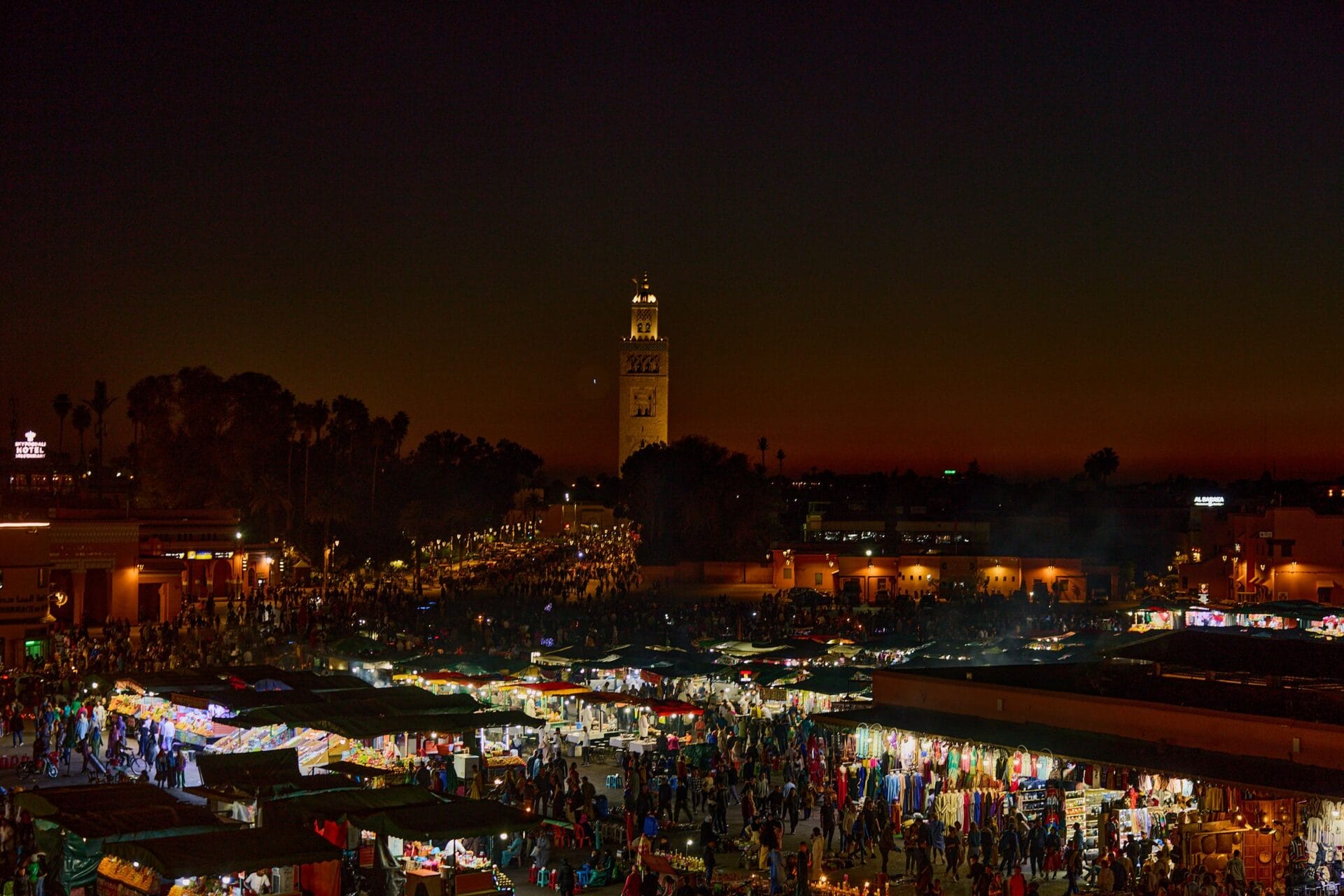
Your private driver meets you at Marrakech Menara airport, a short drive from the medina, and brings you to your hotel. The Almoravids founded Marrakech in 1070 to 1072, and UNESCO inscribed its medina in 1985. In the early evening your licensed guide meets you in the lobby and leads you into Jemaa el-Fna, which UNESCO proclaimed a masterpiece of oral and intangible heritage in 2001 for its storytellers, poets, Berber musicians and Gnaoua dancers. As darkness falls, smoke rises from the grills of the food stalls, and dinner follows at a restaurant in the medina. Logistics: Marrakech Menara airport to your hotel by road, a short drive, private driver, then an evening on foot with your licensed guide.

Day Two
Marrakech: The Koutoubia, the Ben Youssef Madrasa and the Souks
Your licensed guide starts at the Koutoubia, which takes its name from the booksellers who once traded at its feet. The Almohad caliph Abd al-Mu'min rebuilt the mosque around 1158, and its minaret rises 77 meters over the city. Builders completed the Ben Youssef Madrasa in 1564 and 1565 for the Saadian sultan Abdallah al-Ghalib, and it gathers 130 student rooms around a courtyard with a long, shallow pool. In the souks, cumin and paprika sit in cones beside lanterns and leather, and the guide leads you through the lanes to Rahba Kedima, the old spice square. The afternoon stays free at your hotel. Logistics: a walking day in the medina with your licensed guide, and your private driver for transfers.

Day Three
Essaouira on the Atlantic
Your private driver takes you west across the plains to the Atlantic. Sultan Sidi Mohammed ben Abdallah founded Essaouira in the mid-18th century as a royal port, and a French architect laid out its walls in the manner of Vauban. UNESCO inscribed the medina in 2001. Your licensed guide walks you from the Clock Tower and Place Moulay Hassan to the Skala, the sea bastion, where gulls wheel over the fishing port and the boats land sardines and conger eel. The mellah, the old Jewish quarter, holds synagogues such as Slat Lkahal and Chaim Pinto, and Bayt Dakira, a Jewish heritage house. Workshops in the medina carve thuya wood from the roots of the Tetraclinis tree, and lunch brings grilled fish at the port. Logistics: Marrakech to Essaouira by road, about 2 hours 30 minutes, private driver, with a licensed guide in Essaouira.
Day Four
Down the Atlantic Coast to Agadir
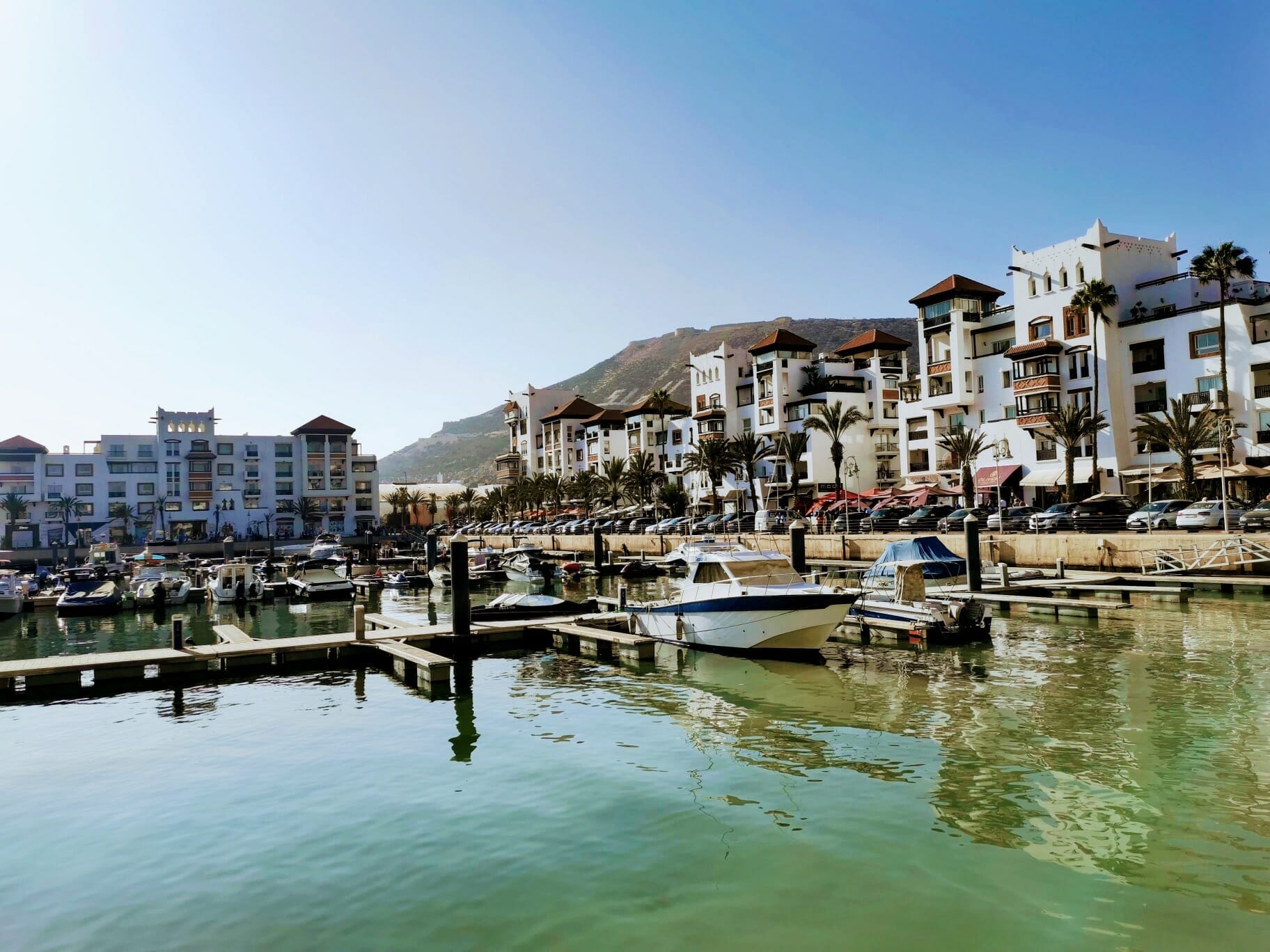
The coastal road runs south from Essaouira past argan groves and the surf beaches of the Atlantic to Taghazout Bay, north of Agadir. Rural women of the region extract argan oil by traditional methods, which UNESCO added to its intangible heritage list in 2014, and where available your guide stops at a women's cooperative on the way. The afternoon stays free for the beach or the pool. At sunset you drive up to Agadir Oufella, the hill 236 meters above the sea where the Saadian sultan Abdallah al-Ghalib built a fortress in the 16th century, and the view runs across the bay. Logistics: Essaouira to Taghazout Bay by road, about 2 hours 45 minutes, private driver and licensed guide.
Day Five
Tafraout and Tiznit in the Anti-Atlas
The road climbs into the Anti-Atlas to Tafraout, a town at the foot of Jebel Lekest, a pink granite mountain which erosion formed. The Ameln Valley north of the town holds 26 villages, and in early spring the almond trees of the area come into blossom. Near the village of Agard Oudad, below the rock locals call Napoleon's Hat, the Belgian artist Jean Vérame and a team of Moroccan firemen painted the granite boulders blue in 1984. In the afternoon the road drops toward the coast to Tiznit, which Sultan Hassan I founded in the early 1880s as a military base, inside about 6 kilometers of walls. Artisan workshops in Tiznit turn out jewelry and engraved silver, and your licensed guide walks you through the souk where the silversmiths sell their work. Day five carries about 6 hours of driving in all, with the mountain stretch in the morning. Logistics: a loop by road from the coast, about 2 hours 45 minutes to Tafraout, about 1 hour 50 minutes on to Tiznit and about 1 hour 30 minutes back, private driver and licensed guide.

Day Six
Taroudant and the Road to the Draa Valley
Day six is the longest road day of the trip, about 6 hours 45 minutes of driving, broken by a morning in Taroudant. Earthen ramparts with nine gates still in use wrap the old town, and the family who founded the Saadian dynasty settled near Taroudant in the 15th century. Your licensed guide walks you through the souks around the squares of Assarag and Talmoklate, where stalls sell argan oil from the trees of the surrounding plain. The road then runs east to Taliouine, a town famous for its saffron, where sellers along the road offer the dried red threads. Beyond the Anti-Atlas the route meets the Draa, Morocco's longest river at about 1,100 kilometers, at Agdz in the Mezguita oasis, and follows the valley south past palm groves and ksour, the earthen fortified villages of the south. Zagora, in the Ternata oasis, closes the day. A mural at the edge of town carries the old sign Tombouctou 52 jours, the camel days to Timbuktu. Logistics: the coast to Taroudant by road, about 1 hour 15 minutes, then Taroudant to Zagora, about 5 hours 30 minutes, private driver and licensed guide.

Day Seven
Zagora to the Erg Chebbi Dunes
The road leaves the Draa and runs northeast through the oasis town of Alnif toward the Tafilalt. Around Erfoud, workshops cut and polish the dark local limestone, full of the straight shells of Siluro-Devonian nautiloids, into slabs and tabletops. Erg Chebbi rises up to 150 meters above the surrounding desert and runs about 28 kilometers from north to south, with Merzouga on its western side. You spend the night either in a hotel in Erfoud, about 60 kilometers to the north, or in a desert camp among the dunes, with real beds, a private bathroom and dinner under canvas. Once the lamps go out, the stars fill the sky over the sand. Logistics: Zagora to Merzouga by road, about 5 hours plus stops, private driver and licensed guide.

Day Eight
The Todra Gorge, the Dades Valley and Skoura
Day eight starts at sunrise over the dunes and runs west on the road of the kasbahs. Near Tinghir the Todra Gorge closes to a stony track as little as 10 meters wide, between walls up to 400 meters high, and the river runs over the stones beside the path. Further west the road follows the Dades Valley to Kelaat M'Gouna, the valley of roses, where a local distillery turns the flowers into rose water and oils. In the oasis of Skoura, palm groves surround Kasbah Amridil, a ksar since the 17th century, where builders added a tall kasbah at the end of the 19th. Ouarzazate, at 1,151 meters, closes the day. Logistics: Merzouga to Ouarzazate by road, about 5 hours 45 minutes on the direct road and longer with the Todra Gorge and the stops, private driver and licensed guide.
Day Nine
Ouarzazate and the Ksar of Aït Benhaddou
UNESCO inscribed the Ksar of Aït Benhaddou in 1987, a village of earthen houses packed inside high walls with corner towers, on a hillside above the Ounila River. The ksar stands on the old caravan route between the Sahara and Marrakech, and its oldest buildings date from no earlier than the 17th century. Your licensed guide walks you up through the lanes, past clay-brick motifs on the upper walls of the tallest houses, to the view over the valley. Directors have filmed Lawrence of Arabia, Gladiator and many other productions here, and Ouarzazate has run its own film studio, Atlas Studios, since 1983. Back in town, the Glaoui family took over and expanded the Taourirt Kasbah in the 19th century, and some of its rooms keep painted decoration and ceilings of reeds. Logistics: Ouarzazate to Aït Benhaddou by road, about 40 minutes each way, private driver and licensed guide.

Day Ten
Over the High Atlas by the Tizi n'Tichka
The French military built the road over the Tizi n'Tichka in 1936 along an old caravan trail, and today National Route 9 crosses the High Atlas there at about 2,200 meters. Your private driver takes the climb at an easy pace, with stops at viewpoints over terraced valleys and earthen villages, and the air cools as the road gains height. On the north side the road winds down to the plain, and Marrakech comes into view in the afternoon. The evening stays free to settle into your hotel, perhaps with a mint tea on a terrace as the city lights come on. Logistics: Ouarzazate to Marrakech by road, about 3 hours 30 minutes plus stops, private driver.
Day Eleven
Majorelle, the Bahia Palace and the Saadian Tombs
Jacques Majorelle began his garden in 1923 and worked on it for almost forty years, painting its walls the cobalt shade named after him. Yves Saint Laurent and Pierre Bergé bought the property in the 1980s, the villa has housed the Berber Museum since 2011, and the Musée Yves Saint Laurent, a building by Studio KO, opened a short walk away in 2017. In the medina, the grand vizier Si Musa began the Bahia Palace in the 1860s and his son Ba Ahmed expanded it from 1894 to 1900, and Carrara marble paves its grand courtyard, 50 by 30 meters. At the Saadian Tombs, Ahmad al-Mansur lies at the center of the Chamber of the Twelve Columns, and the French heritage service rediscovered the tombs in 1917. Dar Si Said, the house of Ba Ahmed's brother, now holds the National Museum of Weaving and Carpets. The day ends with dinner at a restaurant serving tagines and pastilla. Logistics: a day in Marrakech by private vehicle and on foot, private driver and licensed guide.
Day Twelve
Departure from Marrakech
The morning stays free for a last walk in the medina or a coffee in a garden. If your flight leaves in the afternoon, the Menara gardens, whose basin and pavilion appear in the UNESCO listing of the medina, make a calm last stop. Your private driver collects you from the hotel with time to spare for your flight home, and our team arranges VIP airport assistance on request. Bslama, the Moroccan goodbye, usually comes with an invitation to return. Travelers who want more time often add Fez and the north, or cross to Spain, and our team plans those extensions on the same private basis. Logistics: hotel to Marrakech Menara airport by road, private driver, with VIP assistance by prior arrangement.
What is a good 12-day Morocco itinerary?
A good 12-day Morocco itinerary picks one half of the country and gives it time, and this one picks the south in a single loop by road from Marrakech. Days one and two stay in Marrakech, day three reaches the Atlantic at Essaouira, days four and five follow the coast to Agadir with Tafraout and Tiznit, day six runs by Taroudant across the Anti-Atlas to Zagora in the Draa Valley, and day seven reaches the dunes of Erg Chebbi. Days eight and nine belong to the Todra Gorge, Skoura, Ouarzazate and Aït Benhaddou, and day ten crosses the High Atlas back to Marrakech for two final nights. The whole route runs by road, with no domestic flight.
How long are the drives on a southern Morocco road trip?
The four longest road days on this route run about 5 to 7 hours of driving before stops, and the others stay under about 3 hours 30 minutes. Day five loops from the coast through Tafraout and Tiznit in about 6 hours, day six reaches Zagora by Taroudant in about 6 hours 45 minutes, day seven reaches Merzouga in about 5 hours and day eight reaches Ouarzazate in about 5 hours 45 minutes on the direct road. Marrakech to Essaouira runs about 2 hours 30 minutes, Essaouira to Taghazout Bay about 2 hours 45 minutes, and day ten crosses the High Atlas in about 3 hours 30 minutes. Your private driver sets the stops around your party, so a road day becomes a series of short drives between villages, viewpoints and lunch.
Does a 12-day Morocco trip work without Fez?
Yes, if your interest runs to the desert, the kasbah valleys, the mountains and the Atlantic more than to the medieval medinas of the north. This route trades Fez, Meknes and Volubilis for the Anti-Atlas, the Draa Valley and Essaouira, and it keeps Marrakech, the Sahara and Aït Benhaddou, the three places most first-time visitors put on their list. American travelers who have already seen Fez often choose it for a second trip, and travelers new to Morocco choose it when open country matters more to them than city sightseeing.
This 12-day southern route, or a 10 or 15-day Morocco journey?
Choose this route if you want the south in depth, with the Atlantic coast, the Anti-Atlas, the Draa Valley and the desert, and you are glad to trade Fez for them. The 10-day Morocco journey from Casablanca to Marrakech runs through Fez, Volubilis and the Sahara instead, and it suits first-time visitors who want the great medieval medina and the desert in ten days. The 15-day Morocco journey covers both halves of the country, from Tangier and Chefchaouen to Fez, the Sahara, Ouarzazate, Marrakech, Essaouira and the High Atlas, and it serves travelers with two weeks who want the whole of Morocco in one trip.
With a week or a little more, the 8-day journey from Marrakech stays close to the city with the Agafay desert, the High Atlas and the coast at Oualidia, and it suits travelers who prefer short drives to long road days. The 10-day imperial cities journey keeps to Casablanca, Rabat, Meknes, Fez and Marrakech without the desert. Travelers who take this southern route often return later for the 7-day northern Morocco journey through Rabat, Tangier, Chefchaouen and Fez. Every route starts from our Morocco destination page, and our team adjusts any of them to your dates.
Who this journey suits
Couples who want the desert, the mountains and Marrakech in one trip, with a night among the dunes. Returning visitors who saw Fez on an earlier trip and now want the south. Families with teenage or adult children, who share a driver and guide and set their own hours, and who tend to remember the gorge, the dunes and the film sets. Friends traveling together as a private party, who want one plan and one point of contact. Photographers and travelers who enjoy road journeys, since the route spends its middle days among granite, palm groves and earthen kasbahs. Your guide is glad to advise on suitability before booking for anyone who prefers shorter road days.
What the 12-day journey costs and what it includes
The 12-day route starts from $14,376 per person, double occupancy. The from-price covers eleven nights in deluxe four-star properties selected for comfort, location and service. Five-star luxury properties are available by request. On day seven the night runs either in a hotel in Erfoud or in a desert camp among the dunes. Desert camps can be reserved for your party alone or shared with a few other guests, and your travel advisor helps you choose. The from-price includes a private driver for airport transfers and every road day, and licensed guides for the visits described.
Four things move the price: the season, the hotel category, the size of your private party, and added experiences such as a second desert night, a cooking class in Marrakech or a day in the High Atlas villages. Magical Private Travel maintains excellent ratings on Trustpilot and Google’s independent review platforms.
To shape this route around your dates and your party, speak with our team about your 12 days in Morocco.
Frequently asked questions about the 12-day Morocco itinerary
How much does a private 12-day Morocco tour cost?
This 12-day route starts from $14,376 per person, based on two people sharing a room. The from-price covers the route as written: eleven hotel nights, including the night at the edge of the Sahara, a private driver for every road day and transfer, and licensed guides for the visits described, with the full list of inclusions set out in your written quote. Four things move the price. The season matters most, since hotel and camp rates rise and fall through the year. Five-star hotels raise it. Party size changes it, because the driver and guides serve the whole party, so larger private parties pay less per person. Added experiences, such as a longer stay in the desert or a cooking class in Marrakech, add to it. Our team sends a written quote for your dates and party before you commit.
When is the best time for this southern Morocco route?
March, April and late September to November suit this route best, since the route spends time at the coast, in the mountains and in the desert, and the shoulder months sit comfortably across all three. Early spring brings the almond trees around Tafraout into blossom. Summer departures work well with early starts on the road days and lunch indoors in the heat of the afternoon, and the Atlantic towns of Agadir and Essaouira stay fresher than the interior. Winter brings clear, cool days and colder desert nights, and our team plans the camp and the road hours around them. If your dates fall during Ramadan, our guide to the best time to visit Morocco explains how the days change. Our team plans each day around the season you choose.
Are the driver and the guide the same person?
In Morocco they are two different people. A private driver handles the vehicle and the road, and a licensed guide leads the visits. On this route your private driver stays with you from Marrakech around the whole loop and back, so you keep the same vehicle and the same face across the south. Licensed guides lead the visits in Marrakech, Essaouira, Taroudant, the Anti-Atlas, the desert and kasbah country. This split lets your driver focus on the road and your guide focus on the place, its history and its people. Both work for your own party only, and they set the pace around you, whether the day calls for an early start for the dunes or lunch with a view in the Dades Valley.
What is the night in the Sahara like?
On day seven you choose between two kinds of night. A hotel in Erfoud, about 60 kilometers north of the dunes, keeps you in a conventional room. A desert camp among the dunes of Erg Chebbi puts you in a tent with real beds and a private bathroom, with dinner under canvas and the stars overhead once the lamps go out. Erg Chebbi rises up to 150 meters above the surrounding desert and runs about 28 kilometers from north to south, so the camp sits among real sand dunes rather than stony desert. Most travelers who choose the camp wake early for the sunrise over the sand before the drive west to the Todra Gorge. Our note on the Agafay or the Sahara compares a night in the Agafay desert near Marrakech with a night at Erg Chebbi, if you weigh the two.
Why does the route start and end in Marrakech?
Starting and ending in Marrakech lets the whole journey run by road as one loop, with no domestic flight and no day spent driving back to Casablanca. The coast comes first, while the days are easy, the desert sits in the middle, and the High Atlas crossing brings you back to the same city and the same airport. American travelers usually reach Marrakech Menara with one connection, and your planner aligns the first and last days with your flight times once you book them. If you prefer to arrive in Casablanca, our team adds a night there and a road transfer to Marrakech.
Which airports should we fly into and out of?
Fly into and out of Marrakech Menara, a short drive from the medina. A round-trip ticket keeps your flights simple, since the route returns to Marrakech at the end. Your private driver meets you at arrivals on day one and takes you back to the terminal on day twelve. Our team arranges VIP airport assistance on request, covering meet-and-greet and help through the terminal, and aligns the itinerary with your flight times once you book them.
How do we add Fez, Chefchaouen or a longer stay in the desert?
Travelers who want Fez usually add three or four days before the south, with Fez, Meknes and Volubilis, and our 15-day Morocco journey shows one way to join the north and the south in one route. A second night in the desert near Merzouga gives a full day among the dunes and the villages around them, and a night in Skoura slows the kasbah road. Each addition changes the road plan, so your planner reworks the whole route and price rather than adding days at the end. Travelers who want Spain as well often start in Andalusia, and our Spain and Morocco private journey and multi-country journeys show how the two countries fit together.
How flexible is the 12-day route?
The route works as a starting point, and your planner shapes it around your party. Common changes include sleeping in Tafraout instead of returning to the coast on day five, a second night in Essaouira, or a day in the High Atlas villages from Marrakech, with a cooking class or a hammam on the final day. The loop also runs well in reverse, with the desert first and the coast at the end. Your planner keeps the logic of the route, with the long drives in the middle and calm days at each end, and confirms timings, guides and hotel nights once you settle the shape of the trip. You receive a revised day-by-day plan and price before you commit.
Does this journey suit families or travelers who prefer less walking?
Families travel this route often, because a private driver and guide set the pace around the youngest and the oldest in the party. Teenagers tend to respond to the dunes, the Todra Gorge, the film sets of Ouarzazate and the evening in Jemaa el-Fna. The walking itself stays moderate: the medinas of Marrakech, Taroudant and Essaouira run on foot along narrow lanes, and Aït Benhaddou climbs a hillside of uneven steps. The long road days ask for patience more than stamina, and your driver stops wherever the party needs a break. Your guide is glad to advise on suitability before booking, and our page on accessible travel sets out how our team plans for travelers who need step-free routes or extra support.
Who do we contact if something goes wrong or we want a change?
Your planner designs your journey with you and stays in touch after you land. For the fastest response at any hour, message your private WhatsApp group, where our 24/7 support team works alongside Rachel or Dan. Because we begin no more than five journeys per country each week, peak spring and fall dates fill early, and that limit is what lets us stay this close to every trip.
We keep a list of vetted four- and five-star hotels, well located and enjoyed by our past travelers and by our own team.
Examples for each overnight stop on this route. Choose a deluxe boutique hotel or a five-star stay, and your travel advisor matches each night to your wishes, the season and availability.
Marrakech
Boutique: El Fenn. A color-filled medina hotel near Bab Ksour, with a large rooftop terrace and bar facing the Atlas.
Five-star: Royal Mansour Marrakech. A walled estate of 53 private riads by the medina ramparts, each with a rooftop terrace.
Essaouira
Boutique: Heure Bleue Palais, Relais & Châteaux. A restored merchant’s house inside the medina by Bab Marrakech, with a rooftop pool over the ramparts and the sea.
Agadir and Taghazout
Boutique: Amouage (by Surf Maroc). A 26-room oceanfront hotel in Taghazout with an infinity pool, rooftop yoga garden and spa.
Five-star: Fairmont Taghazout Bay. A beach resort on Taghazout Bay, with pool villas, golf nearby and a full spa.
Zagora
Boutique: Azalai Desert Lodge. Eight rooms in two bungalows set in palm-grove gardens near Zagora, with a pool.
The Sahara, Erg Chebbi
You sleep in a desert camp among the dunes, in a tent with real beds and a private bathroom. Camps can be reserved for your party alone or shared with a few other guests, and your travel advisor helps you choose.
Ouarzazate
Boutique: Ksar Ighnda. A restored kasbah in Aït Benhaddou village, with terraces over the palm grove and a hammam.
Five-star: Le Berbère Palace. A kasbah-style hotel in Ouarzazate, long a base for crews at the nearby film studios.
What's Included
A Very Personalized Itinerary, Just For You and Your Schedule
Hand-Picked Ultra-Luxury & Boutique Hotel Options
Insider Experiences + Inspiring Sightseeing + Magical Upgrades
Private Touring with Your Own Personal Expert Guide
Private Airport & Train Station Luxury Transfers
Full Breakfasts + Food & Wine Tasting Options
Your Choice of Activities on “Design Your Days”®
Expert Advice, Restaurant Ideas & Reservations
24/7 Support & Concierge Service from Spain, Portugal & Morocco
Magical is an award-winning luxury travel agency
Private journeys with soul & stories
Excellent independent reviews
Your private WhatsApp group with our 24/7 team and Rachel or Dan
Hidden gems, insider fun & vetted hotels
Your private guide, deluxe vehicle & flexible pace
24/7 concierge-style support
We handle everything — you live the dream
American Precision, Local Soul
Our Unforgettable Trips Are Tailored Just For You
Hi from Europe,
Along with our local partners across Portugal, Spain, Morocco and beyond we believe that our clients deserve the truly tailor-made private luxury trips, not generic "one-size-fits-all" plans.
Get inspired with our sample trips then get in touch about an expert-made personalized custom luxury itinerary, just for you.
Kind regards,
Dan O'Beirne & the MPT team
Request a Quote