


Morocco · Private and tailor-made
Morocco's North, from Tangier to Fez
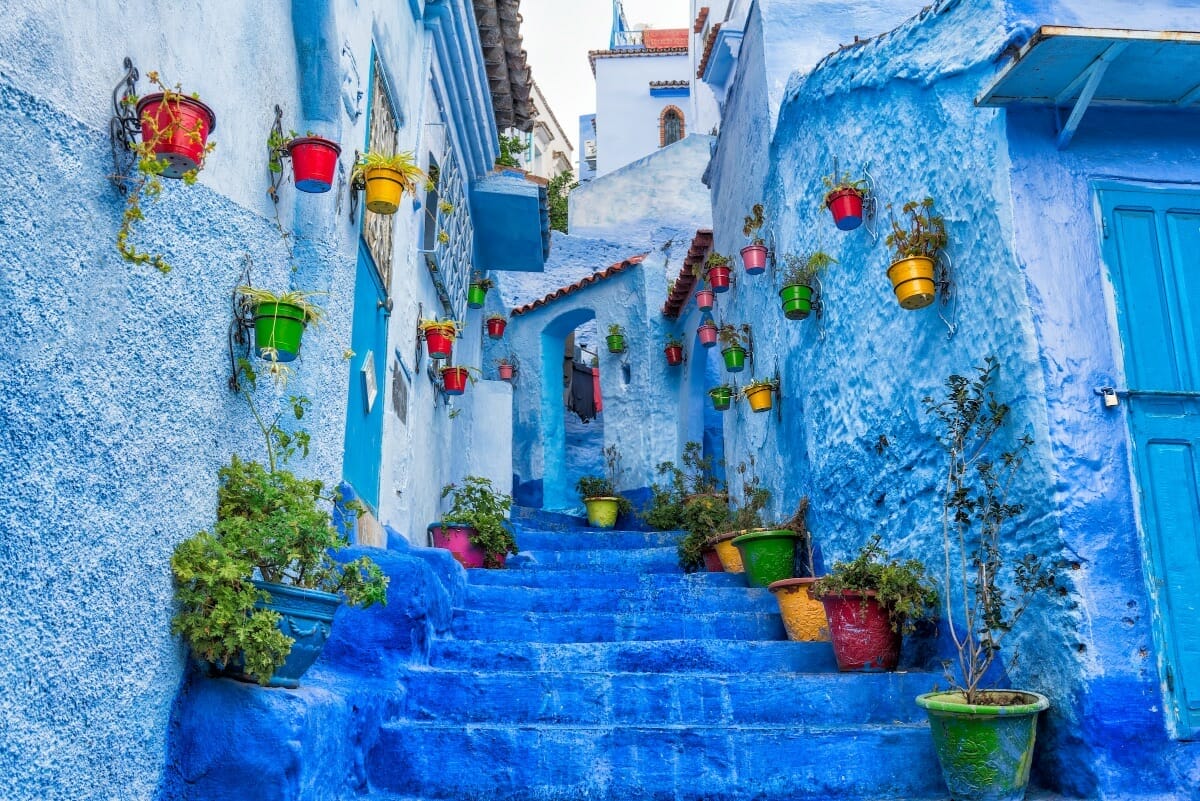
Wander Chefchaouen's blue lanes in the early morning, before the day visitors arrive.
Suggested length
7 days
Price guide
From $6,188 per person, excl. international flights, based on two sharing
Includes hotels, private guiding, experiences and transfers
When
March to early June and late September to early November
or call +1 (727) 699-5439
A planner replies within one business day
American precision with local expertise · Planned from Europe since 2002 · Nearly 17,000 American travelers · Never cancelled a journey
The call to prayer carries over the water from Casablanca’s Hassan II Mosque, and its prayer hall opens this 7-day private tour of northern Morocco, a loop through the part of the country closest to Europe. In Rabat you sip mint tea, sweet green tea with fresh mint, at Café Maure in the Kasbah of the Udayas. Roman Lixus and the Portuguese ramparts of Asilah lead to Tangier and Cape Spartel, where two seas meet. On request you stay over in Chefchaouen and wander its blue lanes early, before the day visitors arrive. In Fez you visit the Al-Attarine Madrasa and the Chouara tannery. A private driver and your own guides stay with you. Your planner tailors each day to your pace.
Walk through the prayer hall of the Hassan II Mosque on its platform over the Atlantic, Casablanca.
Taste mint tea at Café Maure inside the Kasbah of the Udayas, above the Bou Regreg river, Rabat.
Walk the Portuguese ramparts of Asilah above the Atlantic on the road north.
Stand at Cape Spartel, where the Atlantic meets the Mediterranean, Tangier.
Climb the blue lanes of the medina to Uta el-Hammam square, Chefchaouen.
Visit the Al-Attarine Madrasa and the Chouara tannery with your licensed guide, Fez.

“We love to tailor-make trips you’ll talk about for years, built on our local relationships & story-worthy experiences.” – Magical’s American founder, in Europe since 1998, culinary enthusiast & world traveler.






A Journey Designed Just for You
Our resident experts wrote this itinerary as a starting point, and your planner shapes every day around your interests, pace and travel style.
What do our American travelers say?
“Our trip was very smooth, organized from start to finish, excellent guides, comfortable transfers, luxury hotels in good locations, well chosen experiences, and all the details handled.”
“We also really appreciated the suggestion and planning of a winery visit. We did not even know that was an option in Morocco, and it turned out to be a wonderful treat and one of the special surprises of the trip.”
The 7-day northern Morocco itinerary at a glance
The route uses three bases and six nights: two in Rabat, two in Tangier and two in Fez. It opens and closes at Casablanca’s Mohammed V airport, with a guided afternoon in Casablanca on the first day. Every base gives you one full day with no change of hotel, and a private driver handles each road day. The stops between bases, the Roman site of Lixus, the walled town of Asilah and the mountain town of Chefchaouen, break the longer drives into shorter stretches.
Most road legs stay short. Casablanca to Rabat takes about 1 hour. Day three runs about 3 hours in all, in three stages: about 1 hour 45 minutes from Rabat to Lixus near Larache, about 30 minutes on to Asilah and about 45 minutes to Tangier. Day five carries the longest driving of the week, a little over 2 hours from Tangier to Chefchaouen and about 4 hours on to Fez, with lunch in Chefchaouen between. Day seven runs about 3 hours 15 minutes from Fez to Mohammed V airport.
Spring, from March to early June, and autumn, from late September to early November, suit the route best, with mild days for walking the medinas and green hills in the Rif. Summer departures work well with early starts and lunch indoors, and the Atlantic and the Strait keep Rabat and Tangier fresher than the interior. Winter brings short, cool days and the quietest hotels of the year, and our team plans the hours around the season you choose.
Licensed guides we work with on this route include Mehdi and Youssef, who guide travelers across Morocco. Each is a highly educated local expert who cares about the people in their group. We request your guides by name, and your planner confirms who leads each day once your dates are set.
Why the route runs from Casablanca to the Strait and back by way of Fez
The north is the part of Morocco closest to Europe, and its history shows it. At its narrowest the Strait of Gibraltar separates the two continents by about 14 kilometers. The Portuguese took Asilah in 1471 and built the ramparts you walk on day three. Moriscos from Hornachos in Spain settled the Kasbah of the Udayas in Rabat after their expulsion in 1609. Andalusi Muslims, Moriscos and Jews from Spain and Portugal settled Chefchaouen, and from 1923 to 1956 Tangier ran as an International Zone. The week reads these chapters one after another, then ends in Fez, the oldest of the imperial cities on the route.
The order follows the map. The route runs north up the Atlantic coast from Casablanca to Rabat and Tangier, turns inland through the Rif to Chefchaouen and Fez, and returns west by motorway to Casablanca. No leg doubles back until the last day, and you fly in and out of the same airport. The route leaves Marrakech and the Sahara for another trip, and spends the week on the cities and coasts of the north instead.
Journey at a glance
Length
7 days
From
$6,188 per person, double occupancy
Route
Casablanca, Rabat, Asilah, Tangier, Chefchaouen, Fez, Meknes
Your planner adjusts every day to your dates.

Day One
Casablanca and the Hassan II Mosque, then Rabat
Your private driver meets you at Mohammed V airport, and your licensed guide joins you in Casablanca, the largest city in Morocco and its economic center. The visit centers on the Hassan II Mosque, which opened in 1993 on a platform partly over the ocean, with a minaret 210 meters tall. It ranks among the few mosques in Morocco open to non-Muslim visitors, on guided tours only. Inside, the ceilings of carved cedar come from the Middle Atlas, and the roof of the prayer hall slides open to the sky. Outside, the Atlantic swell breaks against the sea wall below the esplanade. In the city center your guide points out the Art Deco and Neo-Mauresque facades of the French protectorate years, when planners called Casablanca a laboratory of urbanism. In the late afternoon the road runs north along the coast to Rabat. Logistics: Mohammed V airport to central Casablanca by road, private driver, then Casablanca to Rabat by road, about 1 hour, private driver.
Day Two
Rabat: the Kasbah of the Udayas and the Hassan Tower
UNESCO inscribed Rabat in 2012 as a modern capital and historic city of shared heritage, and today your licensed guide leads you through both halves. The Almohad caliph Abd al-Mu'min built the Kasbah of the Udayas in 1150 or 1151 on a bluff above the mouth of the Bou Regreg, and his successor Ya'qub al-Mansur added the carved gate of Bab Oudaia between 1195 and 1199. Moriscos expelled from Spain settled here after 1609 and ran a corsair republic, and in the 19th century the kasbah took its name from the Udaya tribe. Blue and white walls line its lanes, the Andalusian Gardens follow the plan of the Moorish gardens of al-Andalus, and at Café Maure you take sweet mint tea above the river with Salé on the far bank. The National Jewellery Museum reopened in the old palace in January 2023. Across town, Ya'qub al-Mansur began the Hassan Tower in 1191, and it stands at about 44 meters, unfinished at his death in 1199, beside the Mausoleum of Mohammed V, which its builders finished in 1971. Logistics: a walking day in Rabat with your licensed guide, with your private driver on hand for transfers.
Day Three
Lixus, Asilah and the Road to Tangier
The road north follows the Atlantic plain to Lixus, on the right bank of the Loukkos river near Larache. Phoenicians settled here in the 8th or 7th century BC, and ancient writers placed the Garden of the Hesperides, with its golden apples, on this hill. Rome made Lixus a colony under Claudius around 50 AD, and your licensed guide walks you past the amphitheater and the forum, with the river winding toward the sea below. Half an hour on, the Portuguese took Asilah in 1471 and built the ramparts and gates, which remain intact. Inside the walls, white houses with blue and green shutters line the lanes, artists paint new murals on the medina walls each year, and the wind comes in off the ocean as you walk the sea wall. Moulay Ahmed er-Raisuni built his palace here in 1909, with zellij tilework and a terrace over the sea. You reach Tangier by late afternoon. Logistics: Rabat to Lixus near Larache by road, about 1 hour 45 minutes, then about 30 minutes to Asilah and about 45 minutes to Tangier, private driver and licensed guide.
Day Four
Tangier: Cape Spartel, the Kasbah and the Socco
The morning starts at Cape Spartel, about 14 kilometers west of the city at the entrance to the Strait of Gibraltar, where Sultan Muhammad IV built the lighthouse in 1864. Here the waters of the Atlantic and the Mediterranean meet. Below the cape, local tradition holds the Caves of Hercules as the place where the hero rested before his eleventh labor, the quest for the golden apples of the Hesperides, so yesterday's story at Lixus comes full circle. The sea opening of the cave traces the outline of Africa against the water. Back in the city, your licensed guide leads you up to the Kasbah Palace, once the residence of the governors of Tangier, and down through the medina to the Petit Socco and the Grand Socco. Beside the Grand Socco, the gardens of the Mendoubia shade a great banyan tree. Matisse painted Window at Tangier here in 1912 and 1913, and the writer Paul Bowles lived and worked in the city for more than half a century. Logistics: Tangier to Cape Spartel by road, about 14 kilometers, private driver, then the medina on foot with your licensed guide.
Day Five
Chefchaouen, the Blue Town, and On to Fez
Day five carries the longest driving of the week, broken by a long stop in the Rif. Ali ibn Rashid al-Alami founded Chefchaouen in 1471 in the foothills of the western Rif, at about 600 meters, and Andalusi Muslims, Moriscos and Jews from Spain and Portugal settled here during and after the Reconquista. Your licensed guide leads you through lanes washed in shades of blue to Uta el-Hammam, the central square, where the kasbah, the Great Mosque and an old caravanserai face each other across the café tables. Theories on the blue vary, from a symbol of the sky to a guard against mosquitoes. Below the medina, the spring of Ras el Maa runs cold from the mountain, the town's first water supply. After lunch the road descends from the Rif across farmland to Fez, and you reach your hotel by early evening. Logistics: Tangier to Chefchaouen by road, a little over 2 hours, then Chefchaouen to Fez on the N13, about 4 hours, private driver, with a licensed guide in Chefchaouen.
Day Six
Fez: Fes el Bali and Fes el Jdid
Idris I founded Fez in 789, and UNESCO inscribed the medina in 1981. Your licensed guide meets you at Bab Bou Jeloud and leads you into Fes el Bali, a car-free town of about 300 hectares, where donkeys and handcarts still carry the loads. Traditional sources credit Fatima al-Fihri with founding al-Qarawiyyin in 859, and UNESCO counts it the oldest continuously operating university. Beside it, the Marinid sultan Abu Sa'id Uthman II built the Al-Attarine Madrasa between 1323 and 1325, and it takes its name from the spice and perfume souk outside, with zellij tilework, carved stucco and cedar eaves around its courtyard. In Place Seffarine the coppersmiths have kept their workshops since at least the 16th century, and the tap of their hammers follows you along the lanes. At the Chouara tannery, round stone vats hold the poppy red, indigo blue and henna orange of the dyes. In the afternoon the visit moves to Fes el Jdid, which the Marinid sultan Abu Yusuf Ya'qub founded in 1276, with the Mellah, the first Jewish quarter of its kind in Morocco, and the gates of the royal palace on Place des Alaouites. Logistics: a walking day in the medina with your licensed guide, with your private driver for the transfer to Fes el Jdid.
Day Seven
Through the Wine Country of Meknès to Casablanca
The motorway runs west from Fez toward the coast, past the farmland and vineyards of the Meknès region. Morocco created its only AOC, Coteaux de l'Atlas 1er Cru, in 2001, and the region also holds the Guerrouane and Beni M'tir appellations. Where it suits your party, a winery visit breaks the drive, with a tasting of Moroccan reds from grapes such as Carignan, Cinsaut, Grenache and Syrah. If your flight leaves the next day, your driver takes you to a hotel in Casablanca instead, near the Corniche and the ocean. Bslama, the Moroccan goodbye, usually comes with an invitation to return. Logistics: Fez to Casablanca's Mohammed V airport by road, about 3 hours 15 minutes plus stops, private driver.
What is a good 7-day northern Morocco itinerary?
A good 7-day northern Morocco itinerary gives two nights each to Rabat, Tangier and Fez and uses the road days for the smaller places between them. Day one lands at Casablanca for the Hassan II Mosque and continues to Rabat. Day two belongs to Rabat, day three runs up the coast by way of Lixus and Asilah to Tangier, and day four stays in Tangier for Cape Spartel and the medina. Day five crosses the Rif by way of Chefchaouen to Fez, day six belongs to the medina of Fez, and day seven returns to Casablanca. You unpack three times in seven days.
Is one week enough for northern Morocco?
One week covers the main cities of the north at an easy pace, with a full day in each base and no single drive over about 4 hours. It leaves out Meknès, Volubilis and Tetouan, which fit with two or three more days. American travelers who want the Roman city of Volubilis and the imperial city of Meknès add them to the drive between Fez and the coast, and Tetouan, with its UNESCO-listed medina, fits between Tangier and Chefchaouen. For a first trip with a week, the route as written keeps the balance between the coast, the mountains and the medina.
How long are the drives on a week in northern Morocco?
Most legs run between 1 and 3 hours, and one day runs longer. Casablanca to Rabat takes about 1 hour, and day three adds up to about 3 hours from Rabat to Tangier in three stages, with Lixus and Asilah between. Day five carries a little over 2 hours from Tangier to Chefchaouen and about 4 hours on to Fez, with lunch and the afternoon walk in Chefchaouen between. Day seven runs about 3 hours 15 minutes from Fez to Mohammed V airport. Your private driver sets the stops around your party.
This northern route, or a Morocco journey with Marrakech and the Sahara?
Choose this route if you have a week and want the cities and coasts of the north: Rabat, Tangier, Chefchaouen and Fez, with Casablanca at both ends. The 8-day Marrakech, Atlas and Atlantic journey spends the same week around Marrakech, with a night in the Agafay desert, the High Atlas and the oyster lagoon at Oualidia, and it suits travelers who want mountains and short drives more than medinas. The 10-day Imperial Cities of Morocco journey runs from Casablanca by way of Rabat, Meknès, Volubilis and Fez to Marrakech, and it suits travelers who want all four imperial cities without Tangier and the Rif.
Travelers set on the dunes choose the 10-day Morocco journey through Fez, the Sahara and Marrakech, or the 12-day southern Morocco journey. Travelers who want Spain as well cross the Strait by ferry on our Spain and Morocco private journey, which follows this route’s northern half from Tangier through Chefchaouen to Fez and continues south to Marrakech. Every route starts from our Morocco destination page, and our team adjusts any of them to your dates.
Who this journey suits
First-time visitors with a week who want the north in depth over a tour of the whole country. Couples who prefer cities, coasts and medinas to long desert drives. Families with children of school age, who share a driver and guide and tend to remember the Caves of Hercules, the blue lanes of Chefchaouen and the tannery vats of Fez. Friends traveling together as a private party, who want one plan and one point of contact. Returning visitors who saw Marrakech and the Sahara on an earlier trip and now want the north. Travelers drawn to the history between Morocco and Spain, from the Moriscos of Rabat to the Andalusi founders of Chefchaouen. Your guide is glad to advise on suitability before booking for anyone who prefers a gentler pace.
What the 7-day journey costs and what it includes
The 7-day route starts from $6,188 per person, double occupancy. The from-price covers six nights in deluxe four-star properties selected for comfort, location and service. Five-star luxury properties are available by request. In Fez the hotel sits close to the medina, and in Rabat and Tangier within easy reach of the kasbah and the sea. The from-price includes a private driver for the airport transfers and every road day, and a licensed guide for the visits described.
Four things move the price: the season, the hotel category, the size of your private party, and the experiences you choose, such as the winery visit near Meknès, a night in Chefchaouen or an added day in Fez. Magical Private Travel maintains excellent ratings on Trustpilot and Google’s independent review platforms.
To shape this week around your dates and your party, speak with our team about your 7 days in northern Morocco.
Frequently asked questions about the 7-day northern Morocco itinerary
How much does a private 7-day northern Morocco tour cost?
This 7-day route starts from $6,188 per person, based on two people sharing a room. The from-price covers the route as written: six nights in Rabat, Tangier and Fez, a private driver for the airport transfers and every road day, and a licensed guide for the visits described, with the full list of inclusions set out in your written quote. Four things move the price. The season matters most, since hotel rates rise and fall through the year. Five-star properties raise it. Party size changes it, because the driver and guide serve the whole party, so larger private parties pay less per person. The experiences you choose, such as the winery visit near Meknès or an added night in Chefchaouen, add to it or come out of it. Our team sends a written quote for your dates and party before you commit.
When is the best time to visit northern Morocco?
Spring, from March to early June, and autumn, from late September to early November, suit this route best. The days run mild for walking the medinas of Rabat, Tangier and Fez, and in spring the hills of the Rif turn green around Chefchaouen. Summer departures work well with early starts and lunch indoors, and the coast helps, since Rabat sits on the Atlantic and Tangier on the Strait, both fresher than Fez in the heat. Winter brings cooler days, shorter light and the quietest hotels of the year. If your dates fall during Ramadan, our guide to the best time to visit Morocco explains how the days change. Our team plans each day around the season you choose.
Are the driver and the guide the same person?
In Morocco they are two different people. A private driver handles the vehicle and the road, and a licensed guide leads the visits. On this route your private driver looks after every transfer, from Mohammed V airport on day one to the same airport on day seven, so you keep the same vehicle through the week. A licensed guide leads the afternoon in Casablanca, the day in Rabat, the stops at Lixus and Asilah, the day in Tangier, the walk in Chefchaouen and the day in the medina of Fez. This split lets your driver focus on the road and your guide focus on the place, its history and its people. Both work for your own party only, and they set the pace around you.
Do non-Muslim visitors enter the Hassan II Mosque?
Yes. The Hassan II Mosque ranks among the few mosques in Morocco open to non-Muslim visitors, and entry runs on guided tours only, with several departures through the day outside prayer times. Your licensed guide times the Casablanca afternoon around the tour schedule. The visit takes in the prayer hall, with its carved cedar ceilings, zellij tilework and a roof which slides open to the sky, and the ablutions hall below, with its marble fountains in the shape of lotus flowers. The mosque opened in 1993 on a platform partly over the ocean, and its minaret rises 210 meters. After the tour, the esplanade above the sea wall gives the best view of the minaret against the Atlantic. Your guide confirms the tour times for your date and advises on what to wear.
Why does this route leave out Marrakech and the Sahara?
A week gives the north its due or gives the south its due, and rarely both. Marrakech lies far to the south of this route, and the Erg Chebbi dunes of the Sahara lie further still, across the Middle Atlas from Fez, so adding either one turns a relaxed week into a string of long road days. This route keeps every base within easy reach of the next and spends the time on the cities and coasts of the north. Travelers who want Marrakech with the same week choose our 8-day Marrakech, Atlas and Atlantic journey. Travelers who want both halves of the country choose a longer route, such as the 10-day Morocco journey, which links Fez, the Sahara and Marrakech.
Do we stay overnight in Chefchaouen?
On the route as written, Chefchaouen comes as a long stop on day five between Tangier and Fez, with a guided walk through the blue lanes, lunch and time on Uta el-Hammam square before the drive on to Fez. The town sits a little over 2 hours from Tangier and about 4 hours from Fez, so the stop breaks the longest road day of the week in two. Travelers who want the town in the early morning and the evening, after the day visitors leave, add a night here on request. The extra night shortens day five and adds a day to the trip, or it takes the place of one night in Tangier. Our team reworks the plan and price for either shape before you commit.
Does this journey suit families or travelers who prefer less walking?
Families travel this route often, because a private driver and guide set the pace around the youngest and the oldest in the party. Children tend to respond to the Caves of Hercules, the blue lanes of Chefchaouen, the donkeys in the lanes of Fez and the dye vats of the tannery. The walking stays moderate on most days, with more of it in Chefchaouen, which climbs a hillside on steps and slopes, and in the car-free medina of Fez, where every visit runs on foot. Day five asks for patience more than stamina, and your driver stops wherever the party needs a break. Your guide is glad to advise on suitability before booking, and our page on accessible travel sets out how our team plans for travelers who need step-free routes or extra support.
How does this route connect with Spain?
Tangier sits on the Strait of Gibraltar, about 14 kilometers from Europe at the narrowest point, so the route links with Spain easily. The fast ferry from Tarifa docks at the port of Tanger Ville, in the heart of the city and a short walk from the medina, after a crossing of about 1 hour, and Baleària runs up to six departures on the route. Travelers who start in Andalusia cross by ferry, begin the Moroccan week in Tangier and reshape the loop around it. Morocco’s high-speed line also links Tangier and Casablanca in about 2 hours 10 minutes, which opens other shapes for the week. Our Spain and Morocco private journey shows how the two countries fit together, and our team plans the crossing around your dates.
How flexible is the 7-day route?
The route works as a starting point, and your planner shapes it around your party. Common changes include a night in Chefchaouen, a third night in Fez for a cooking class or a day in the countryside, or a stop at the Roman ruins of Volubilis and the imperial city of Meknès on the drive back to the coast. Some parties end in Fez with a flight from Fez airport, and some fly into Tangier and reverse the loop. Your planner keeps the logic of the route, with two nights in each base and short drives on most days, and confirms timings, guides and hotel nights once you settle the shape of the trip. You receive a revised day-by-day plan and price before you commit.
Who do we contact if something goes wrong or we want a change?
Your planner designs your journey with you and stays in touch after you land. For the fastest response at any hour, message your private WhatsApp group, where our 24/7 support team works alongside Rachel or Dan. Because we begin no more than five journeys per country each week, peak spring and fall dates fill early, and that limit is what lets us stay this close to every trip.
We keep a list of vetted four- and five-star hotels, well located and enjoyed by our past travelers and by our own team.
Examples for each overnight stop on this route. Choose a deluxe boutique hotel or a five-star stay, and your travel advisor matches each night to your wishes, the season and availability.
Casablanca
Boutique: Hôtel Particulier Le Doge, Relais & Châteaux. A 16-room Art Deco private mansion in central Casablanca, with a spa and hammam.
Five-star: Royal Mansour Casablanca. A rebuilt and raised 1950s landmark in the Art Deco city center, near the port.
Rabat
Boutique: Villa Mandarine. A villa hotel in a grove of 700 orange trees in Rabat, with a heated pool.
Five-star: Fairmont La Marina Rabat-Salé. Opened in 2022 where the Bou Regreg meets the Atlantic, facing Salé marina and Rabat.
Tangier
Boutique: Villa Mabrouka. Yves Saint Laurent’s former home, turned into a 12-room hotel by Jasper Conran, facing the Strait.
Five-star: Fairmont Tazi Palace Tangier. A 1926 palace built for Ahmad Tazi on the Jbel Kebir hillside, with Andalusian gardens.
Fez
Boutique: Dar Bensouda. A traditional riad in the Fes medina, with a spa, pool and roof terrace.
Five-star: Riad Fès, Relais & Châteaux. A restored medina palace with tiled patios, a contemporary 14-meter pool and a bar.
What's Included
A Very Personalized Itinerary, Just For You and Your Schedule
Hand-Picked Ultra-Luxury & Boutique Hotel Options
Insider Experiences + Inspiring Sightseeing + Magical Upgrades
Private Touring with Your Own Personal Expert Guide
Private Airport & Train Station Luxury Transfers
Full Breakfasts + Food & Wine Tasting Options
Your Choice of Activities on “Design Your Days”®
Expert Advice, Restaurant Ideas & Reservations
24/7 Support & Concierge Service from Spain, Portugal & Morocco
Magical is an award-winning luxury travel agency
Private journeys with soul & stories
Excellent independent reviews
Your private WhatsApp group with our 24/7 team and Rachel or Dan
Hidden gems, insider fun & vetted hotels
Your private guide, deluxe vehicle & flexible pace
24/7 concierge-style support
We handle everything — you live the dream
American Precision, Local Soul
Our Unforgettable Trips Are Tailored Just For You
Hi from Europe,
Along with our local partners across Portugal, Spain, Morocco and beyond we believe that our clients deserve the truly tailor-made private luxury trips, not generic "one-size-fits-all" plans.
Get inspired with our sample trips then get in touch about an expert-made personalized custom luxury itinerary, just for you.
Kind regards,
Dan O'Beirne & the MPT team
Request a Quote