


Spain · Private and tailor-made
Spain’s Food Culture & Moorish Palaces
Tapas in Madrid, the Triana market and a chef’s kitchen in Seville, and a private guide to discover the Alhambra and Alcázar palaces.
By arrangement · How private access worksSuggested length
12 days
Price guide
From $10,608 per person, excl. international flights, based on two sharing
Includes hotels, private guiding, experiences and transfers
When
April to June and September to October
or call +1 (727) 699-5439
A planner replies within one business day
American precision with local expertise · Planned from Europe since 2002 · Nearly 17,000 American travelers · Never cancelled a journey
This 12-day private tour of Spain runs from Madrid to Barcelona through the heart of Andalusia, with a day in Toledo. By arrangement and where your dates allow, Ana or Alicia, art historian guides, lead you into the Prado art museum before it opens. Discover paintings once owned by kings like Bosch’s Garden of Earthly Delights or masterpieces from Velázquez, El Greco or Goya without a crowd. In Seville you follow the Triana market to lunch in a chef’s kitchen, and mountain roads through Zahara de la Sierra and Grazalema lead to clifftop Ronda. In Granada you walk the Moorish Nasrid Palaces and the Court of the Lions. Discover Gaudí’s Barcelona, from the Sagrada Família to La Pedrera, then Montserrat. Move, trim or stretch any day, and the route fits you.
Walk the Nasrid Palaces and the Court of the Lions with Israel, Granada.
Study Velázquez, Goya and Bosch at the Prado with Ana, an art historian, Madrid.
Taste an Andalusian lunch in a chef’s kitchen after the Triana market, Seville.
Ride the mountain roads through Zahara de la Sierra and Grazalema to Ronda.
Visit the Sagrada Família, Casa Batlló and La Pedrera in one Gaudí day, Barcelona.
Hear the Escolania boys’ choir at Montserrat on a day it sings, outside Barcelona.

“We love to tailor-make trips you’ll talk about for years, built on our local relationships & story-worthy experiences.” – Magical’s American founder, in Europe since 1998, culinary enthusiast & world traveler.







A Journey Designed Just for You
Our resident experts wrote this itinerary as a starting point, and your planner shapes every day around your interests, pace and travel style.
What do our American travelers say?
The 12-day Spain itinerary at a glance
The private journey begins in Madrid and ends in Barcelona, so you never double back. It starts with the royal capital and its collections, moves south into the Andalusia of the Moorish Almohads and the Nasrids, and ends in the Barcelona of Gaudí. Timeless Toledo shows how Christian, Jewish and Muslim communities shared one city. Explore Seville, a Roman and Almohad medieval city that became the Spanish Empire’s royal port. Granada shows the last Nasrid court. Barcelona closes the story with modernist architecture and creative cuisine. Our note on whether to fly into Madrid or Barcelona explains the airport logic in more detail.
The mountain section between Seville and Granada runs by road on purpose. The white villages and Ronda sit away from the rail lines, and a driver lets you stop for a village lunch or a viewpoint. The long jump from Andalusia to Catalonia, about 680 kilometers, runs by air. The result is a 12-day route with one train, one flight and short road transfers, and the time goes to the places rather than the connections.
The route uses five bases and eleven nights: three in Madrid, two in Seville, two in Ronda, two in Granada and two in Barcelona. Every base after Madrid gets two nights, so you unpack five times in twelve days and wake up at least once in each city without a transfer ahead of you.
Three kinds of connection link the bases. Our team books the high-speed train from Madrid to Seville, about 2 hours 30 minutes on the line Spain opened in 1992. A licensed driver then takes the road from Seville through the white villages to Ronda, and on from Ronda to Granada, about 2 hours. From Granada, a direct flight to Barcelona, about 1 hour 30 minutes, saves a long day on the road across the length of the country.
The route suits spring and autumn best. Spain’s state weather agency, AEMET, records average daily highs in Seville of about 23°C (74°F) in April and 26°C (79°F) in October, against 36°C (97°F) in July. Madrid averages about 18°C (65°F) in April and 19°C (67°F) in October, and Granada about 21°C (69°F) in April and 23°C (74°F) in October. Summer and winter departures both work with a different daily rhythm, and our team plans the hours around the season.
Licensed guides we work with on this route include Ana and Alicia in Madrid, Melanie in Toledo, Andrés and Rosario in Seville, Israel and Rafael in Granada, and Irma and Mariona in Barcelona. Each is a highly educated local expert who cares about the people in their group. We request your guides by name, and your planner confirms who leads each day once your dates are set.
Journey at a glance
Length
12 days
From
$10,608 per person, double occupancy
Route
Madrid, Toledo, Seville, White Villages, Ronda, Granada, Barcelona, Montserrat
Your planner adjusts every day to your dates.

Day One
Madrid: The Royal Palace and the Habsburg Center
Your licensed driver meets you at Madrid-Barajas airport and brings you to a hotel in the historic center. In the afternoon your licensed guide walks you through the oldest part of the capital, starting at the Royal Palace, which stands on the site of the old Alcázar, lost to fire on Christmas Eve 1734. The palace holds 3,418 rooms, and the royal family uses it for state ceremonies. Almudena Cathedral faces it across the plaza, and the Plaza de Oriente opens toward the Teatro Real. The walk ends in Plaza Mayor, completed in 1619, where 237 balconies look down on the arcades and a first round of tapas waits at an outdoor table. Logistics: Madrid-Barajas airport to central Madrid by road with your licensed driver, then a light afternoon on foot with your licensed guide.
Day Two
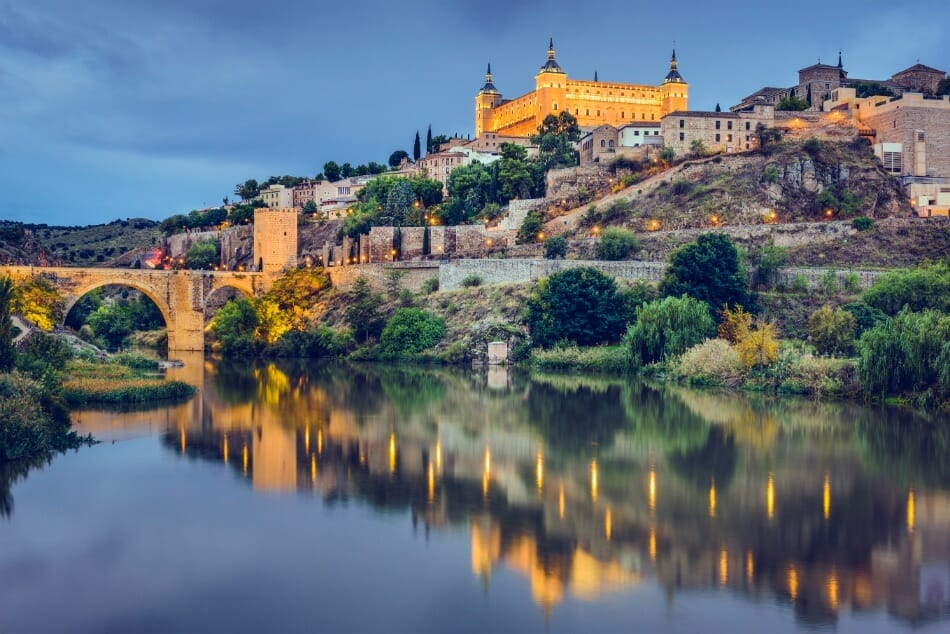
Toledo, City of Three Cultures
Toledo sits on a steep rock above a bend of the Tagus River, about 70 kilometers south of Madrid, and UNESCO inscribed the old city in 1986. Christian, Jewish and Muslim communities lived here side by side for centuries, and your licensed guide reads the streets with you. Work on the Gothic cathedral began in the 1220s, and its sacristy holds fifteen paintings by El Greco, among them El Expolio. The synagogues of Santa María la Blanca and El Tránsito stand a few streets apart, and the small mosque of Bib Mardum, completed in 999, survives as the church of Cristo de la Luz. Before you leave, taste mazapán de Toledo, the almond marzipan the European Union protects with a geographical indication. Logistics: Madrid to Toledo by road, about 1 hour each way, licensed driver, with a licensed guide for the day in Toledo.

Day Three
The Prado and El Retiro
The Prado opened to the public in 1819, in a building Juan de Villanueva designed in 1785 for Charles III. Where your dates allow, Ana, an art historian, leads the morning through Velázquez's Las Meninas, Goya's Black Paintings and Hieronymus Bosch's The Garden of Earthly Delights, a triptych Bosch painted between 1490 and 1510 and the Prado has held since 1939. In the afternoon you walk into El Retiro, 120 hectares of gardens within the Paseo del Prado and Buen Retiro World Heritage site, which UNESCO inscribed in 2021. The Palacio de Cristal, a glass and iron pavilion from the 1887 Philippines Exposition, stands beside a lake, and the afternoon light passes straight through its walls. Logistics: the Prado and El Retiro sit side by side, so the day runs on foot, and your licensed driver collects you for the return to the hotel.

Day Four
South to Seville
The high-speed line from Madrid to Seville runs about 472 kilometers through Córdoba to Santa Justa station. In the afternoon your licensed guide opens Seville through its three World Heritage monuments, which UNESCO inscribed together in 1987. At the Real Alcázar, King Pedro I built his Mudéjar palace in the 1360s. Next door, work on the cathedral began in 1402 on the site of the Almohad great mosque, and the Almohads completed the Giralda, the minaret turned bell tower, in 1198. Christopher Columbus lies inside the cathedral. The Patio de los Naranjos, the mosque's old ablution court, keeps its fountain and its rows of orange trees, and the scent of orange blossom fills it in spring. Logistics: Madrid to Seville by high-speed train, about 2 hours 30 minutes, and a licensed driver meets you at Santa Justa.

Day Five
Triana, a Chef's Kitchen and Flamenco
The morning starts on foot at Plaza del Salvador and crosses the Isabel II bridge, completed in 1852 and known to every Sevillian as the Triana bridge. On the far bank, the Mercado de Triana stands on the site of the medieval Castle of San Jorge, and a small museum shows the castle foundations beneath the market. Your licensed guide walks you past stalls of olives, cured ham and fresh fish, and then a chef welcomes you into a Sevillian kitchen for a traditional Andalusian lunch. Dishes such as salmorejo, the chilled tomato and bread cream from Córdoba, often open the meal. In the evening you take your seats for an intimate flamenco performance, close enough to hear the dancers' heels strike the boards. UNESCO added flamenco to its list of intangible heritage in 2010. Logistics: a walking day in Seville with your licensed guide, and a licensed driver for the evening transfer to and from the flamenco venue.

Day Six
The White Villages on the Road to Ronda
Your licensed driver leaves the main road for the mountain routes of the Sierra de Grazalema Natural Park, home to El Pinsapar, one of the last forests of the Spanish fir. Zahara de la Sierra comes first, its whitewashed houses stacked below the remains of a Moorish castle. Castilian troops took the castle in 1483, nine years before the fall of Granada, and the view from the top runs across the reservoir below the village. Grazalema follows, in the foothills of the Sierra del Pinar, a village whose weavers made its shawls famous from the 17th century. From Zahara the road winds around the reservoir and drops through a valley into Ronda by late afternoon. Logistics: Seville to Ronda by road, about 1 hour 45 minutes on the direct route and longer on the white-villages road with stops, licensed driver.
Day Seven
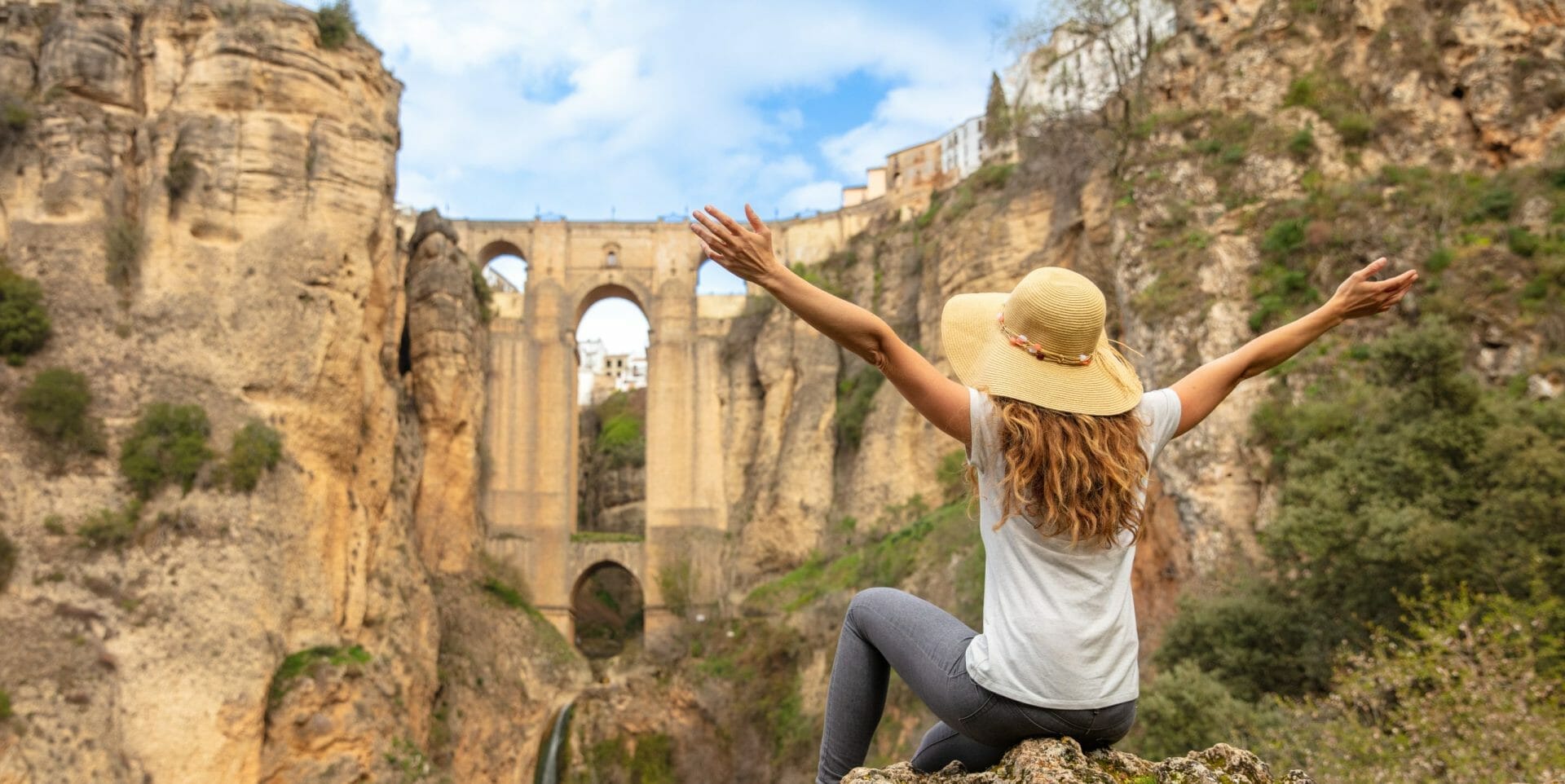
Clifftop Ronda and Mountain Wines
Ronda stands on a plateau split by the El Tajo gorge, more than 100 meters deep, with the Guadalevín River at the bottom. Builders worked on the Puente Nuevo from 1759 to 1793, and the bridge still links the old Moorish town with the newer quarter. With your licensed guide you cross it, look straight down the gorge from the parapet, and walk down to the Arab Baths, which date from the 13th and 14th centuries. In the afternoon, where your dates allow, our team arranges a visit and tasting at a winery in the Serranía de Ronda, a subzone of the Sierras de Málaga designation where vineyards grow between 600 and 1,000 meters above sea level. Logistics: Ronda on foot with your licensed guide in the morning, and your licensed driver takes you to the winery and back in the afternoon.
Day Eight
Granada, the Last Nasrid Capital
On 2 January 1492, Boabdil surrendered Granada and the Alhambra to Ferdinand and Isabella, and the city still shows both sides of the surrender. With your licensed guide you follow the Darro River below the Albaicín, the hillside quarter UNESCO added to the Alhambra listing in 1994, and listen to the water run below the old stone bridges. El Bañuelo, on the riverbank, is the only Islamic bathhouse outside the Alhambra in Granada open to visitors. In the center, the Royal Chapel, built from 1505 to 1517, holds the tombs of Ferdinand and Isabella beside the cathedral. Nearby, the Corral del Carbón, a merchants' inn from the early 14th century, survives as the only Nasrid-era funduq in the Iberian Peninsula. Logistics: Ronda to Granada by road, about 2 hours, licensed driver, then an afternoon on foot with your licensed guide.

Day Nine
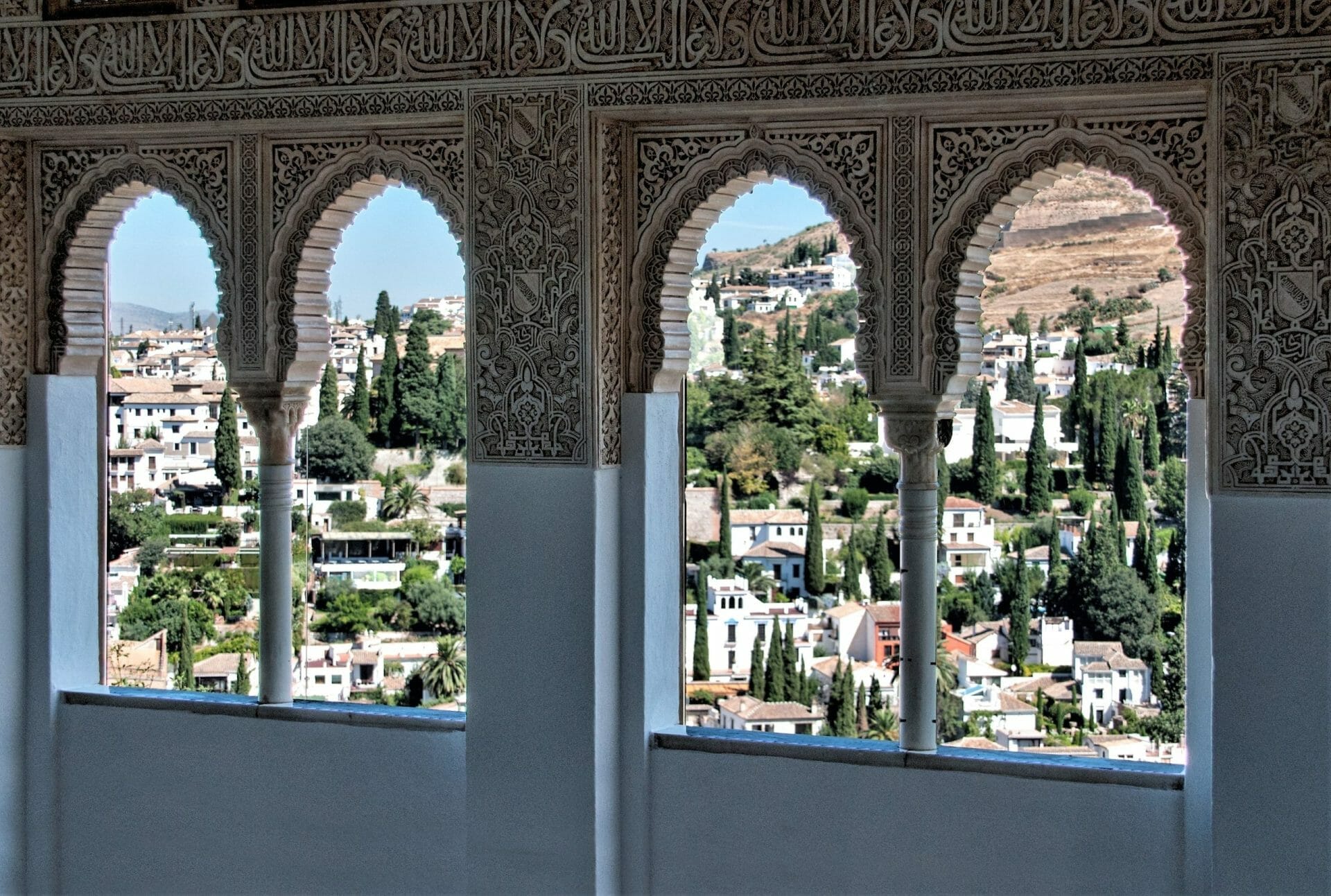
The Alhambra and the Generalife
The Alhambra sits on the Sabika hill, and Muhammad I, the first Nasrid emir, began the complex in 1238. Where your dates allow, Israel, one of our licensed guides in Granada, leads the day. Inside the Nasrid Palaces the courtyards turn intimate, and water runs through narrow channels at floor level. In the Court of the Lions, twelve marble lions carry the fountain basin of the palace Muhammad V built during his second reign, from 1362. The Alcazaba, the oldest part of the complex, guards the western tip and looks out over the city to the Sierra Nevada. The Generalife, once the country residence of the emirs, steps down the hillside to the east among cypress, roses and running water. Logistics: our team books the timed entry to the Nasrid Palaces in advance, the visit runs on foot, and your licensed driver handles the transfers to and from the hill.

Day Ten
Gaudí's Barcelona
Construction of the Sagrada Família began in 1882, Gaudí took over as chief architect in 1883, and Pope Benedict XVI consecrated it as a basilica in 2010. UNESCO lists its Nativity Façade and crypt among Gaudí's seven World Heritage works, and your licensed guide starts the afternoon there. Your licensed driver then follows Passeig de Gràcia to Casa Batlló, which Gaudí remodeled between 1904 and 1906 and Barcelonans call the House of Bones, and on to Casa Milà, built from 1906 to 1912 and nicknamed La Pedrera, the stone quarry. On its roof, 28 chimneys stand like helmeted sentinels over the grid of the Eixample. Logistics: Granada to Barcelona by direct flight, about 1 hour 30 minutes, and a licensed driver meets you at El Prat.

Day Eleven
Montserrat and the Penedès
Montserrat's highest peak, Sant Jeroni, reaches 1,236 meters, about 50 kilometers from central Barcelona, and Abbot Oliba founded its Benedictine monastery in 1025. Your licensed driver and licensed guide collect you from the hotel. In the basilica, the 12th-century statue of the Virgin of Montserrat, La Moreneta, draws pilgrims every day, and Catalonia honors her as its patron saint. Where the schedule allows, you hear the Escolania, one of the oldest boys' choirs in Europe, with records from 1307, sing the Salve Regina at midday. In the afternoon, where your dates allow, the day continues to the Penedès, the area producing about 95 percent of all cava, for a tasting at a family estate near Sant Sadurní d'Anoia, with sparkling wine from Macabeo, Xarel·lo and Parellada grapes. Logistics: Barcelona to Montserrat by road, about 1 hour, licensed driver and licensed guide, with the Penedès on the way back.

Day Twelve
Departure from Barcelona
The morning stays free for a last walk along Passeig de Gràcia or a coffee on a terrace in the Eixample. Barcelona-El Prat airport lies about 15 kilometers southwest of the city center, and your licensed driver collects you from the hotel with time to spare for your flight home. Our team arranges VIP airport assistance on request. Travelers who want more time in Iberia often extend from Barcelona into Portugal or Morocco, and our team plans those extensions on the same private basis. Logistics: hotel to Barcelona-El Prat airport by road with your licensed driver, with VIP assistance by prior arrangement.
What is a good 12-day itinerary for Spain?
A good 12-day itinerary for Spain covers Madrid, Andalusia and Barcelona from five bases, with at least two nights in each city after Madrid. This route spends days one to three in Madrid with Toledo and the Prado, days four and five in Seville, days six and seven in the white villages and Ronda, days eight and nine in Granada with the Alhambra, and days ten and eleven in Barcelona with Gaudí and Montserrat. It flies in to Madrid and out of Barcelona, uses one high-speed train and one domestic flight, and keeps road transfers to about two hours except on the white-villages day, where the stops are the point.
Is 12 days enough for Spain, or do you need two weeks?
Twelve days covers Spain’s three best-known regions at a pace where you sleep at least two nights in every base, and it leaves out what a two-week Spain itinerary adds: Segovia, a second Andalusian town such as Carmona or Córdoba, and a coastal stop such as the Costa Brava. If your list stops at Madrid, Seville, Granada and Barcelona with Toledo, Ronda and Montserrat as day trips, twelve days fits it without strain. If you also want the Roman aqueduct in Segovia or a beach day, our 14-day Spain highlights journey adds those two days of breathing room.
How do you travel between Madrid, Seville, Granada and Barcelona on a private tour?
On this route a high-speed train runs from Madrid to Seville, a licensed driver covers Seville to Ronda and Ronda to Granada by road, and a direct flight links Granada to Barcelona. The train takes about 2 hours 30 minutes and arrives at Santa Justa, where your driver waits. The road days run about 1 hour 45 minutes to Ronda on the direct route and about 2 hours to Granada. The Granada to Barcelona flight takes about 1 hour 30 minutes. Our article on Spain’s high-speed trains to Seville explains the rail options in more depth.
This 12-day route, or a 10, 14 or 22-day Spain journey?
Choose this route if you want Madrid, Andalusia and Barcelona in one trip, with time in the mountains between Seville and Granada. The 10-day Highlights of Spain journey covers the same three regions but drops Ronda, the white villages and Montserrat, and it suits travelers with ten days who care most about the big cities. The 12-day Spain journey with Mallorca, Barcelona and Madrid trades Andalusia for the Mediterranean, and it serves travelers who want an island and the sea more than the Alhambra.
With two weeks or more, the 14-day Spain highlights journey adds Segovia, Carmona and the Costa Brava, and the 22-day Spain journey adds Segovia, Málaga, the Basque Country and the Costa Brava. Both run at an easier pace than twelve days. With a week, a single-region trip such as the 7-day Madrid and Andalusia journey serves you better than a rushed version of this route. All of them start from the Spain destination page, and our team adjusts any of them to your dates.
Who this journey suits
Couples on a first trip to Spain who want the classic cities with a few slower days in the mountains. Families with teenage or adult children, who share a guide and driver and set their own hours. Friends traveling together as a private party, who want one plan and one point of contact. American travelers who come for art and architecture, from the Prado and El Greco to the Alhambra and Gaudí. Returning visitors who saw Madrid or Barcelona years ago and now want Andalusia in depth. Your guide is glad to advise on suitability before booking for anyone who prefers shorter walking days.
Who are our guides?
Our team selects guides as much for personality as for what they know. In Granada, where your dates allow, Israel, one of our licensed guides, leads the Alhambra day. He paces the Nasrid Palaces around your timed entry and takes the Generalife and the Alcazaba at the speed your party sets.
In Madrid, where your dates allow, Ana, an art historian, leads our Prado visits. She builds the morning around the painters you care about, whether your party favors Velázquez and Goya, the Flemish rooms with Bosch, or a shorter visit with time for El Retiro afterward. Our guide to highlights of the Prado gives a sense of the collection before you go.
What the 12-day journey costs and what it includes
The 12-day route starts from $10,608 per person, double occupancy. The from-price covers eleven nights in deluxe four-star properties selected for comfort, location and service. Five-star luxury properties are available by request. It includes licensed guides for the visits described, a licensed driver for airport and road transfers, and timed entry to the Alhambra’s Nasrid Palaces.
Four things move the price: the season, the hotel category, the size of your private party, and added experiences such as the Ronda winery visit, the cava tasting in the Penedès or a cooking class in Barcelona. Magical Private Travel maintains excellent ratings on Trustpilot and Google’s independent review platforms.
To shape this route around your dates and your party, speak with our team about your 12 days in Spain.
Frequently asked questions about the 12-day Spain itinerary
How much does a private 12-day luxury tour of Spain cost?
This 12-day route starts from $10,608 per person, based on two people sharing a room. The from-price covers the route as written: eleven hotel nights, licensed guides for the visits described and a licensed driver for every road transfer, with the full list of inclusions set out in your written quote. Four things move the price. The season matters most, since hotel rates rise and fall through the year. Five-star hotels raise it. Party size changes it, because the guide and driver serve the whole party, so larger private parties pay less per person. Added experiences, such as the Ronda winery visit or a cava tasting in the Penedès, add to it. Our team sends a written quote for your dates and party before you commit.
When is the best time to take this 12-day Spain itinerary?
April to June and September to October suit this route best. Spain’s weather agency, AEMET, records average daily highs in Seville of about 23°C (74°F) in April and 26°C (79°F) in October, and about 36°C (97°F) in July. Granada averages about 21°C (69°F) in April and 23°C (74°F) in October, Madrid about 18°C (65°F) and 19°C (67°F), and Barcelona about 18°C (64°F) in April and 22°C (72°F) in October. Summer departures work well with early starts in Seville and Granada and lunch indoors in the heat of the afternoon. Winter brings cooler days, shorter light and the quietest hotels of the year, and our team plans each day around the season you choose. Spring also brings orange blossom to the Patio de los Naranjos in Seville.
Do we need to book the Alhambra in advance?
Yes, and our team handles it. Every Alhambra ticket including the Nasrid Palaces carries a fixed entry time for the palaces, and the Alhambra’s own ticket office asks visitors to arrive on time for the slot. Visitors buying or collecting tickets at the monument must do so at least one hour before their assigned time. Each space on a ticket allows one entry. For these reasons our team books the timed entry as soon as you confirm your dates, and your licensed guide plans the rest of the day around it, usually with the Alcazaba and the Generalife before or after the palaces. Where your dates allow, Israel, one of our licensed guides in Granada, leads the visit. The Generalife gardens and the Alcazaba sit within the same complex and need no separate journey.
Why does the route fly from Granada to Barcelona?
Granada and Barcelona lie about 680 kilometers apart, at opposite ends of Spain’s Mediterranean side, and a direct flight covers the distance in about 1 hour 30 minutes. By road the same trip takes most of a day, and it would cost you an afternoon in Barcelona. Your licensed driver takes you to Granada’s airport, and a second licensed driver meets you at Barcelona-El Prat. If you prefer rail, our team prices the train option for you as well, and the itinerary shifts to fit the longer journey. The flight keeps day ten for Gaudí, with the Sagrada Família, Casa Batlló and La Pedrera in the afternoon.
Are the guide and the driver the same person?
In Spain they are two different people. A licensed guide leads the visits, and a licensed driver handles the vehicle and the road transfers. Your licensed guide changes from city to city, so your guide in Seville differs from your guide in Granada or Barcelona. The driver stays with you on the road days, such as the white villages and the drive from Ronda to Granada, and meets you at the station or airport when you change regions. This split lets your guide focus on the site and your driver focus on the road, and it means the guide in each city knows the city in depth. Where your dates allow, named specialists such as Israel in Granada and Ana at the Prado lead those visits.
Which airports should we fly into and out of?
Fly into Madrid-Barajas and home from Barcelona-El Prat. An open-jaw ticket of this kind avoids doubling back across Spain at the end of the trip. Barcelona-El Prat lies about 15 kilometers southwest of the city center, and your licensed driver meets you at arrivals in Madrid and takes you to the airport in Barcelona on day twelve. Our team arranges VIP airport assistance at both ends on request, covering meet-and-greet and help through the terminal. Our article on flying into Madrid or Barcelona compares the two airports in more detail, and our team aligns the itinerary with your flight times once you book them.
How flexible is the 12-day route?
The route works as a starting point, and your planner shapes it around your party. Common changes include swapping Ronda for Córdoba between Seville and Granada, adding a night in Madrid for Segovia, or adding a beach day on the Costa Brava at the end. Our article on Córdoba or Ronda between Granada and Seville explains the choice. Food lovers often add a market tour or a cooking class in Barcelona, and art lovers add the Reina Sofía for Picasso’s Guernica in Madrid. The sequence of Madrid, Andalusia and Barcelona stays logical in either direction, so the route also runs from Barcelona to Madrid if your flights fit it better. Our team confirms timings, ticketed entries and hotel nights once you settle the shape of the trip.
Does this journey suit families or travelers with limited mobility?
Families travel this route often, because a private guide and driver set the pace around the youngest and the oldest in the party. Teenagers tend to respond to the Alhambra, the flamenco evening and the Gaudí rooftops, and the two-night bases leave room for a pool afternoon. Several days involve walking on cobbled streets and slopes, especially in Toledo, the Albaicín in Granada and old Ronda, and the Alhambra visit runs on foot across a large hillside site. Your guide is glad to advise on suitability before booking, and our team adjusts walking routes, adds vehicle time between sites, or shortens days where it helps. Our page on accessible travel in Spain sets out how our team plans for travelers who need step-free routes or extra support.
Does the route extend to Portugal or Morocco?
Yes. Portugal lies to the west of the route and Morocco lies across the Strait of Gibraltar from Andalusia, so the 12-day route extends naturally in either direction. Travelers who add Portugal often finish with three or four nights in Lisbon and Sintra, where your dates allow, Luisa, one of our licensed guides in Lisbon and Sintra, leads the days alongside a licensed driver. Travelers who add Morocco usually cross from Andalusia before Barcelona, adding Tangier, Fez or Marrakech. Our Spain and Morocco private journey shows one way to combine the two, and our multi-country journeys page collects the other combinations. In Morocco our team works with private drivers and licensed guides as separate roles, as in Spain. Your planner prices the extension alongside the Spain route so you see the full cost at once.
Who do we contact if something goes wrong or we want a change?
Your planner designs your journey with you and stays in touch after you land. For the fastest response at any hour, message your private WhatsApp group, where our 24/7 support team works alongside Rachel or Dan. Because we begin no more than five journeys per country each week, peak spring and fall dates fill early, and that limit is what lets us stay this close to every trip.
We keep a list of vetted four- and five-star hotels, well located and enjoyed by our past travelers and by our own team.
Examples for each overnight stop on this route. Choose a deluxe boutique hotel or a five-star stay, and your travel advisor matches each night to your wishes, the season and availability.
Madrid
Boutique: Tótem Madrid. A restored 19th-century building on Calle Hermosilla, steps from Serrano’s shops in the Salamanca district.
Five-star: Rosewood Villa Magna. Reopened by Rosewood in 2021 on the Paseo de la Castellana, with a leafy front garden.
Seville
Boutique: Hotel Casa 1800 Sevilla. A 19th-century mansion with a patio and a rooftop pool facing the cathedral and Giralda.
Five-star: Hotel Alfonso XIII. Built for the 1929 Ibero-American Exposition, a neo-Mudéjar palace of tiles and arches near the Alcázar.
Ronda
Boutique: Hotel Montelirio. A stately old house on the edge of the Tajo gorge, close to the Puente Nuevo.
Also consider: Parador de Ronda. The old town hall and market building on the edge of El Tajo, beside the Puente Nuevo.
Granada
Boutique: Parador de Granada. A 15th-century Franciscan convent inside the Alhambra precinct, with gardens facing the Generalife.
Five-star: Hospes Palacio de los Patos. A 19th-century palace beside a contemporary wing, linked by gardens, with a spa below.
Barcelona
Boutique: H10 Casa Mimosa. A listed 19th-century Modernista building on Pau Claris, on the same block as Gaudí’s La Pedrera.
Five-star: Mandarin Oriental Barcelona. A former bank on Passeig de Gràcia turned into a calm, pale-toned hotel with a rooftop pool.
What's Included
A Very Personalized Itinerary, Just For You and Your Schedule
Hand-Picked Ultra-Luxury & Boutique Hotel Options
Insider Experiences + Inspiring Sightseeing + Magical Upgrades
Private Touring with Your Own Personal Expert Guide
Private Airport & Train Station Luxury Transfers
Full Breakfasts + Food & Wine Tasting Options
Your Choice of Activities on “Design Your Days”®
Expert Advice, Restaurant Ideas & Reservations
24/7 Support & Concierge Service from Spain, Portugal & Morocco
Magical is an award-winning luxury travel agency
Private journeys with soul & stories
Excellent independent reviews
Your private WhatsApp group with our 24/7 team and Rachel or Dan
Hidden gems, insider fun & vetted hotels
Your private guide, deluxe vehicle & flexible pace
24/7 concierge-style support
We handle everything — you live the dream
American Precision, Local Soul
Our Unforgettable Trips Are Tailored Just For You
Hi from Europe,
Along with our local partners across Portugal, Spain, Morocco and beyond we believe that our clients deserve the truly tailor-made private luxury trips, not generic "one-size-fits-all" plans.
Get inspired with our sample trips then get in touch about an expert-made personalized custom luxury itinerary, just for you.
Kind regards,
Dan O'Beirne & the MPT team
Request a Quote