Why do savvy travelers choose Extremadura?
Extremadura is Spain without the crowds. This western region between Madrid, Seville and Portugal holds three UNESCO World Heritage Sites, Roman theaters still in use, medieval walled towns, open oak country where fighting bulls and Iberian pigs roam, and some of the clearest night skies in southern Europe. Yet Extremadura received about 376,000 international visitors in 2025, while Spain as a whole welcomed about 97 million. That is less than half of one percent.

For you, that means a slower pace. You walk into Mérida’s Roman theater or the old town of Cáceres without fighting for space, you sit down to lunch without a reservation scramble, and you meet people who have time for a conversation. Because Extremadura’s towns are not overrun by visitors, as parts of coastal Spain, France, Italy and Greece are in summer, the welcome here feels warm and personal.
Your visit also does good. Every night you spend in a family hotel, every wheel of Torta del Casar you buy from its maker, and every morning on a ranch supports rural communities that depend on travelers who choose to look beyond the famous names.
Planning a journey through Spain or Portugal? We build Extremadura into your private route, with a licensed guide, a hotel in a historic palace or parador, and a morning in the dehesa, subject to availability. Talk to Dan or Rachel.
Which UNESCO sites can you see in Extremadura?
Extremadura has three UNESCO World Heritage Sites and four more places recognized by UNESCO for their nature and geology.
| UNESCO site | What you see |
|---|---|
| Old Town of Cáceres (World Heritage, 1986) | A walled medieval and Renaissance city of towers, palaces and stone lanes |
| Archaeological Ensemble of Mérida (World Heritage, 1993) | The Roman theater, amphitheater, Temple of Diana and Roman bridge of ancient Augusta Emerita |
| Royal Monastery of Guadalupe (World Heritage, 1993) | A Gothic and Mudéjar monastery, home of the Virgin of Guadalupe |
| Monfragüe (Biosphere Reserve, 2003) | A national park of cliffs, rivers and birds of prey |
| Tajo Internacional (Biosphere Reserve) | River canyons on the border with Portugal |
| La Siberia (Biosphere Reserve) | Lakes, hills and certified dark skies |
| Villuercas-Ibores-Jara (UNESCO Global Geopark) | Mountains and valleys around Guadalupe |

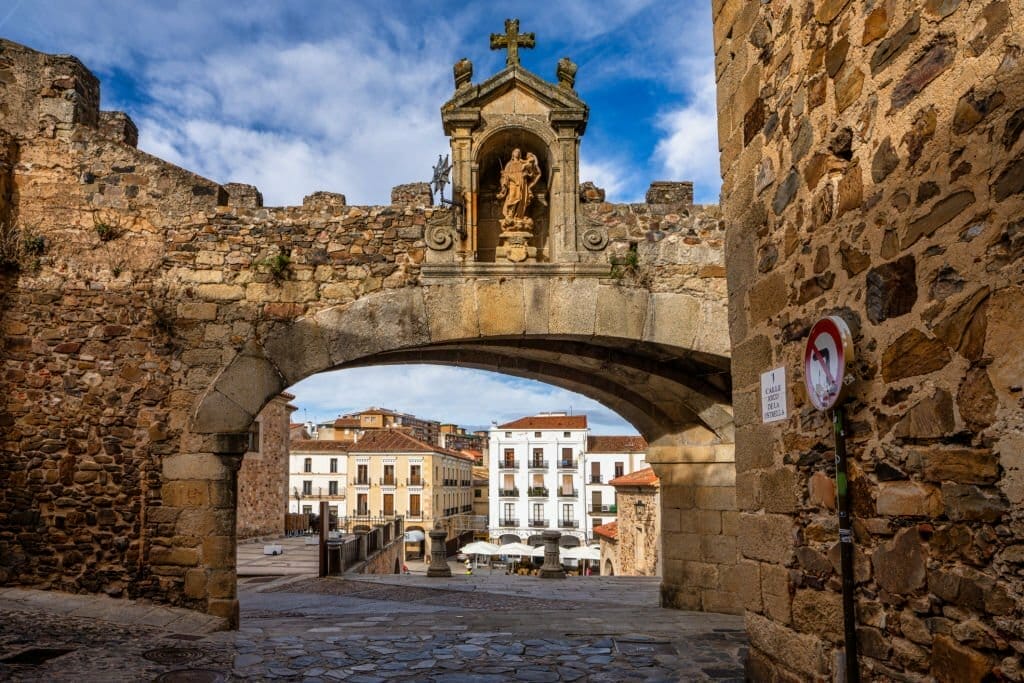
Mérida was the capital of Roman Lusitania, and its theater still stages plays every summer. Cáceres looks much as it did five centuries ago, and its old town is one of the best preserved in Spain. Guadalupe sits in the hills of the Geopark, and its Virgin gave her name to the Virgin of Guadalupe of Mexico. Trujillo, the hometown of conquistadors, and Zafra, with its arcaded squares and castle palace, round out the classic route. Read more on our Extremadura destination page.
Where can you enjoy nature and stargazing in Extremadura?
Nearly a quarter of Extremadura is dehesa, open woodland of holm and cork oaks over grassland, where Iberian pigs forage for acorns and fighting bulls graze in open pasture. The region counts more than 50 protected natural areas.
Monfragüe National Park is the highlight for nature lovers, with cliffs where vultures and eagles nest above the Tagus. The night sky is the second surprise. Extremadura has five territories certified as Starlight Tourist Destinations: the Monfragüe Biosphere Reserve, Alqueva, Las Hurdes, the Villuercas-Ibores-Jara Geopark and La Siberia. El Chorrerón, near Moraleja, became the region’s first Starlight site. We suggest a private stargazing session with an astronomy guide on a clear night, subject to availability.

Which fighting bull ranch can you visit in Extremadura?
Extremadura is classic fighting bull country, and two ranches stand out for travelers.
Victorino Martín is one of the most famous names in Spanish ranching. The family raises its herd at Las Tiesas de Santa María, near Portezuelo in the north of Cáceres province, and keeps a museum at its second estate, Monteviejo, in Moraleja. The ranch offers visits designed to order, including a VIP visit at Las Tiesas in a four by four with a stop where the retired bulls live out their lives. We suggest a private visit centered on the herds and the dehesa, followed by lunch in the countryside, subject to availability.

Santa Emilia, in Torrejón el Rubio, sits inside Monfragüe National Park. Its four by four tour through the dehesa runs about an hour and a half, and pairs well with a day of birdwatching in the park and a night in Trujillo or Cáceres.

We know bullfighting is a controversial subject, and we respect every view on it. That is why we suggest a ranch visit to any traveler, including those who would never attend a corrida. The morning centers on nature: open pastures, a quiet and pristine countryside, and the way these bulls are raised free in open country, with room to roam. Read about a morning on a fighting bull ranch.
What should you eat and drink in Extremadura?
Extremadura feeds Spain’s best tables. Three names to know:
- Jamón Dehesa de Extremadura. The European Union recognized Dehesa de Extremadura as a Protected Designation of Origin for Iberian ham in 1996. The pigs roam the dehesa and fatten on acorns in the fall.
- Torta del Casar. This raw sheep’s milk cheese is curdled with wild thistle and ripens until the center turns soft enough to spoon. Torta del Casar won a gold medal at the 2025 World Cheese Awards, and in 2021 the Gran Casar torta was named Spain’s best cheese. Extremadura makes four protected cheeses in all. Meet the cheeses of Extremadura.
- The wines of Bodega Habla. Founded in 1999 near Trujillo, Habla farms about 200 hectares of slate soils, and its Habla N° 33 Malbec scored 92 Falstaff points in 2025. Extremadura has about 81,000 hectares of vineyards, one of the largest areas in Spain, and producers such as Habla are putting the region on Spain’s wine map.
We suggest a cheese tasting with a maker in Casar de Cáceres, a visit to Bodega Habla, and a jamón tasting in Zafra or Jerez de los Caballeros, all subject to availability.

What are the great fiestas of Extremadura in 2027?
| Fiesta | 2027 dates |
|---|---|
| Holy Week, Mérida, Cáceres and Jerez de los Caballeros | March 21 to 28 |
| El Chíviri, Trujillo | Easter Sunday, March 28 |
| San Jorge, Cáceres | Week of April 23 (expected) |
| National Cheese Fair, Trujillo | Late April or early May (expected) |
| Emerita Lvdica, Mérida | May 7 to 16 (expected) |
| Classical Theatre Festival, Mérida | July and August (expected) |
| Templar Festival, Jerez de los Caballeros | July (expected) |
| Virgen de la Salud, Fregenal de la Sierra, and Extremadura Day, Guadalupe | September 8 |
| San Miguel Livestock Fair, Zafra | Late September to early October (expected) |
| Torta del Casar Week, Casar de Cáceres | October (expected) |
A note on dates. The 2027 dates above reflect the information available in November 2026. Local authorities and organizers set festival dates and sometimes change them, so please confirm each date with the official organizer before you book flights or hotels. Dates marked “expected” follow the pattern of past years.
Mérida. The Classical Theatre Festival brings Greek and Roman drama back to the 2,000 year old Roman theater each summer. The 2026 edition ran from July 3 to August 30, with more than 150 performances. In May, Emerita Lvdica fills the city with Roman markets and reenactments. Mérida’s Holy Week is a Festival of International Tourist Interest, and its dawn Way of the Cross walks in silence to the Roman amphitheater.
Cáceres. The week of April 23 honors San Jorge, the city’s patron, and ends with the burning of a great dragon in the Plaza Mayor. Holy Week processions here are also of International Tourist Interest, set against the UNESCO old town.
Zafra. The San Miguel Livestock Fair has been held since 1453, and an estimated one million people visit during the fair. In 2026 it ran from October 1 to 6. Horses, Iberian pigs and the rural culture of the dehesa fill the fairground.

Trujillo. The National Cheese Fair brought together 80 cheesemakers from Spain, Portugal and Italy, with more than 500 cheeses, in 2026. On Easter Sunday, the whole town sings and dances El Chíviri in the Plaza Mayor in traditional dress.

Jerez de los Caballeros. Holy Week here is a Festival of National Tourist Interest, and each July the Templar Festival revives the town’s medieval past.
Fregenal de la Sierra. In 1781 the town built a bullring inside its Templar castle, one of the most unusual sights in Spain. Every September 8, dancers honor the Virgen de la Salud with one of the oldest dances in Extremadura.
Guadalupe. On September 8, Extremadura Day, pilgrims gather at the monastery to honor the Virgin of Guadalupe, patron of Extremadura and of the Hispanic world.

Planning a trip around a fiesta in Extremadura? We build your private route around the dates you choose, with hotels close to the celebrations and a guide to explain the traditions, all subject to availability. Plan my Extremadura trip with Dan or Rachel
How do you fit Extremadura into a trip through Spain or Portugal?
Plan two or three nights. Extremadura sits on the road between Madrid and Lisbon, and between Madrid and Seville, so you see it without a detour. Trujillo is about two and a half hours by road from Madrid, and Mérida about three hours from Lisbon.
A fall journey works especially well. Seville’s Feria de San Miguel closes the last weekend of September, Zafra’s livestock fair follows in early October, and Madrid celebrates Spain’s national day on October 12. Our guide to Spain and Portugal’s great fiestas and ferias in 2027 has the full calendar. For a ready route, see our 14 day private Spain and Portugal tour from Madrid to Porto.
Frequently asked questions
Is Extremadura worth visiting?
Yes, for travelers who want UNESCO heritage, nature and food without the crowds. Extremadura received about 376,000 international visitors in 2025, out of about 97 million for all of Spain.
How many UNESCO sites does Extremadura have?
Three World Heritage Sites (the old town of Cáceres, the archaeological ensemble of Mérida and the Royal Monastery of Guadalupe), three Biosphere Reserves (Monfragüe, Tajo Internacional and La Siberia) and the Villuercas-Ibores-Jara UNESCO Global Geopark.
When is the best time to visit Extremadura?
March to early June and late September to November bring mild weather, green or golden dehesa, and the main fiestas.
Can you visit a fighting bull ranch in Extremadura?
Yes. Victorino Martín near Moraleja and Santa Emilia inside Monfragüe National Park both welcome visitors, with advance booking.
What food is Extremadura known for?
Iberian ham from the Dehesa de Extremadura designation, Torta del Casar and three other protected cheeses, pimentón de la Vera paprika, and a growing wine scene led by producers such as Bodega Habla.
Is Extremadura good for stargazing?
Yes. Five territories hold Starlight Tourist Destination certification, including Monfragüe and La Siberia.
How do we plan your private Extremadura journey?
Here is how we shape Extremadura around you:
- Hotels with history. We suggest palace hotels and paradors in Cáceres, Trujillo, Mérida, Zafra and Guadalupe, subject to availability.
- A licensed guide. Your guide opens Roman Mérida, the old town of Cáceres and the monastery of Guadalupe.
- Nature at your pace. A morning on a ranch, birdwatching in Monfragüe or a private stargazing night, on request.
- Food and wine. Cheese, jamón and wine tastings with the families who make them.
- One plan across borders. Pair Extremadura with Madrid, Seville or Lisbon in a single custom route.
- Support every day. A WhatsApp group with Dan or Rachel, plus our team 24/7 in your time zone, from departure to return.
Magical Private Travel is American-owned and has planned private journeys across Spain, Portugal and Morocco since 2002, for more than 17,000 travelers. We are members of Travel Leaders Network and ASTA, and CLIA-accredited.
Plan my Extremadura trip with Dan or Rachel
Sources
- Junta de Extremadura, international visitors in 2025
- Ministry of Industry and Tourism, Spain 2025 tourism balance
- Hosteltur, Extremadura UNESCO sites and protected areas
- Turismo de Extremadura, astrotourism and Starlight destinations
- Junta de Extremadura, El Chorrerón Starlight site
- Visitas Victorino Martín
- ¡Hola!, visiting Victorino Martín
- Picuco, Santa Emilia ranch visit in Monfragüe
- Agronews Castilla y León, DOP Dehesa de Extremadura
- Demócrata, Torta del Casar gold at the World Cheese Awards
- El Independiente, Gran Casar named Spain’s best cheese 2021
- Lebendige Weine, Bodegas Habla
- Falstaff, Habla N° 33
- Planomato, Holy Week in Mérida 2027
- Planomato, Emerita Lvdica 2027
- Festivales de España, Mérida Classical Theatre Festival 2026
- Spain.info, San Jorge in Cáceres
- Spain.info, Holy Week in Cáceres
- Cocampo, Zafra fair 2026
- Escapada Rural, Zafra San Miguel fair
- Ministry of Agriculture, Trujillo National Cheese Fair 2026
- Festivales de España, El Chíviri
- Junta de Extremadura, Holy Week in Jerez de los Caballeros
- Forbes, Jerez de los Caballeros Templar Festival
- Spain.info, Fregenal de la Sierra
- Guías Viajar, Fregenal bullring and September 8
- Festivales de España, Guadalupe on September 8
- El Español, Torta del Casar Week 2026