







Plan two or three nights in Extremadura, ideally from March to early June or from late September to November, on the road between Madrid and Lisbon or Seville. Your licensed guide leads you through Roman Mérida, the walled old town of Cáceres and the conquistadors’ Trujillo, with the Guadalupe monastery on request. Private journeys including Extremadura start from $884 per person per day, based on double occupancy, excluding flights.
At a glance. Ideal stay: two or three nights · Best months: March to early June, late September to November · Nearest international airports: Madrid Barajas (MAD), about two and a half hours by road to Trujillo, or Lisbon (LIS), about three hours to Mérida · From $884 per person per day, double occupancy, excl. flights
In Casar de Cáceres, cheesemakers curdle raw merino sheep’s milk with the dried flower of a wild thistle instead of animal rennet. The cheese, Torta del Casar, ripens until its center runs soft, and the custom is to slice off the top crust and eat it with a spoon. Across the oak pastures nearby, black ibérico pigs fatten on acorns from autumn into winter. Extremadura feeds some of Spain’s finest tables and remains one of its quietest regions, and knowing which estate and which table to choose is our work.
What does a licensed guide show you in Extremadura?
Your licensed guide shapes each day around what you love, and with three UNESCO World Heritage sites within easy reach of one another, the old towns rarely feel crowded. The licensed guides we work with are highly educated local experts in Roman and medieval history.
Mérida, a Roman capital still in use
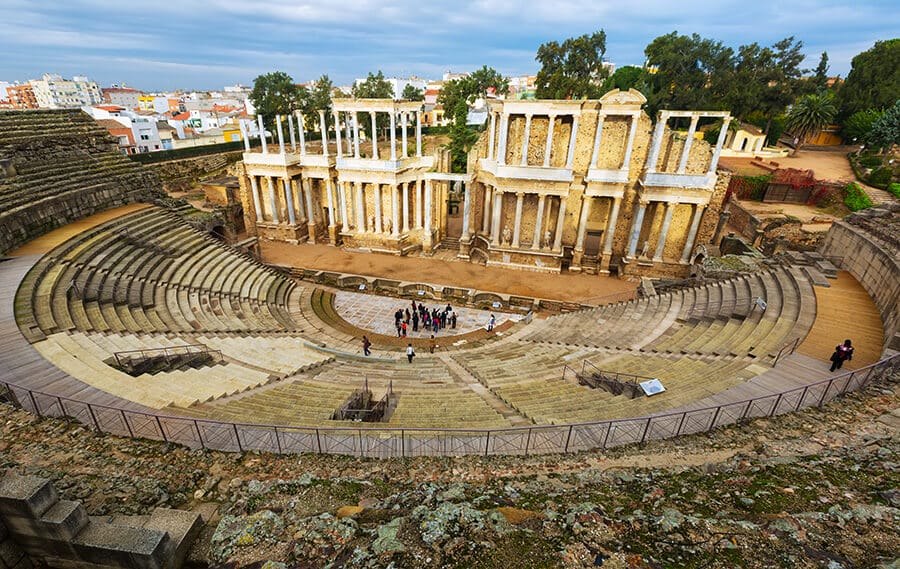
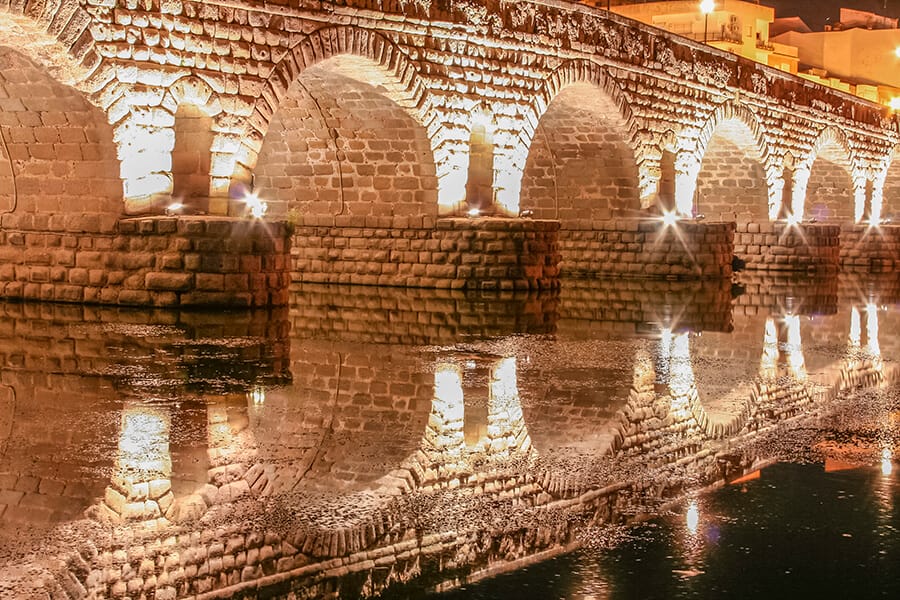
Augustus founded Augusta Emerita in 25 BC for veterans of his wars in northern Spain, and it became the capital of Lusitania, the Roman province that covered most of what is now Portugal. Its theater, built around 16 BC, still stages Greek and Roman plays each July and August in the International Classical Theatre Festival, first staged there in 1933. Your guide links the theater, the amphitheater, the Temple of Diana and the Roman bridge across the Guadiana, among the longest surviving from antiquity, while storks nest on the arches of the Los Milagros aqueduct. The Roman city is a UNESCO World Heritage site.
Cáceres, a walled city built for the camera
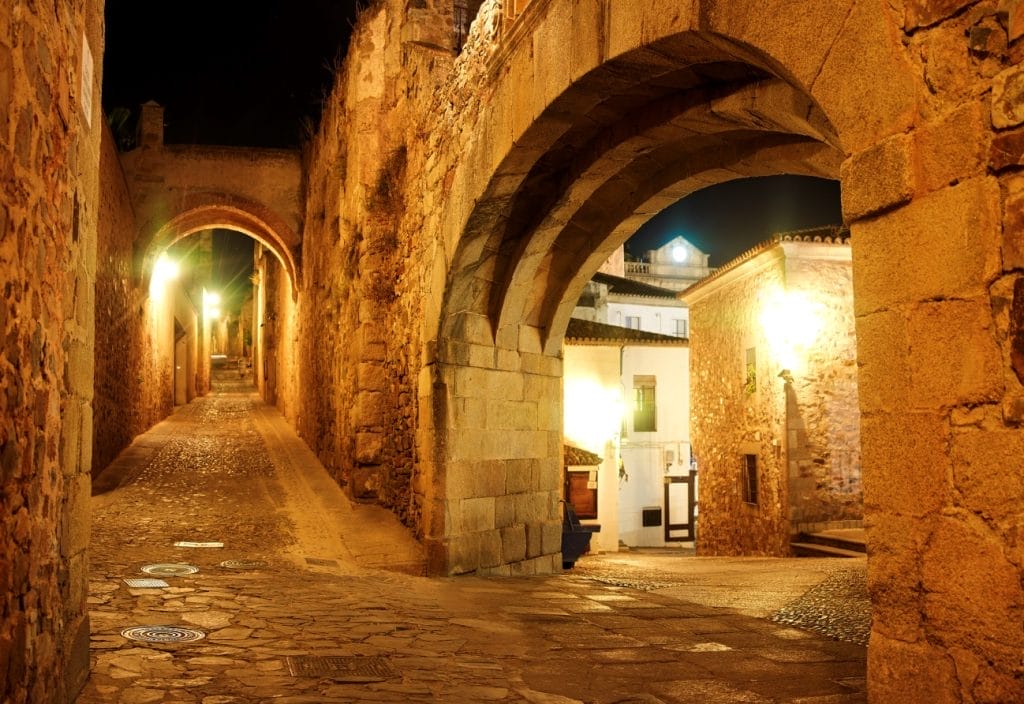
Inside its Almohad walls, the old town of Cáceres keeps Gothic and Renaissance palaces crowned with towers and family crests, and almost nothing modern breaks the skyline. In Game of Thrones it stood in for the streets of King’s Landing, and in House of the Dragon for Flea Bottom. At dusk the stone turns gold under the lights. A few streets away, the Helga de Alvear museum holds one of Europe’s major private collections of contemporary art, more than 3,000 works given to Extremadura by the German-born Madrid gallerist Helga de Alvear.
Trujillo, the conquistadors’ hometown
Francisco Pizarro was born in Trujillo, and the palaces around its Plaza Mayor were built with fortunes brought back from the Americas. His bronze statue in the square is the work of an American sculptor, Charles Cary Rumsey, and its twin stands in Buffalo, New York. Above the town, the Moorish castle served as Casterly Rock in Game of Thrones, with sweeping views across the plains.
Guadalupe, the monastery behind a Caribbean island
Columbus came here on pilgrimage to give thanks after his first voyage, and in 1493 he named the Caribbean island of Guadeloupe after the Virgin of the Royal Monastery of Santa María de Guadalupe. The monastery’s sacristy hangs a series of paintings by Zurbarán in their original setting, and the whole complex is a UNESCO World Heritage site, set in the Villuercas hills about an hour from Trujillo.
Zafra, a stop on the road from Seville
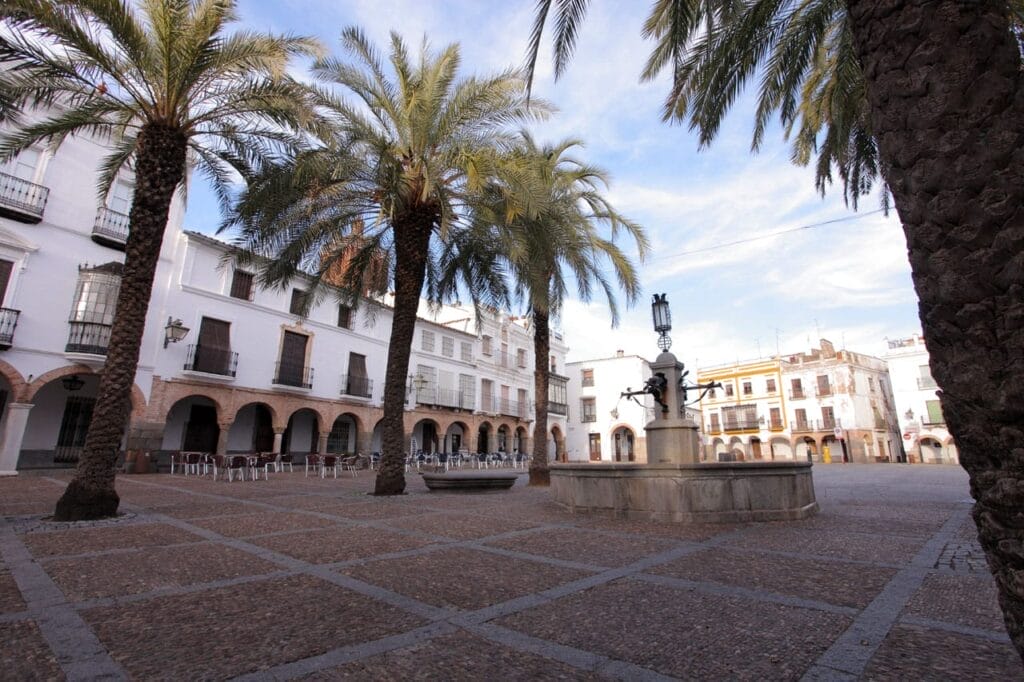
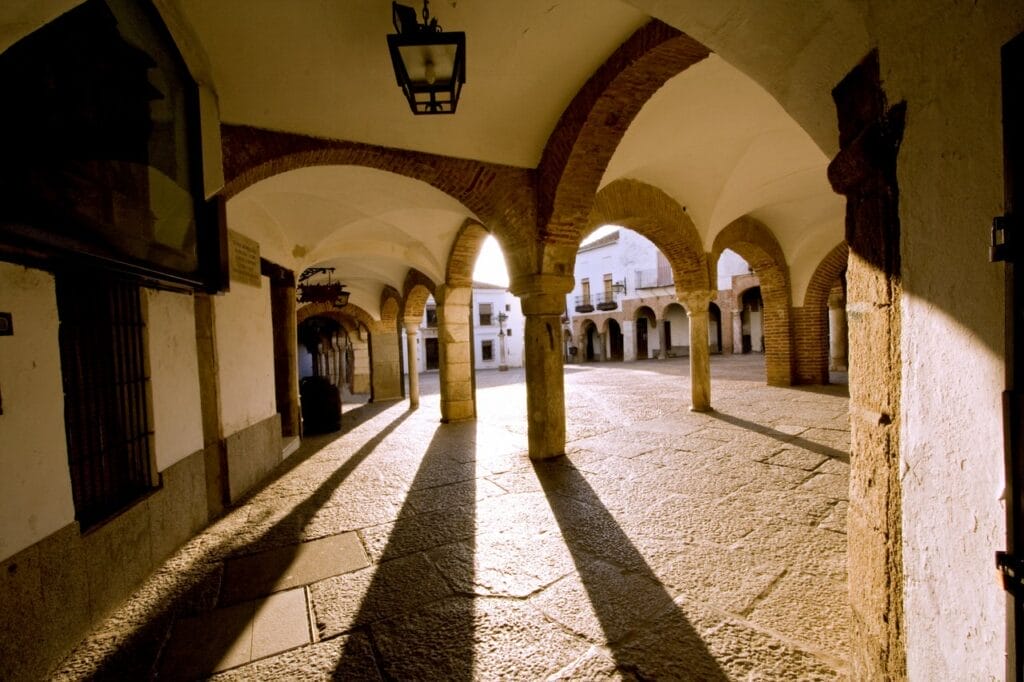
About halfway on the drive north from Seville to Cáceres, Zafra makes an easy stop, and locals still call it Sevilla la Chica, little Seville. The castle-palace built in 1437 by the first Count of Feria, with towers at each corner and a Renaissance courtyard, is now a four-star Parador, and its restaurant serves lunch inside the old walls. A few steps away, the arcaded Plaza Grande, lined with palm trees, opens through the little Arquillo del Pan into the Plaza Chica, where tapas bars and cafés fill the arches. On request, a guide leads a short walk through the old town, or you simply stop for a coffee or a bite before continuing north.

Where do Extremeños eat and drink?
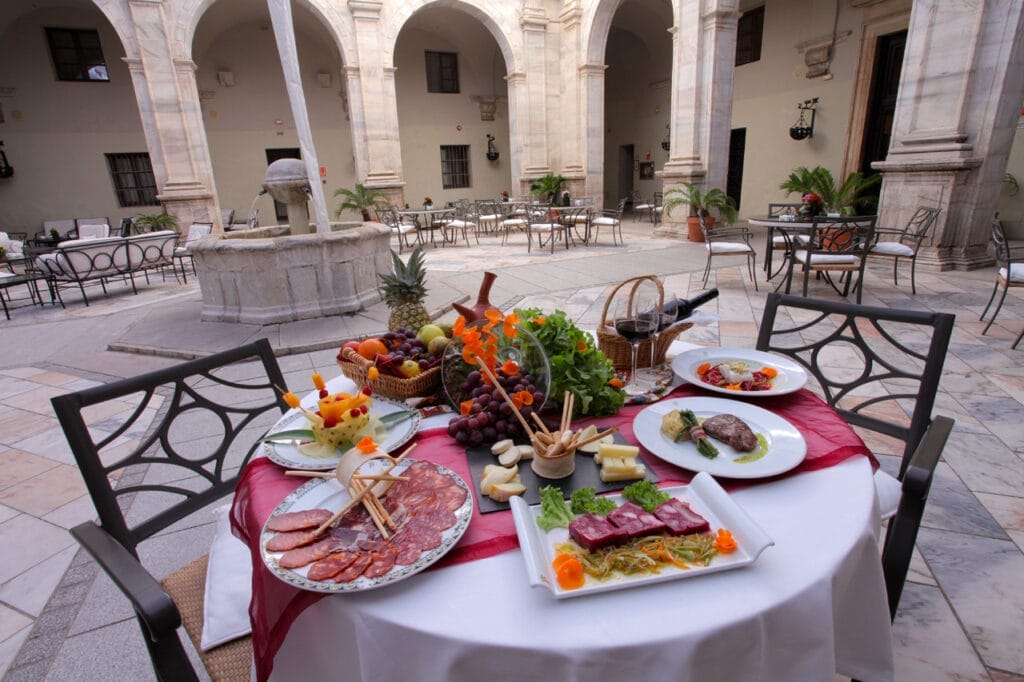
Ham comes first. In the dehesa, the open oak pastures that cover much of the region, ibérico pigs graze freely through the montanera, the acorn season from autumn into late winter, and the best hams cure for three years or more. On request, a family estate opens its dehesa and curing cellars for a private visit and tasting.
In the La Vera valley, peppers dry slowly over oak fires in wooden drying houses before they are ground into pimentón de la Vera, the smoked paprika that colors Spanish cooking. Trujillo hosts a national cheese fair each spring, and on request a cheesemaker in Casar de Cáceres shows how the thistle-curdled Torta is made. For wine, the Ribera del Guadiana vineyards around Almendralejo make full reds, and a private tasting at a family winery is easy to add.
In Cáceres, Atrio holds three Michelin stars, one of only 16 restaurants in Spain with the highest rating, and its cellar of more than 40,000 bottles ranks among the largest in Spain.
What are the best hotels in Extremadura?
The finest is Atrio Restaurante Hotel, a Relais & Châteaux hotel inside the walls of old Cáceres, where you sleep upstairs from its three-Michelin-star dining room. For a four-star stay a few lanes away, the Parador de Cáceres occupies two Gothic noble houses in the same walled old town. From a base in Cáceres, Trujillo is about 40 minutes away and Mérida under an hour, so one hotel covers the region.
How many days should you spend in Extremadura?
Two or three nights. Two cover Cáceres, Trujillo and Mérida at an easy pace from a base in Cáceres. A third adds the Guadalupe monastery, a day of birdwatching and light hiking in Monfragüe, or a private visit to a ham estate in the dehesa.

When is the best time to visit Extremadura?
March to early June and late September to November bring mild days and green or golden pastures. In late March or early April, more than a million cherry trees flower in the Jerte valley in the north. July and August are hot, with highs in the mid to upper 90s°F, though summer evenings at the classical theater festival in Mérida make the heat worth it. The acorn season starts in autumn, when the dehesa is at its most beautiful. Hotels, like airlines, use dynamic pricing, so rates rise with demand. A higher price marks a popular week, not a poor time to travel.
Where can you hike in Extremadura?
Monfragüe National Park, about half an hour south of Plasencia, has one of Europe’s largest colonies of black vultures, and griffon vultures circle at eye level from the rock of the Salto del Gitano above the Tagus. We know the light hiking trails with the finest views, from the ruined castle above Monfragüe to the Garganta de los Infiernos, a gorge of natural rock pools in the Jerte valley.
How does Extremadura fit a journey through Spain and Portugal?
Extremadura sits on the natural road between Madrid and Lisbon. Trujillo is about two and a half hours from Madrid by road, Cáceres half an hour beyond it, and Mérida under an hour to the south. From Mérida, Seville is about two hours, and the Portuguese border is under an hour, with Évora and the Alentejo about an hour and a half away. Your licensed driver handles every leg, which makes Extremadura an elegant bridge for travelers pairing Spain and Portugal on one private journey.
Private Extremadura Journeys

Multi-Country
14-Day Private Spain and Portugal Tour: A First Visit from Madrid to Porto
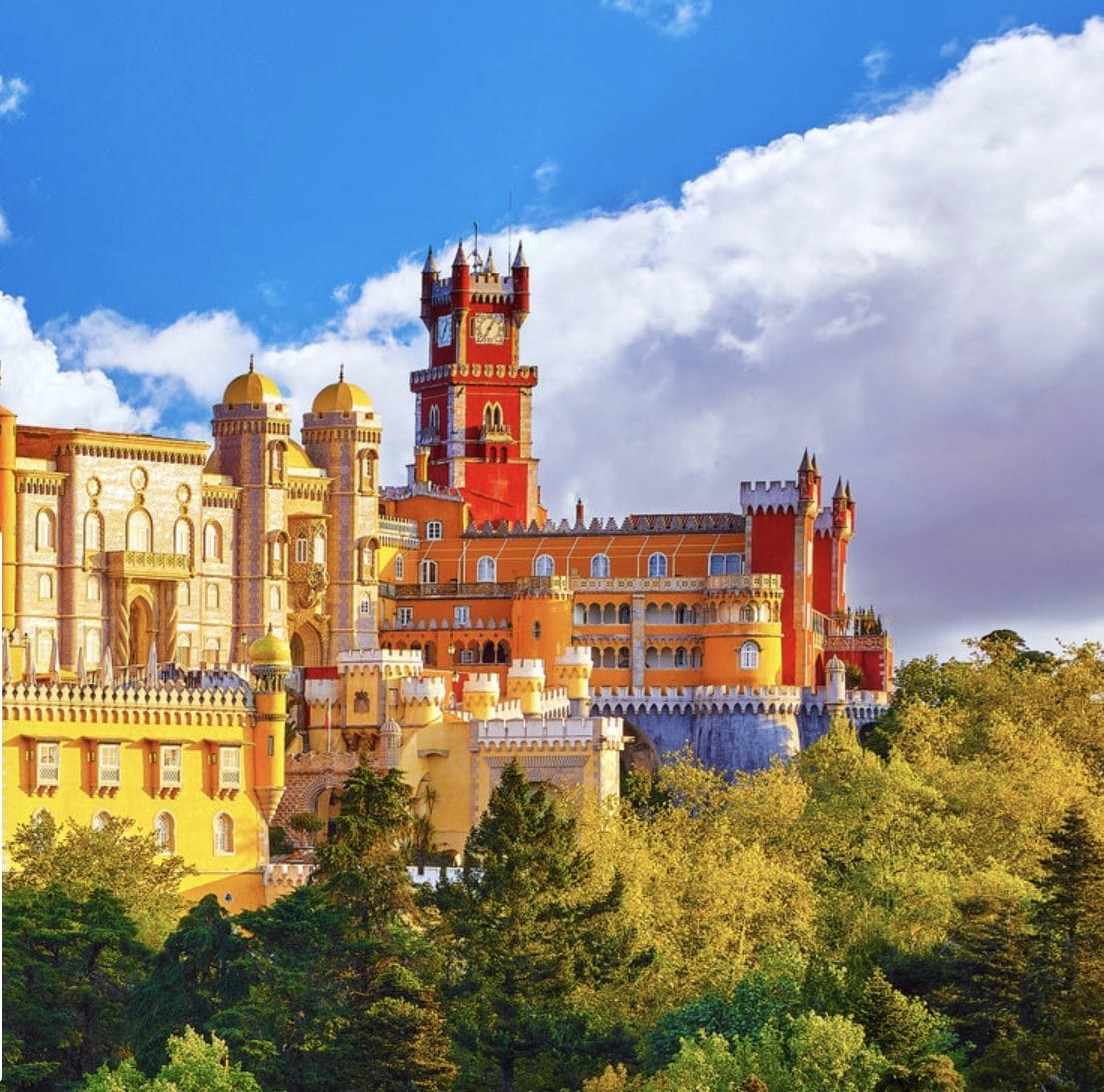
Madrid, Toledo, the Alhambra, Seville, Lisbon, Sintra, Porto and the Douro on a first visit. 14 days from $13,972 pp.
Multi-Country
Barcelona to Lisbon Private Tour: 14 Days by Rail and Road Through Spain and Portugal
Barcelona to Lisbon by train and road via Madrid, the Alhambra, Seville and the Algarve. 14 days from $14,892 pp.

Multi-Country
Spain and Portugal Jewish Heritage Tour: 14 Private Days from Barcelona to Porto
Sephardic Iberia from Girona’s Call to Porto, via Toledo, Córdoba, Lisbon and Tomar. 14 days from $15,446 pp.
Swipe to see all three journeys
How do you want Extremadura to feel?
Our sample trips are a starting point. Tell us your dates and what you love. Your first itinerary carries no planning fee and no obligation, and you’ll hear back within one business day.
Start planningWhat do our travelers say about Spain and Portugal?
Frequently asked questions about private Extremadura tours
What are the top attractions in Extremadura?
The Roman theater, amphitheater and bridge of Mérida, the walled old town of Cáceres, Trujillo’s Plaza Mayor and castle, the Royal Monastery of Guadalupe and Monfragüe National Park.
What are the best off-the-beaten-path experiences in Extremadura?
A private visit to a ham estate in the dehesa, a Torta del Casar tasting with the cheesemaker, an evening play in Mérida’s Roman theater in summer, light hiking in Monfragüe and the cherry blossom in the Jerte valley.
What do most people not know about Extremadura?
Mérida was the capital of Lusitania, the Roman province that covered most of present-day Portugal. Trujillo’s statue of Pizarro has a twin in Buffalo, New York. And the Caribbean island of Guadeloupe takes its name from a monastery in the Extremadura hills.
Why take a private tour of Extremadura?
Extremadura rewards travelers who know where to go. Our licensed guides open its Roman and medieval towns at an easy pace, our local contacts open the ham estates and cheese dairies, and your licensed driver covers the open roads between them.
Can a private Extremadura tour include Seville or Lisbon?
Yes. Every journey is tailor-made, so Extremadura fits between Madrid and Seville, or between Madrid and Lisbon on a journey through Spain and Portugal.
Plan your private Extremadura journey
Our sample journeys are a starting point, and each can be routed through Extremadura. The 14-Day Private Spain and Portugal Tour travels from Madrid to Porto from $13,972 per person. The Barcelona to Lisbon Private Tour runs 14 days by rail and road from $14,892. The Spain and Portugal Jewish Heritage Tour travels 14 private days from Barcelona to Porto from $15,446. Each is tailor-made, so your planner shapes the route, the hotels and the pace around you.
Since 2002, nearly 17,000 travelers have journeyed with us. Your journey is planned by our Spain team, led by founder Dan O’Beirne, an American in Europe since 1998, and Magical Private Travel maintains excellent ratings on Trustpilot and Google’s independent review platforms. Planned from Europe. American precision with local expertise.
More answers on our FAQ page. Explore more of private Spain journeys.
Ready when you are. Your first itinerary carries no planning fee and no obligation.
Start planning