


Spain · Private and tailor-made
Northern Spain at the Table
Taste Ribera del Duero with the Rodero family at the bodega Carmelo Rodero founded in 1991.
Suggested length
10 days
Price guide
From $12,484 per person, excl. flights, based on two sharing
Includes hotels, private guiding, experiences and transfers
When
April to June and September to October
or call +1 (727) 699-5439
A planner replies within one business day
American precision with local expertise · Planned from Europe since 2002 · Nearly 17,000 American travelers · Never cancelled a journey
Velázquez and Goya fill the first afternoon, when, where your dates allow, Ana, an art historian, walks you through their rooms at the Prado. From Madrid and Toledo, this private food and wine tour of Northern Spain heads to Bilbao for the Guggenheim and on to the old town of San Sebastián. You walk the terraced salt pans of the Valle Salado, then go underground into the wine cellars beneath walled Laguardia. In Ribera del Duero you taste with the Rodero family at the bodega Carmelo Rodero founded in 1991. Aranda de Duero serves lechazo, milk-fed lamb roasted in a wood-fired oven, and Segovia’s Roman aqueduct closes the loop. Change any day, and you pay only for what suits you.
Taste a gilda and a glass of txakoli poured from a height in the Parte Vieja, San Sebastián.
Walk the Prado’s Velázquez and Goya rooms with Ana, an art historian, Madrid.
Walk the terraced salt pans of the Valle Salado, Añana.
Visit an underground wine cellar beneath the walled town of Laguardia, Rioja Alavesa.
Taste lechazo, milk-fed lamb roasted in a wood-fired oven, Aranda de Duero.
Taste cochinillo asado, carved at the table with the edge of a plate, Segovia.

“We love to tailor-make trips you’ll talk about for years, built on our local relationships & story-worthy experiences.” – Magical’s American founder, in Europe since 1998, culinary enthusiast & world traveler.






A Journey Designed Just for You
Our resident experts wrote this itinerary as a starting point, and your planner shapes every day around your interests, pace and travel style.
What do our American travelers say?
The 10-day Northern Spain food and wine itinerary at a glance
The route uses four bases and nine nights: two in Madrid, three in Bilbao, one in Laguardia, two in Ribera del Duero near Peñafiel, and a final night back in Madrid. Bilbao gets three nights because San Sebastián, the txakoli valleys of Álava and the Añana salt valley all sit within easy reach of it as day trips, so you unpack once for the whole Basque section.
One flight and a chain of short drives link the bases. A direct flight carries you from Madrid to Bilbao in about 1 hour 10 minutes, against about 4 hours by road. From Bilbao a licensed driver takes the road south to Laguardia, about 1 hour 30 minutes, then across the meseta to Peñafiel, about 2 hours 30 minutes, then over to Segovia, about 1 hour 10 minutes, and on to Madrid, about 1 hour 30 minutes. Day seven, from Laguardia to Peñafiel, is the longest drive of the trip and includes a lunch stop.
April to June and September to October suit the route best. AEMET’s 1981 to 2010 averages give Bilbao airport a mean daily high of 23.4°C (about 74°F) in June and 24.6°C (about 76°F) in September, and Valladolid, the nearest major station to Peñafiel, 27.0°C (about 81°F) in June and 25.6°C (about 78°F) in September. Madrid averages 28.2°C (about 83°F) in June against 32.1°C (about 90°F) in July. October brings the Rioja grape harvest.
Licensed guides we work with on this route include Ana and Alicia in Madrid, Melanie in Toledo, Miriam in Bilbao, Rosa in San Sebastián, Vanesa in La Rioja, and Leticia in Segovia. Each is a highly educated local expert who cares about the people in their group. We request your guides by name, and your planner confirms who leads each day once your dates are set.
Why the route runs from Madrid to the Basque coast and back through wine country
The menu changes with the ground, so the route follows it from the Atlantic down to the high plateau. It starts with salt cod, anchovies and txakoli on the Basque coast, moves to Rioja and lamb chops grilled over vine shoots in the Ebro valley, climbs to Tinto Fino and wood-roasted lamb on the Duero, and ends with Segovia’s suckling pig on the way back to Madrid. Our article on a private Northern Spain wine trip with Rioja gives more background on the region.
Flying north first replaces a drive of about 4 hours with a flight of about 1 hour 10 minutes, and driving south lets every wine region fall on the way home rather than on a detour. The return through Segovia keeps the last full day short on the road and closes the loop in Madrid, so you fly in and out of the same airport. The route as written is a starting point, and it sits with our other private journeys in Spain.
Journey at a glance
Length
10 days
From
$12,484 per person, double occupancy
Route
Madrid to Bilbao, San Sebastián, Rioja, Ribera del Duero, and Segovia.
Your planner adjusts every day to your dates.

Day One
Madrid Arrival and the Prado
Your licensed driver meets you at Madrid-Barajas airport, about 13 kilometers northeast of Puerta del Sol, and brings you to a hotel in the historic center. The Prado opened to the public in November 1819, in a building Juan de Villanueva designed for Charles III. In the afternoon, where your dates allow, Ana, an art historian, leads a focused visit through Velázquez's Las Meninas and Goya's Black Paintings. In the evening the walk passes the Royal Palace, with its 3,418 rooms and its role in state ceremonies, on the way to Plaza Mayor, completed in 1619, where 237 balconies look down on the arcades. Nearby, the iron-framed Mercado de San Miguel, opened in 1916, lines its counters with cured ham, cheese and vermouth on tap. Logistics: Madrid-Barajas airport to central Madrid by road with your licensed driver, then the Prado and an evening walk on foot.

Day Two
Toledo, Marzipan and Three Cultures
Toledo sits on a steep rock above a bend of the Tagus River, about 70 kilometers by road from Madrid, and UNESCO inscribed the historic city in 1986 for its centuries of Christian, Jewish and Muslim coexistence. Your licensed guide leads the day. Work on the cathedral began in 1226, and its sacristy holds fifteen paintings by El Greco, among them El Expolio. Samuel ha-Levi built the Synagogue of El Tránsito around 1357, and today it houses the Sephardic Museum. The Convent of San Clemente, founded in the 13th century, keeps a small marzipan museum, and local tradition places the sweet's origin inside its walls. Mazapán de Toledo carries a protected geographical indication from the European Union, and the smell of toasted almonds drifts out of the old town's pastry shops. Where it suits your party, our team reserves a table for a long Castilian lunch before the drive back. Logistics: Madrid to Toledo by road, about 1 hour each way, licensed driver, with a licensed guide for the day in Toledo.
Day Three
North to Bilbao: the Guggenheim and the Seven Streets
King Juan Carlos I opened the Guggenheim Museum Bilbao on 18 October 1997, and Frank Gehry's building, clad in titanium plates laid like scales, follows the Nervión estuary. Your licensed guide starts with Jeff Koons's Puppy at the entrance and Richard Serra's The Matter of Time, the weathering steel sculptures of the museum's only permanent exhibit. Across the river, the Casco Viejo grew from the town Diego López de Haro chartered in 1300 into the Seven Streets, Zazpikaleak in Basque. The Mercado de la Ribera, opened in 1929 on the riverbank beside the old town, sells Idiazabal, the Basque sheep's milk cheese, sometimes smoked. In the evening your guide leads a first round of pintxos through the old town bars, often with bacalao al pil-pil, salt cod in a garlic and olive oil sauce the cook emulsifies by keeping the pan moving. Logistics: Madrid to Bilbao by direct flight, about 1 hour 10 minutes, and a licensed driver meets you at Bilbao airport, about 9 kilometers north of the city.
Day Four
San Sebastián: Pintxos, Txakoli and the Bay
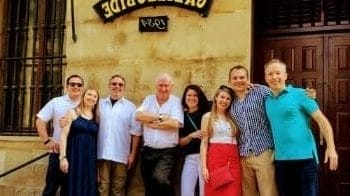
British and Portuguese troops burned San Sebastián in 1813, and most buildings in the Parte Vieja date from the rebuilding afterward. Your licensed guide walks you along La Concha to the far end of Ondarreta beach, where Eduardo Chillida's Comb of the Wind, three steel sculptures of about 10 tons each, grips the rocks as the Atlantic breaks below. Back in the old town, the bar counters fill with pintxos. Local tradition traces the gilda, an anchovy, a green olive and a pickled guindilla pepper on one skewer, to a San Sebastián bar in the 1940s, and the name nods to Rita Hayworth's film Gilda. Txakoli, a dry, lightly sparkling white wine, pours from a height into tall glasses, and the Getaria version gained its denominación de origen in 1989. Where it suits your party, the afternoon holds a Basque cooking class, or a lunch as a member's guest in a txoko, one of the private gastronomic societies the city first recorded in 1870. Logistics: Bilbao to San Sebastián by road, a little over 1 hour each way, licensed driver, with a licensed guide in San Sebastián.

Day Five
Txakoli Country, the Salt Valley and Orduña
Txakoli vines grow inland too. Arabako Txakolina, the youngest of the three Basque txakoli denominations, gained its status in 2001 and covers some 55 hectares of vines around Aiara, Amurrio, Artziniega, Laudio and Okondo. Where it suits your party, your licensed guide arranges a visit and tasting at a family winery in the valley. Farther south, the Valle Salado de Añana has produced salt without interruption for about 7,500 years, by the site's own count. Brine rises from springs at the top of the valley and runs downhill through channels to thousands of terraced salt pans, and the FAO named the valley a Globally Important Agricultural Heritage System in 2017. On a clear day the pans shine white against the green hillside. The day ends in Orduña, an exclave of Biscay between Álava and Burgos in the upper Nervión valley. Logistics: a loop by road from Bilbao with your licensed driver and licensed guide, with Bilbao to Añana about 50 minutes on the direct road.
Day Six
Laguardia and the Wines of Rioja Alavesa
Rioja became Spain's first denominación de origen calificada in 1991, and the region divides into three zones: Rioja Alta, Rioja Oriental and Rioja Alavesa. Rioja Alavesa lies between the Sierra de Cantabria and the Ebro River, with some 11,500 hectares of vineyards. Laguardia, its capital, received its founding privileges from Sancho VI of Navarre in 1164 and still sits inside its walls. The Rioja wine council counts more than 230 underground cellars beneath its houses and streets, and the air turns cool and damp as you walk down the steps. The church of Santa María de los Reyes keeps a late 14th-century portico with its 17th-century color intact. Where it suits your party, your licensed guide arranges visits to two contrasting wineries, one of them small and family run. Lunch brings chuletillas al sarmiento, lamb chops grilled over burning vine shoots, or patatas a la riojana with chorizo and peppers. Logistics: Bilbao to Laguardia by road, about 1 hour 30 minutes, licensed driver, with a licensed guide in Laguardia.

Day Seven
Across the Meseta to Peñafiel
Day seven is the longest road day, about two and a half hours south from Laguardia to Peñafiel, with a lunch stop on the way. Ribera del Duero gained its denominación de origen on 21 July 1982, and its vineyards climb from about 750 to 911 meters above sea level across Burgos, Valladolid, Segovia and Soria. Tinto Fino, the local name for Tempranillo, leads the reds. In Peñafiel the castle runs more than 200 meters along a narrow ridge above the town and measures only about 35 meters across. Inside, the Museo Provincial del Vino traces the wine culture of Ribera del Duero, from soils and grape varieties to cooperage and basket weaving, and where it suits your party a guided tasting follows. Below the castle, 48 buildings with wooden balconies from the 18th and 19th centuries frame the Plaza del Coso, a square on record since the Middle Ages. Logistics: Laguardia to Peñafiel by road, about 2 hours 30 minutes, licensed driver, with a licensed guide in Peñafiel.

Day Eight
Aranda de Duero: Underground Cellars and Roast Lamb
Aranda de Duero sits at the center of the Ribera del Duero wine region, and a network of medieval cellars runs about 8 kilometers beneath its old town, dug roughly 7 to 10 meters underground. Your licensed guide leads you down into one of them, where the stone walls smell of earth and old wine. At lunch the town's asadores serve lechazo, milk-fed lamb no more than 35 days old, roasted in a wood-fired oven. The afternoon turns to the vineyards around Peñafiel and Roa de Duero, home to the region's best-known vines, with a winery visit and tasting where it suits your party. Logistics: Peñafiel to Aranda de Duero by road, about 35 minutes each way, licensed driver, with a licensed guide in Aranda.
Day Nine
Segovia's Aqueduct and Cochinillo, then Madrid
Segovia's Roman aqueduct carries 167 arches of unmortared granite blocks and reaches 28.5 meters at its tallest above the Plaza del Azoguejo. UNESCO inscribed it with the old town in 1985. Your licensed guide walks you up through the old town to the cathedral, where work began in 1525, and on to the Alcázar. Lunch is cochinillo asado, suckling pig roasted in a wood-fired brick oven, and in Segovia's traditional dining rooms the carver cuts through the crackling skin with the edge of a plate to show its tenderness. In the afternoon the road passes the Guadarrama Mountains on the way to Madrid for the final night. Where it suits your party, our team reserves a dinner table with a flamenco performance, an art UNESCO added to its intangible heritage list in 2010. Logistics: Peñafiel to Segovia by road, about 1 hour 10 minutes, then Segovia to Madrid, about 1 hour 30 minutes, licensed driver, with a licensed guide in Segovia.
Day Ten
Departure from Madrid
Madrid-Barajas lies about 13 kilometers northeast of Puerta del Sol, so a midday flight leaves the morning free for a last coffee and churros in the old center. Our team arranges VIP airport assistance on request. Travelers who want more time often add Barcelona, Andalusia or Portugal's Douro Valley, and our team plans those extensions on the same private basis. Logistics: hotel to Madrid-Barajas airport by road with your licensed driver, with VIP assistance by prior arrangement.
What does a 10-day food and wine tour of Northern Spain include?
A 10-day food and wine tour of Northern Spain covers the Basque Country, Rioja Alavesa and Ribera del Duero, with Madrid at each end. This route gives the Basque Country three nights in Bilbao, with San Sebastián’s pintxo bars, the txakoli country of Álava and the Añana salt valley as day trips. It gives Rioja a night inside the walls of Laguardia, Ribera del Duero two nights near Peñafiel with Aranda de Duero’s underground cellars, and Madrid three nights in all. The dishes follow the ground: gildas and bacalao al pil-pil on the coast, chuletillas al sarmiento in Rioja, lechazo on the Duero and cochinillo in Segovia. Every winery visit, tasting and cooking class on the route is an option you choose. Our guide to tapas in Spain explains how the bar culture works before you arrive.
Rioja or Ribera del Duero: which wine region should you visit?
Visit both, because this route spends a day in each and the contrast is the reason to go. Rioja, Spain’s first denominación de origen calificada since 1991, ages its reds under rules it names crianza, reserva and gran reserva. A crianza spends at least two years in oak and bottle, one of them in barrel, and a gran reserva at least 24 months in barrel and 36 in bottle. Rioja Alavesa’s vineyards sit between the Sierra de Cantabria and the Ebro. Ribera del Duero, a denominación since 1982, grows Tinto Fino, its own name for Tempranillo, on a high plateau between about 750 and 911 meters. The same grape leads in both regions, so a tasting in each shows how altitude and soil change the wine. Our guide to luxury wine tours in Spain covers other regions worth a visit.
How many days do you need for the Basque Country and Rioja?
Five days covers the Basque Country and Rioja at a steady pace, with three nights in Bilbao for San Sebastián and the Álava valleys, then a night in Laguardia. This route adds two nights in Madrid at the start, two in Ribera del Duero and a last night in Madrid to reach ten days. A traveler with a week who prefers the coast to Castile spends it well on the Basque Country and Rioja alone, with two nights in Laguardia instead of one. With three or four days, San Sebastián and a single Rioja day hold the essentials.
This 10-day route, or a longer Spain journey or a Portugal food and wine trip?
Choose this route if food and wine matter more to you than the classic monuments of the south. It trades the Alhambra and Seville for pintxo bars, cellars and wood-fired ovens, and keeps Madrid, the Prado and Toledo as the cultural anchor. First-time visitors who want Andalusia and Barcelona get more from the 10-day Highlights of Spain journey, which covers Madrid, Seville, Granada and Barcelona in the same number of days.
With three weeks, the 22-day Spain private tour combines the Basque food culture of Bilbao and San Sebastián and the Rioja wine country with Madrid, Toledo, Segovia, Andalusia, the Mediterranean coast and Barcelona, at the cost of fewer nights in the north. If port and the Douro appeal more than Rioja, the 9-day Portugal food and wine journey runs through Porto, the Douro Valley, Braga, Guimarães, Lisbon and Sintra, with a cooking class in Porto. Every Spain route starts from our Spain destination page, and our team adjusts any of them to your dates.
Who this journey suits
Couples who plan trips around tables and wine lists, and who want a guide to open the right bar doors.
Returning visitors who already know Madrid, Seville and Barcelona and now want the Basque Country and the wine regions of the north.
Friends traveling together as a private party, where one wants the Guggenheim, another the cellars, and the driver keeps the whole day on one plan.
Wine collectors and serious amateurs who want Rioja and Ribera del Duero side by side, with tastings chosen around the styles they already drink.
Families with adult children who cook, where a Basque cooking class or a market morning gives the trip a shared project.
The people behind the route
Our team selects guides as much for how they read a table as for what they know. In Madrid, where your dates allow, Ana, an art historian, leads our Prado visits. On the arrival afternoon she builds a shorter visit around the painters your party cares about, often Velázquez and Goya, so the first day still ends with an evening walk and a first glass of wine. Our guide to highlights of the Prado gives a sense of the collection before you go.
What the 10-day journey costs and what it includes
The 10-day route starts from $12,484 per person, double occupancy. The from-price covers nine nights in deluxe four-star properties selected for comfort, location and service. Five-star luxury properties are available by request. It includes licensed guides for the visits described and a licensed driver for airport and road transfers.
Four things move the price: the season, the hotel category, the size of your private party, and the optional experiences you choose, such as winery visits in Rioja Alavesa and Ribera del Duero, a Basque cooking class, a txoko lunch or a tasting menu. Magical Private Travel maintains excellent ratings on Trustpilot and Google’s independent review platforms.
To shape this route around your dates and your table, speak with our team about your Northern Spain food and wine journey.
Frequently asked questions about the Northern Spain food and wine tour
How much does a 10-day food and wine tour of Northern Spain cost?
This 10-day route starts from $12,484 per person, based on two people sharing a room. The from-price covers the route as written: nine hotel nights, licensed guides for the visits described and a licensed driver for every road transfer, with the full list of inclusions set out in your written quote. Four things move the price. The season matters most, since hotel rates in San Sebastián and the wine country rise and fall through the year. Five-star hotels raise it. Party size changes it, because the guide and driver serve the whole party, so larger private parties pay less per person. Optional experiences add to it, such as winery visits in Rioja and Ribera del Duero, a Basque cooking class in San Sebastián or a tasting menu in Bilbao. Our team sends a written quote for your dates and party before you commit.
When is the best time for a food and wine trip to Northern Spain?
April to June and September to October suit this route best. AEMET’s 1981 to 2010 averages give Bilbao airport a mean daily high of 17.6°C (about 64°F) in April, 24.6°C (about 76°F) in September and 21.4°C (about 71°F) in October. Valladolid, the nearest major station to Peñafiel, averages 16.9°C (about 62°F) in April and 25.6°C (about 78°F) in September, and Madrid 18.2°C (about 65°F) in April and 26.4°C (about 80°F) in September, against 32.1°C (about 90°F) in July. October brings the Rioja grape harvest, when the vineyards around Laguardia turn from green to gold. The Basque coast is the wetter end of the route: AEMET records about 111 millimeters of rain at Bilbao airport in October against 60 in Madrid, so your guide keeps an indoor pintxo route and the Guggenheim ready for a wet afternoon. Winter departures suit wood-roasted lamb and suckling pig, with shorter days in the vineyards.
Are the winery visits, tastings and cooking classes included?
Each one is an option you choose, never a fixed part of the route. Our team builds the food and wine days around your party: one couple wants two winery visits in Rioja Alavesa and a long lunch, another prefers a single cellar in Laguardia and a free afternoon. The options on this route include a family winery in the Arabako Txakolina area of Álava, two contrasting wineries in Rioja Alavesa, a tasting at the wine museum in Peñafiel castle, an underground cellar in Aranda de Duero, a Basque cooking class in San Sebastián and, where available, a lunch as a member’s guest in a txoko. Your planner prices each one separately, so the quote shows exactly what you have chosen. The guided walks, the pintxo evenings with your guide and the museum visits form the frame of each day.
Do we need to drink wine to enjoy this route?
No. The route runs on food as much as on wine, and the days hold the Prado, Toledo, the Guggenheim, the Añana salt valley, Peñafiel castle and Segovia’s aqueduct. Non-drinkers in a party often enjoy the market visits, the pintxo bars, the cooking class and the long Castilian lunches as much as anyone. Our team replaces a winery visit with a cheese or olive oil tasting, a walk in the vineyards or a longer museum visit on request. Our page on alcohol-free luxury travel in Spain sets out how our team plans for American travelers who prefer not to drink.
How do you travel between Madrid, Bilbao, Rioja and Ribera del Duero?
One flight and a chain of short drives cover the whole route. A direct flight links Madrid to Bilbao in about 1 hour 10 minutes, and a licensed driver meets you at Bilbao airport, about 9 kilometers north of the city. From then on the route runs by road with your licensed driver: Bilbao to Laguardia about 1 hour 30 minutes, Laguardia to Peñafiel about 2 hours 30 minutes, Peñafiel to Segovia about 1 hour 10 minutes and Segovia to Madrid about 1 hour 30 minutes. The San Sebastián day runs a little over an hour each way, and Aranda de Duero sits about 35 minutes from Peñafiel. Luggage stays in the vehicle, so the road days carry stops for lunch and a view rather than station changes.
Are the guide and the driver the same person?
In Spain they are two different people. A licensed guide leads the visits, and a licensed driver handles the vehicle and the road transfers. Your licensed guide changes from region to region, so the guide in San Sebastián knows its bars and the guide in Laguardia knows its cellars and wineries. The driver stays with you on the road days, such as the drive from Bilbao to Laguardia and across the meseta to Peñafiel, and meets you at the airport when you arrive. The split lets your guide focus on the place and your driver focus on the road, and a driver on a wine route means nobody in your party needs to think about the drive home after a tasting. Where your dates allow, Ana, an art historian, leads the Prado visit in Madrid.
Does the route include Michelin-starred restaurants?
The from-price covers the route, not restaurant bills, but our team reserves tables at Michelin-starred restaurants in San Sebastián, Bilbao and the wine country on request. The best-known tasting menus book out well ahead, so our team asks about them at the start of planning. Many travelers choose one long tasting menu on the trip and spend the other evenings in pintxo bars, asadores and family restaurants, where the cooking is closer to the everyday food of the region. Our article on a Michelin-starred restaurant in Bilbao describes one such evening. Your planner times each booking around the road days, so a long lunch never lands before a long drive.
Which airport should we fly into and out of?
Fly into and home from Madrid-Barajas. The route makes a loop, so the same airport works at both ends, and Madrid-Barajas lies about 13 kilometers northeast of Puerta del Sol. Your licensed driver meets you at arrivals on day one and takes you back to the airport on day ten. The Madrid to Bilbao flight on day three runs about 1 hour 10 minutes, and our team aligns the itinerary with its timing once you settle your dates. Our team arranges VIP airport assistance at Barajas on request, covering meet-and-greet and help through the terminal. Our article on arriving at Madrid-Barajas airport explains what to expect on landing.
Does the route suit families or travelers with limited mobility?
Families with teenage or adult children travel this route well, especially when someone in the party cooks, because the cooking class, the markets and the pintxo evenings give everyone a part to play. Several days involve walking on cobbled streets and slopes, especially in Toledo, the old towns of Bilbao and San Sebastián, Laguardia and Segovia. The underground cellars in Laguardia and Aranda de Duero involve steep stone steps, and the Añana salt valley runs across terraces on a hillside. Your guide is glad to advise on suitability before booking, and our team adjusts walking routes, adds vehicle time between sites, or swaps a cellar visit for a winery with level access where it helps. Our page on accessible travel in Spain sets out how our team plans for travelers who need step-free routes or extra support.
How flexible is the route, and does it extend to Portugal or Barcelona?
The route works as a starting point, and your planner shapes it around your party. Common changes include a second night in Laguardia for a slower Rioja day, a night in San Sebastián instead of a day trip, or a night in Segovia before Madrid. From Bilbao, a direct flight links the Basque Country to Barcelona, and from the Duero the road continues west into Portugal, where the river becomes the Douro and the Douro Valley port country begins. In Portugal outside Lisbon and Sintra, a licensed driver-guide looks after you, one person holding both licenses. Our multi-country journeys page collects the combinations, and your planner prices any extension alongside the Spain route so you see the full cost at once.
We keep a list of vetted four- and five-star hotels, well located and enjoyed by our past travelers and by our own team.
Examples for each overnight stop on this route. Choose a deluxe boutique hotel or a five-star stay, and your travel advisor matches each night to your wishes, the season and availability.
Madrid
Boutique: Tótem Madrid. A restored 19th-century building on Calle Hermosilla, steps from Serrano’s shops in the Salamanca district.
Five-star: Rosewood Villa Magna. Reopened by Rosewood in 2021 on the Paseo de la Castellana, with a leafy front garden.
Bilbao
Boutique: Hotel Miró. Fashion designer Antonio Miró’s hotel on Alameda Mazarredo, across from the Guggenheim.
Five-star: The Artist Grand Hotel of Art. Directly opposite the Guggenheim, with Javier Mariscal interiors and a large art-filled atrium.
La Rioja
Boutique: Hotel Viura. Stacked concrete cubes beside the village church in Villabuena de Álava, with a rooftop terrace.
Five-star: Hotel Marqués de Riscal. Frank Gehry’s titanium ribbons over the Marqués de Riscal winery in Elciego.
Ribera del Duero
Boutique: AF Pesquera. A 1922 flour mill in Peñafiel turned hotel, below the castle that houses the provincial wine museum.
Five-star: Abadía Retuerta LeDomaine. A 12th-century monastery on its own Duero wine estate, with rooms in the monks’ old guesthouse.
What's Included
A Very Personalized Itinerary, Just For You and Your Schedule
Hand-Picked Ultra-Luxury & Boutique Hotel Options
Insider Experiences + Inspiring Sightseeing + Magical Upgrades
Private Touring with Your Own Personal Expert Guide
Private Airport & Train Station Luxury Transfers
Full Breakfasts + Food & Wine Tasting Options
Your Choice of Activities on “Design Your Days”®
Expert Advice, Restaurant Ideas & Reservations
24/7 Support & Concierge Service from Spain, Portugal & Morocco
Magical is an award-winning luxury travel agency
Private journeys with soul & stories
Excellent independent reviews
Only five journeys per country, per week
Hidden gems, insider fun & vetted hotels
Your private guide, deluxe vehicle & flexible pace
24/7 concierge-style support
We handle everything — you live the dream
American Precision, Local Soul
Our Unforgettable Trips Are Tailored Just For You
Hi from Europe,
Along with our local partners across Portugal, Spain, Morocco and beyond we believe that our clients deserve the truly tailor-made private luxury trips, not generic "one-size-fits-all" plans.
Get inspired with our sample trips then get in touch about an expert-made personalized custom luxury itinerary, just for you.
Kind regards,
Dan O'Beirne & the MPT team
Request a Quote