
The best places to see Spanish art are Madrid, Barcelona and Seville. Madrid’s Golden Triangle of Art, the Prado, the Reina Sofía and the Thyssen-Bornemisza, holds Velázquez, Goya, El Greco and Picasso’s Guernica within a short walk of one another along the Paseo del Prado. Barcelona has Gaudí’s architecture, the Picasso Museum and the Miró Foundation, with Dalí’s theater-museum in Figueres an easy day trip north. Seville, the city of Velázquez and Murillo, keeps its Golden Age paintings in the cathedral, convents and hospitals they were made for.
Want to see Spain’s great art with a private licensed guide? See our 14-day art and architecture tour of Spain, or talk to a planner, who replies within one business day.

Where should art lovers start in Spain?
Hola, Dan O’Beirne here, founder of Magical Private Travel and in Europe since 1998. Barcelona gets more attention in the media, but most art-loving residents of Madrid would never trade cities, and I understand why. As the capital of a global empire, Madrid was the center of wealth, royalty and power, and the crown paid the best artists of Europe to fill its palaces. The Spanish royal collection became the Prado, and that is why a first art trip to Spain starts in Madrid, then adds Barcelona for Gaudí and the moderns and Seville for the Golden Age.
What should we see in Madrid’s Golden Triangle of Art?
The Prado holds the deepest collection of Spanish painting anywhere: Velázquez’s Las Meninas, Goya’s Black Paintings and his portraits of the royal family, El Greco, Ribera and Zurbarán, plus Bosch’s Garden of Earthly Delights and great rooms of Titian and Rubens. The Reina Sofía, a short walk south, is home to Picasso’s Guernica and major works by Dalí and Miró. The Thyssen-Bornemisza, across the boulevard, fills the gaps with one family’s collection running from early Italian painting to Pop Art.
Add the Royal Palace for Tiepolo’s ceilings and the royal apartments, and the Sorolla Museum, the painter’s own house and garden, for Spain’s master of light. Toledo, about 30 minutes away by high-speed train, holds El Greco’s Burial of the Count of Orgaz in the church of Santo Tomé. Our Madrid guide and Toledo guide cover both cities in more depth.
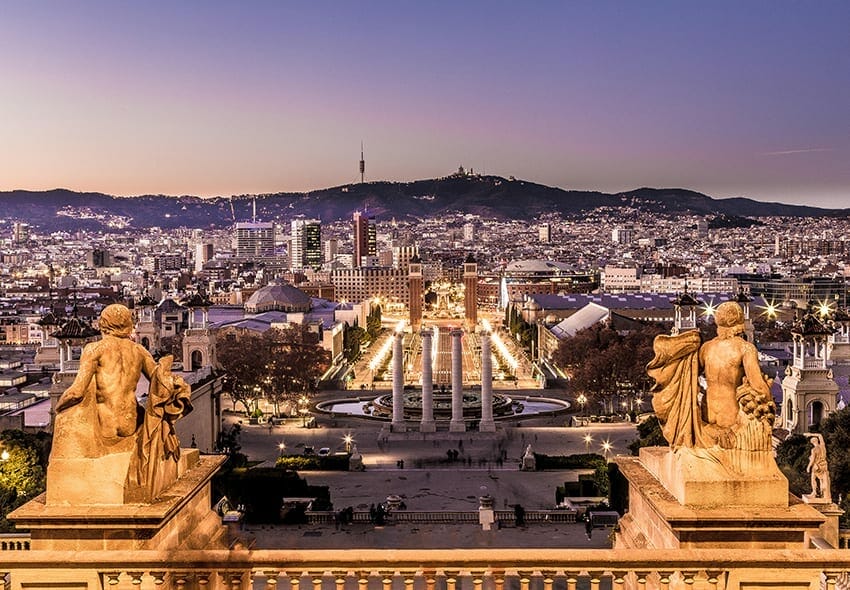
What should art lovers see in Barcelona?
Start with Gaudí: the Sagrada Família, Park Güell, Casa Batlló and Casa Milà, known as La Pedrera, his last civil work before he devoted himself to the basilica. The Picasso Museum traces his early years, including the Las Meninas series he painted in 1957 in answer to Velázquez. On Montjuïc, the Miró Foundation and the National Art Museum of Catalonia, with its Romanesque church frescoes, reward a full morning.
For Dalí, head north to Figueres, where the Dalí Theatre-Museum rises on the ruins of the town’s old theater, burned during the Spanish Civil War, and pair it with the medieval quarter of Girona. Our Barcelona guide covers the city’s architecture beyond Gaudí.

Which masterpieces should we not miss in Seville?
Seville grew rich as Spain’s royal port for the Americas, and its painters filled the city’s churches and hospitals. These four works each come with a story.
Murillo’s Vision of Saint Anthony of Padua (1656), Seville Cathedral. In 1874 a thief cut the kneeling saint from this enormous canvas and fled to America. The fragment turned up in New York, where a dealer bought it for $250 and sent it back to Seville to be set into the painting again.
Murillo’s Works of Mercy (1666 to 1670), Hospital de la Caridad. Murillo painted a series on the works of mercy for the hospital chapel, alongside Valdés Leal’s famous paintings of death. Marshal Soult’s French army carried four of them off in 1810, and they now hang in museums abroad, so copies fill those places in the chapel today.
Velázquez’s Santa Rufina (about 1630), Centro Velázquez. One of very few paintings by Velázquez in his hometown, bought in 2007 by the Focus-Abengoa Foundation for about 12.4 million euros to bring him home. It hangs in the Hospital de los Venerables in the Santa Cruz quarter, near the Cathedral.
Alejo Fernández’s Virgin of the Navigators (1530s), Real Alcázar. Painted for the hall where pilots and captains were licensed to sail to the Indies, it shows the Virgin sheltering sailors and the people of the New World under her cloak, and it ranks among the earliest European paintings of the Americas.
Murillo painted the Immaculate Conception many times, and the Museo de Bellas Artes, in a former convent, shows several of his finest beside Zurbarán and Valdés Leal. Our guide to art and culture in Andalusia continues to Córdoba, Granada and Picasso’s Málaga, and our Seville guide covers the rest of the city.
Where else in Spain can we see great art?
Bilbao has the Guggenheim, Frank Gehry’s titanium landmark, and a fine arts museum of its own. Valladolid keeps the National Museum of Sculpture, with Spain’s great polychrome wood carvings. Valencia, Sorolla’s hometown, shows his work at its Museo de Bellas Artes, and Mérida in Extremadura holds the National Museum of Roman Art beside its Roman theater. Our guides to Bilbao, Valencia and Extremadura cover each in more depth.
How do we plan a private art tour of Spain?
A licensed guide brings the Prado and the Reina Sofía to life in a few focused hours, choosing the rooms and the stories that matter to you instead of a march past every wall. We book timed entries in advance, plan the big museums for the morning, and leave the afternoons for a palace, a studio or a quiet church. The 14-day art and architecture tour runs from Madrid through Andalusia to Barcelona, the 10-day Highlights of Spain tour covers the essentials in less time, and food lovers often pair the museums with our food and wine tour of northern Spain. See what one client said about his private Spain and Portugal journey, or read more client reviews.
Questions about seeing art in Spain
What are the three museums of Madrid’s Golden Triangle of Art?
The Prado, the Reina Sofía and the Thyssen-Bornemisza. All three sit within a short walk of one another along the Paseo del Prado, and together they cover European art from the Middle Ages to the 20th century.
Where is Picasso’s Guernica?
At the Museo Reina Sofía in Madrid, part of the Golden Triangle of Art, a short walk from the Prado.
Where can you see Velázquez’s Las Meninas?
At the Prado Museum in Madrid. Picasso’s 1957 series of variations on Las Meninas hangs in the Picasso Museum in Barcelona.
Is the Dalí Theatre-Museum in Barcelona?
No. It is in Figueres, Dalí’s hometown north of Barcelona, an easy day trip that pairs well with Girona.
Where can you see Velázquez in Seville?
His Santa Rufina hangs at the Centro Velázquez in the Hospital de los Venerables, in the Santa Cruz quarter near the Cathedral. Velázquez was born in Seville in 1599.
How many days do you need for art in Madrid?
Two full days cover the Prado, the Reina Sofía and the Thyssen-Bornemisza at a comfortable pace with a licensed guide. A third day adds the Royal Palace, the Sorolla Museum or a day trip to Toledo for El Greco.
Travel planning is complicated. We make it easy. Tell us the artists you love and your dates, and a planner replies within one business day.